2 418 kr
Skickas inom 10-15 vardagar
2 418 kr
Skickas inom 10-15 vardagar
526 kr
Skickas inom 10-15 vardagar
402 kr
Skickas inom 10-15 vardagar
27 kr
Läs direkt efter köp
Stories and narratives are powerful tools for explaining the world around us. This book explores storytelling as a way of engaging audiences with sustainable development issues and reflects on the opportunities and limitations of storytelling for sustainability as an innovative approach to sustainability communication.
Bringing together voices and perspectives from research and practice, this volume explores the ways in which storytelling can support change toward sustainability. Unlike other anthologies, the book first provides a sound scientific basis by unfolding the storytelling approach and presenting empirical studies on its impact on effects. It clarifies important terms and presents recent findings on the impact of storytelling on sustainability from an extensive 3-year research project on this question. The second part shows how storytelling can be used in different fields of practice to communicate sustainability in more engaging and effective ways. Here, the main focus is on not only case-based accounts of positive change, but also tensions, arising from the application of storytelling for sustainability in journalism, higher education, corporate communication, or science communication.
Combining theory with practical examples, this innovative book will be a great resource for students and scholars of environmental communication and sustainable development, as well as professionals working in related fields.
618 kr
Läs direkt efter köp
Stories and narratives are powerful tools for explaining the world around us. This book explores storytelling as a way of engaging audiences with sustainable development issues and reflects on the opportunities and limitations of storytelling for sustainability as an innovative approach to sustainability communication.
Bringing together voices and perspectives from research and practice, this volume explores the ways in which storytelling can support change toward sustainability. Unlike other anthologies, the book first provides a sound scientific basis by unfolding the storytelling approach and presenting empirical studies on its impact on effects. It clarifies important terms and presents recent findings on the impact of storytelling on sustainability from an extensive 3-year research project on this question. The second part shows how storytelling can be used in different fields of practice to communicate sustainability in more engaging and effective ways. Here, the main focus is on not only case-based accounts of positive change, but also tensions, arising from the application of storytelling for sustainability in journalism, higher education, corporate communication, or science communication.
Combining theory with practical examples, this innovative book will be a great resource for students and scholars of environmental communication and sustainable development, as well as professionals working in related fields.
621 kr
Läs direkt efter köp
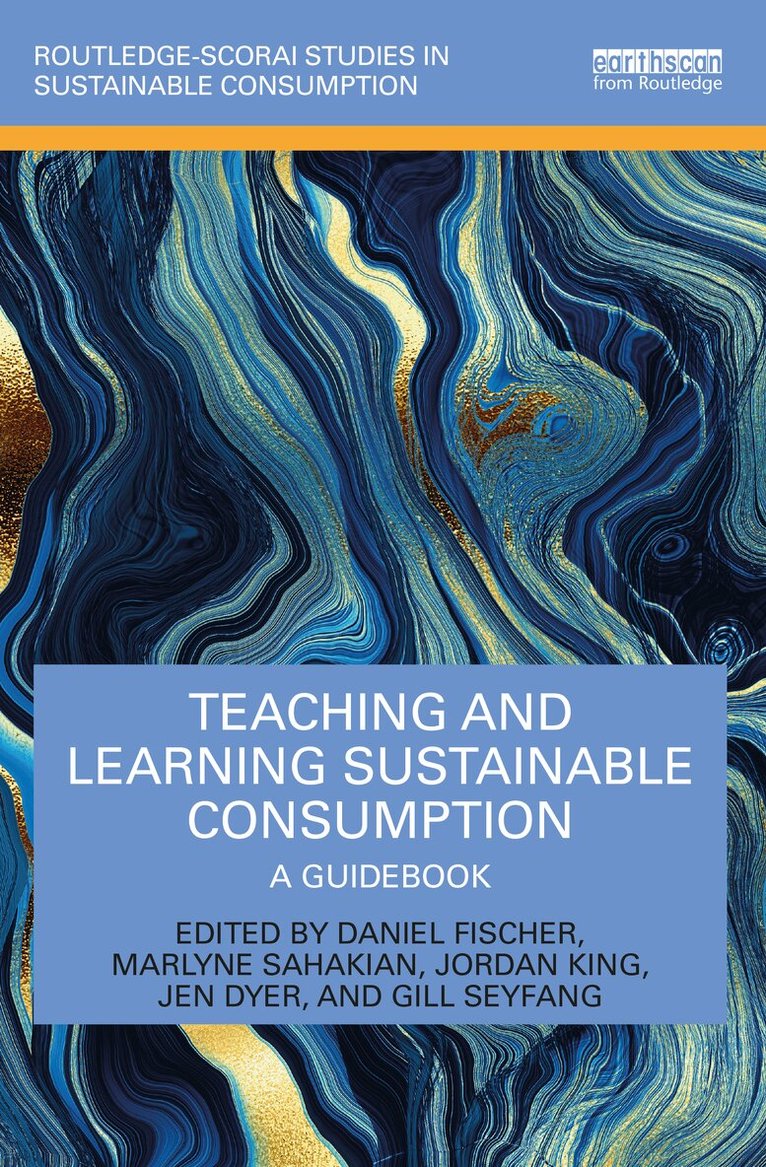
This book is a comprehensive guide on how to teach sustainable consumption in higher education. Teaching and Learning Sustainable Consumption: A Guidebook systematizes the themes, objectives, and theories that characterize sustainable consumption as an educational field.
The first part of the book discusses approaches to teaching and learning sustainable consumption in higher education, including reflections on how learning occurs, to more practical considerations like how to set objectives or assess learning outcomes. The second part of the book is a dive into inspiring examples of what this looks like in a range of contexts and towards different aims – involving 57 diverse contributions by teachers and practitioners. Building on the momentum of a steady increase in courses addressing sustainable consumption over the past decade, this guidebook supports innovative approaches to teaching and learning, while also bringing to the fore conceptual debates around higher education and sustainability.
Overall, this book will be a seminal resource for educators teaching about sustainability and consumption. It will help them to navigate the specifics of sustainable consumption as a field of scholarship, and design their teaching approaches in a more informed, competent, and creative way.
621 kr
Läs direkt efter köp
This book is a comprehensive guide on how to teach sustainable consumption in higher education. Teaching and Learning Sustainable Consumption: A Guidebook systematizes the themes, objectives, and theories that characterize sustainable consumption as an educational field.
The first part of the book discusses approaches to teaching and learning sustainable consumption in higher education, including reflections on how learning occurs, to more practical considerations like how to set objectives or assess learning outcomes. The second part of the book is a dive into inspiring examples of what this looks like in a range of contexts and towards different aims – involving 57 diverse contributions by teachers and practitioners. Building on the momentum of a steady increase in courses addressing sustainable consumption over the past decade, this guidebook supports innovative approaches to teaching and learning, while also bringing to the fore conceptual debates around higher education and sustainability.
Overall, this book will be a seminal resource for educators teaching about sustainability and consumption. It will help them to navigate the specifics of sustainable consumption as a field of scholarship, and design their teaching approaches in a more informed, competent, and creative way.
2 054 kr
Skickas inom 10-15 vardagar
582 kr
Skickas inom 10-15 vardagar
402 kr
Skickas inom 10-15 vardagar
868 kr
Läs direkt efter köp
868 kr
Läs direkt efter köp
553 kr
Läs direkt efter köp
538 kr
Läs direkt efter köp
La question d’histoire moderne au programme de l’agrégation d’histoire invite les candidats à se pencher sur le cadre de vie rural de la majorité de Français, sur leur gouvernement par assemblées et officiers de village et sur l’influence que des pouvoirs nombreux, incarnés au village par des figures de la communauté ou extérieurs, peuvent avoir sur les sociétés rurales. Ces problématiques sont abordées selon une chronologie différente des habitudes académiques qui séparent l’Ancien Régime de la période révolutionnaire et impériale, à savoir depuis les années 1630 jusqu’en 1814. Au royaume sont ajoutées les colonies, où des Français projetés ailleurs ont expérimenté d’autres manières de vivre et d’être gouvernés.
Avant tout, les sociétés rurales organisent leur propre existence. Mais sur des questions socio-économiques, religieuses, culturelles, judiciaires, fiscales et militaires, politiques et administratives, des figures particulières ou lointaines œuvrent à contrôler et à déterminer de plus en plus d’aspects de la vie des ruraux, et sont porteurs de dynamiques qui, déstabilisant les équilibres anciens, suscitent adaptations aux nouveautés imposées et recompositions au sein des sociétés villageoises. L’abolition de la société d’ordres en 1789 et la recomposition communale et municipale de 1790 ne sont pas les moindres des bouleversements auxquels les sociétés rurales sont confrontées.
Abordant la question à partir d’une grande variété d’exemples et d’espaces concernés par le programme – en métropole et dans les colonies – les auteurs du présent manuel proposent, en tenant compte de grandes variétés interrégionales, de dégager les évolutions qui traversent les sociétés rurales en réponse aux préoccupations et aux exigences changeantes, voire contradictoire, des pouvoirs.
Ce manuel propose :
Des sections abordant les principaux points au programme ;Des chapitres offrant un panorama de l’historiographie et de la bibliographie disponible sur chaque sujet ;Des chapitres comportant exemples et citations d’une sélection de sources mobilisables en dissertation ;Des exercices corrigés de commentaire de texte pour s’entraîner à cette épreuve écrite ;Des encadrés, tableaux et schémas permettant d’éclairer le propos des auteurs et d’apporter des exemples.Ont participé à l’ouvrage sous la direction d’Antoine Follain et de Daniel Fischer :
Léonard Barbulesco-Vesval, Raphaël Bergeron-Gauthier, Ivan Burel, Eugénie de Dompsure, Fulgence Delleaux, Brice Evain, Anna Forestier, Jean-Philippe Garneau, Stéphane Gomis, Bruno Jaudon, Philippe Jéhin, Yves Krumenacker, Estelle Lemoine-Maulny, Sylvain Olivier, Stanis Perez, Hervé Piant, Nina Pösch, Nicolas Soulas, Nicola Todorov et Mireille Touzery.
237 kr
Läs direkt efter köp
475 kr
Läs direkt efter köp
315 kr
Läs direkt efter köp
389 kr
Skickas inom 10-15 vardagar
480 kr
Skickas inom 10-15 vardagar
507 kr
Läs direkt efter köp
Daniel Fischer setzt sich mit der Strategiefähigkeit von Unternehmerverbänden innerhalb politischer Kampagnen auseinander. Dabei umschreibt der Begriff „Strategiefähigkeit“ die Fähigkeit einer Organisation, politische Ziele zu definieren, ein abgestimmtes Vorgehen zu planen und es auch konsistent mit der gesamten Organisationsstruktur umzusetzen. Der Autor untersucht und bewertet anhand eines Kriterienkataloges die Strategiefähigkeit des Verbandes Die Familienunternehmer – ASU unter Kampagnenbedingungen. Die anhand des Fallbeispiels gewonnenen Erkenntnisse werden in verallgemeinerbare Leitlinien für eine verbesserte und dauerhafte Strategiefähigkeit von Unternehmerverbänden umgesetzt.
447 kr
Läs direkt efter köp
531 kr
Skickas inom 3-6 vardagar
170 kr
Skickas inom 3-6 vardagar
824 kr
Skickas inom 3-6 vardagar
863 kr
Skickas inom 3-6 vardagar
394 kr
Skickas inom 3-6 vardagar
531 kr
Skickas inom 3-6 vardagar
394 kr
Skickas inom 3-6 vardagar
681 kr
Skickas inom 10-15 vardagar
715 kr
Läs direkt efter köp
Daniel Fischer untersucht das bislang bestehende Wissensdefizit hinsichtlich der Bedeutung erlebter und antizipierter Emotionen im Rahmen der Eskalation und Deeskalation von Commitments. Aufbauend auf einem eigens dafür entwickelten theoretischen Bezugsrahmen wird eine großzahlige empirische Befragung projektverantwortlicher Entscheidungsträger durchgeführt. Es wird gezeigt, dass erlebte und antizipierte Emotionen Einfluss auf die Eskalationstendenz nehmen und bedeutende Mediatoren der Wirkungen eingesetzter Deeskalationsmaßnahmen sind.