Daniel Hadwiger – författare
Visar alla böcker från författaren . Handla med fri frakt och snabb leverans.
3 produkter
3 produkter
Inbunden, Engelska, 2026
2 375 kr
Kommande
Urban Authenticity and Heritage explores the contested notion of “urban authenticity” in European cities after 1945. It examines how buildings, neighbourhoods, and cultural practices are perceived as “authentic” — and why these claims matter.From post-war reconstruction to contemporary urban transformations, the book shows that authenticity is not fixed but a dynamic process shaped by social actors, political agendas, and collective memory. The contributors move beyond traditional heritage frameworks to analyse how authenticity is constructed through debates, representations, and practices of “authentification.” They reveal the role of citizens, institutions, media, and tourism in shaping places and traditions as symbols of identity and belonging. In doing so, the volume challenges essentialist understandings of heritage, presenting authenticity as relational, negotiated, and deeply embedded in changing urban contexts.Bridging urban history and critical heritage studies, the book offers new insights into the cultural, political, and emotional dimensions of cities. It demonstrates how claims to authenticity influence urban planning, identity formation, and the reimagining of Europe’s urban past and future. Its multi-, inter-, and transdisciplinary approach will appeal to researchers in heritage, urban, historical, tourism, anthropological, sociological, and European studies, as well as heritage professionals
1 649 kr
Skickas inom 3-6 vardagar
E-bok
PDF, Tyska, 2021866 kr
Läs direkt efter köp
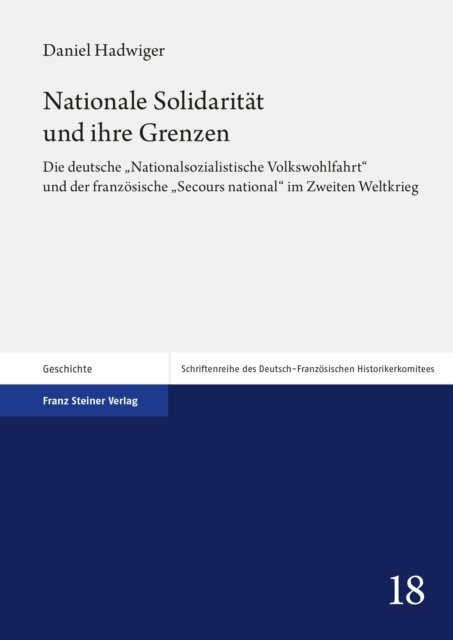
Wie politisch war Fürsorge im Zweiten Weltkrieg? Daniel Hadwiger untersucht diese Frage am Beispiel der bedeutendsten Wohlfahrtsorganisationen des NS-Staats und des Vichy-Regimes: der Nationalsozialistischen Volkswohlfahrt (NSV) in Deutschland und des Secours national in Frankreich.Hadwiger zeigt in einer transnationalen und vergleichenden Perspektive, wie beide Wohlfahrtsorganisationen eine soziale Funktion wahrnahmen, aber auch der Überwachung und Propaganda dienten. Er untersucht, wie durch In- und Exklusion in der Fürsorge die Idee einer deutschen Volksgemeinschaft und einer französischen Nation in- und außerhalb der nationalen Grenzen propagiert und praktiziert wurde. Als Beitrag zu einer transnationalen Gesellschaftsgeschichte des Nationalsozialismus bettet er die Fürsorge im Deutschen Reich in einen europäischen Kontext ein. Im Zweiten Weltkrieg wurden nicht nur Armeen, sondern auch Wohlfahrtsorganisationen eingesetzt, um die Bevölkerung zu beherrschen, Territorien zu gewinnen und konkurrierende Ordnungsmodelle durchzusetzen.Ausgezeichnet mit dem Dissertationspreis des Deutsch-Französischen Historikerkomitees 2020.