Daniel Pasquini – författare
2 653 kr
Läs direkt efter köp
1 702 kr
Skickas inom 10-15 vardagar
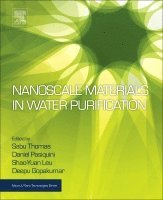
Novel nanoscale materials are now an essential part of meeting the current and future needs for clean water, and are at the heart of the development of novel technologies to desalinate water. The unique properties of nanomaterials and their convergence with current treatment technologies present great opportunities to revolutionize water and wastewater treatment. Nanoscale Materials for Water Purification brings together sustainable solutions using novel nanomaterials to alleviate the physical effects of water scarcity.
This book covers a wide range of nanomaterials, including noble metal nanoparticles, magnetic nanoparticles, dendrimers, bioactive nanoparticles, polysaccharidebased nanoparticles, nanocatalysts, and redox nanoparticles for water purification. Significant properties and characterization methods of nanomaterials such as surface morphology, mechanical properties, and adsorption capacities are also investigated
Explains how the unique properties of a range of nanomaterials makes them important water purification agents Shows how the use of nanotechnology can help create cheaper, more reliable, less energy-intensive, more environmentally friendly water purification techniques Includes case studies to show how nanotechnology has successfully been integrated into water purification system design2 370 kr
Läs direkt efter köp
2 556 kr
Kommande
9 233 kr
Skickas inom 10-15 vardagar
11 449 kr
Läs direkt efter köp
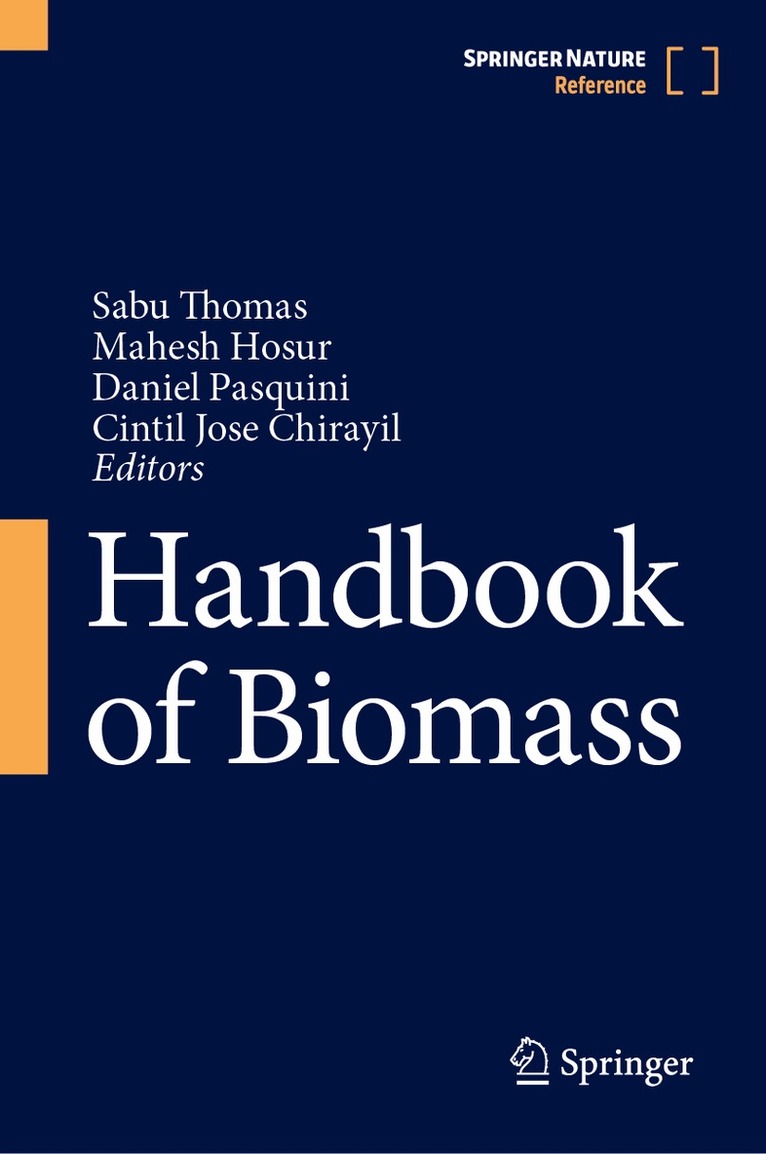
This handbook constitutes state-of-the-art research covering topics such as chemical constituents of biomass, their specific properties, characterization and different applications. The contents also discuss challenges and issues involved in its applications. This volume brings together a number of biomass-derived potential renewable elements and its circular economy approach in one place. The content includes industrial applications and fills the gap in laboratory research works to practical applications in related industries. The book gives an insight towards the circular economy approach by the biomass, different gross morphologies of biomasses and the valuable chemical constituents that can be derived from the biomass and moreover the potential applications of all those constituents. It enables researchers and scientists to get informed of the designs to improve existing utilization of biomass in an efficient manner and deliver better products at lower cost.
The volume isuseful reference for professionals, researchers, industrial practitioners, graduate students and senior undergraduates in the fields of polymer science, bioscience and bioengineering. It also provides an in-depth reference for biomass processors and fabricators and for industry sectors utilizing biomass such as packaging, sensors, film manufacturers, medical device manufacturers and biomedical engineers.