Daniela Ushizima – författare
891 kr
Läs direkt efter köp
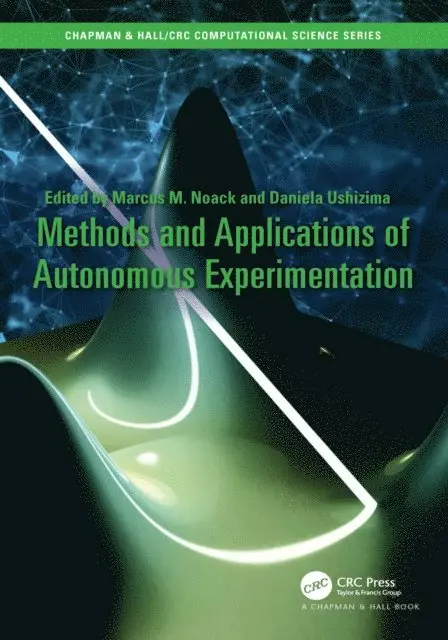
Autonomous Experimentation is poised to revolutionize scientific experiments at advanced experimental facilities. Whereas previously, human experimenters were burdened with the laborious task of overseeing each measurement, recent advances in mathematics, machine learning and algorithms have alleviated this burden by enabling automated and intelligent decision-making, minimizing the need for human interference. Illustrating theoretical foundations and incorporating practitioners’ first-hand experiences, this book is a practical guide to successful Autonomous Experimentation.
Despite the field’s growing potential, there exists numerous myths and misconceptions surrounding Autonomous Experimentation. Combining insights from theorists, machine-learning engineers and applied scientists, this book aims to lay the foundation for future research and widespread adoption within the scientific community.
This book is particularly useful for members of the scientific community looking to improve their research methods but also contains additional insights for students and industry professionals interested in the future of the field.
891 kr
Läs direkt efter köp
Autonomous Experimentation is poised to revolutionize scientific experiments at advanced experimental facilities. Whereas previously, human experimenters were burdened with the laborious task of overseeing each measurement, recent advances in mathematics, machine learning and algorithms have alleviated this burden by enabling automated and intelligent decision-making, minimizing the need for human interference. Illustrating theoretical foundations and incorporating practitioners’ first-hand experiences, this book is a practical guide to successful Autonomous Experimentation.
Despite the field’s growing potential, there exists numerous myths and misconceptions surrounding Autonomous Experimentation. Combining insights from theorists, machine-learning engineers and applied scientists, this book aims to lay the foundation for future research and widespread adoption within the scientific community.
This book is particularly useful for members of the scientific community looking to improve their research methods but also contains additional insights for students and industry professionals interested in the future of the field.
1 230 kr
Skickas inom 10-15 vardagar
822 kr
Skickas inom 10-15 vardagar
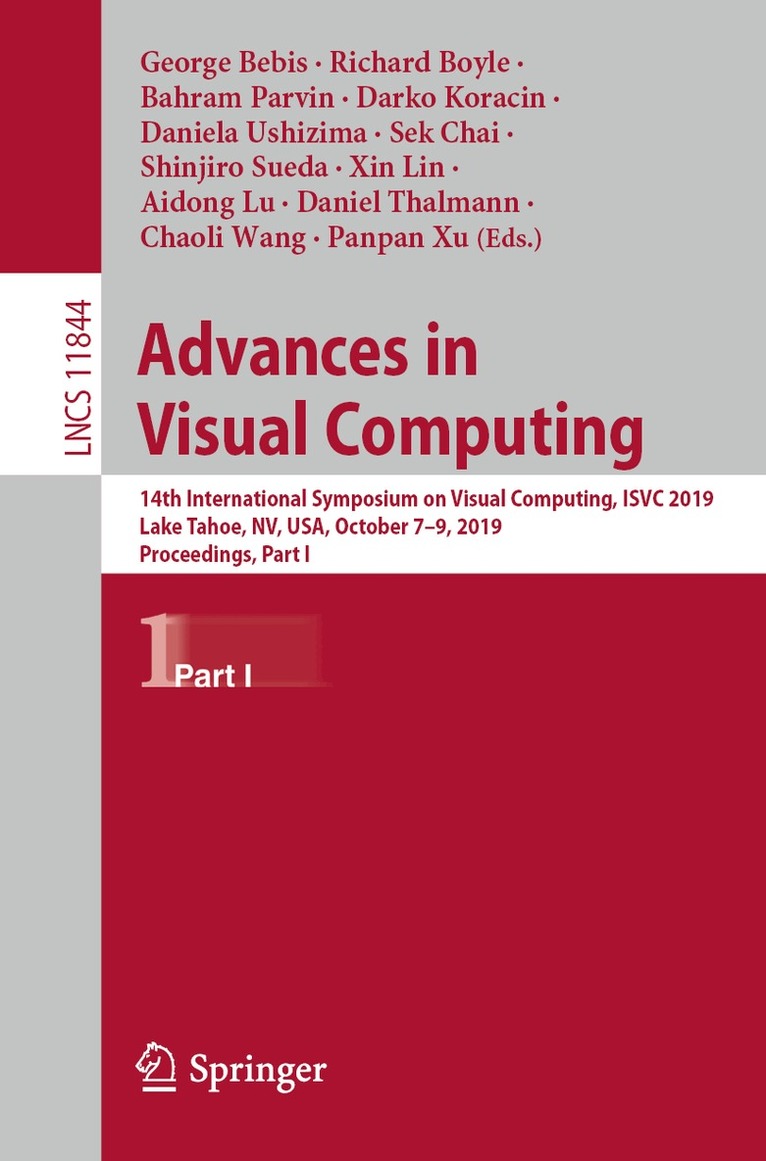
Advances in Visual Computing
14th International Symposium on Visual Computing, ISVC 2019, Lake Tahoe, NV, USA, October 7–9, 2019, Proceedings, Part I
562 kr
Skickas inom 10-15 vardagar
734 kr
Läs direkt efter köp
This book constitutes the refereed proceedings of the 14th International Symposium on Visual Computing, ISVC 2019, held in Lake Tahoe, NV, USA in October 2019.
The 100 papers presented in this double volume were carefully reviewed and selected from 163 submissions. The papers are organized into the following topical sections: Deep Learning I; Computer Graphics I; Segmentation/Recognition; Video Analysis and Event Recognition; Visualization; ST: Computational Vision, AI and Mathematical methods for Biomedical and Biological Image Analysis; Biometrics; Virtual Reality I; Applications I; ST: Vision for Remote Sensing and Infrastructure Inspection; Computer Graphics II; Applications II; Deep Learning II; Virtual Reality II; Object Recognition/Detection/Categorization; and Poster.
Advances in Visual Computing
14th International Symposium on Visual Computing, ISVC 2019, Lake Tahoe, NV, USA, October 7–9, 2019, Proceedings, Part II
917 kr
Skickas inom 10-15 vardagar
1 141 kr
Läs direkt efter köp
This book constitutes the refereed proceedings of the 14th International Symposium on Visual Computing, ISVC 2019, held in Lake Tahoe, NV, USA in October 2019.
The 100 papers presented in this double volume were carefully reviewed and selected from 163 submissions. The papers are organized into the following topical sections: Deep Learning I; Computer Graphics I; Segmentation/Recognition; Video Analysis and Event Recognition; Visualization; ST: Computational Vision, AI and Mathematical methods for Biomedical and Biological Image Analysis; Biometrics; Virtual Reality I; Applications I; ST: Vision for Remote Sensing and Infrastructure Inspection; Computer Graphics II; Applications II; Deep Learning II; Virtual Reality II; Object Recognition/Detection/Categorization; and Poster.