Dave Klein – författare
Visar alla böcker från författaren Dave Klein. Handla med fri frakt och snabb leverans.
4 produkter
4 produkter
Häftad, Engelska, 1996
455 kr
Skickas inom 5-8 vardagar
Del 2 - J-B SIOP Frontiers Series
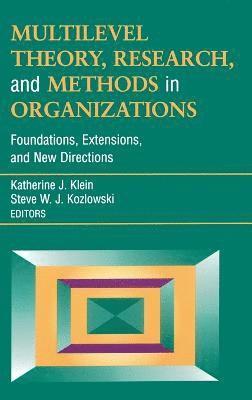
Multilevel Theory, Research, and Methods in Organizations
Foundations, Extensions, and New Directions
Inbunden, Engelska, 2000
1 046 kr
Skickas inom 5-8 vardagar
Organizational science has never been a fully integrated discipline. Traditionally, organizational research has been conducted from three distinct points of view--the organization, the group, and the individual--although it is clear that processes occurring across all levels of an organization affect the behavior of individuals, groups, and organizations as a whole. This fragmentation has encouraged the proliferation of separate disciplines, theories, and approaches. But in this volume, two dozen experts convince readers to consider multilevel analysis in the study of virtually all phenomena that occur within organizations. By illuminating top-down, bottom-up, and A-level processes and effects within an organization, the contributors bridge the gap between macro and micro approaches with a single unified theory.
E-bok
Engelska, 2008521 kr
Läs direkt efter köp
On December 28, 1958, the New York Giants played the Baltimore Colts at Yankee Stadium for the NFL Championship, the first ever NFL game to go into sudden death overtime. The game was televised nationally, a rarity in 1958, and featured players and coaches whose names are among the most well-known in the legend and lore of football: Frank Gifford, Alan Ameche, Sam Huff, Andy Robustelli, Tom Landry, Johnny Unitas, Rosie Grier, and Alex Webster. For the first edition of the book Klein formed chapters around interviews with twelve prominent players, five of whom have since died. The 50th anniversary edition contains new interviews with players left out of the first edition—Frank Gifford, Art Donovan, and Ray Perkins. As well as a "where are they now?" update on all the players mentioned.
E-bok
Engelska, 2022328 kr
Läs direkt efter köp
Master the wicked-fast Apache Kafka streaming platform through hands-on examples and real-world projects.In Kafka in Action you will learn: Understanding Apache Kafka concepts Setting up and executing basic ETL tasks using Kafka Connect Using Kafka as part of a large data project team Performing administrative tasks Producing and consuming event streams Working with Kafka from Java applications Implementing Kafka as a message queue Kafka in Action is a fast-paced introduction to every aspect of working with Apache Kafka. Starting with an overview of Kafka's core concepts, you'll immediately learn how to set up and execute basic data movement tasks and how to produce and consume streams of events. Advancing quickly, you’ll soon be ready to use Kafka in your day-to-day workflow, and start digging into even more advanced Kafka topics. About the technology Think of Apache Kafka as a high performance software bus that facilitates event streaming, logging, analytics, and other data pipeline tasks. With Kafka, you can easily build features like operational data monitoring and large-scale event processing into both large and small-scale applications. About the book Kafka in Action introduces the core features of Kafka, along with relevant examples of how to use it in real applications. In it, you’ll explore the most common use cases such as logging and managing streaming data. When you’re done, you’ll be ready to handle both basic developer- and admin-based tasks in a Kafka-focused team. What's inside Kafka as an event streaming platform Kafka producers and consumers from Java applications Kafka as part of a large data project About the reader For intermediate Java developers or data engineers. No prior knowledge of Kafka required. About the author Dylan Scott is a software developer in the insurance industry. Viktor Gamov is a Kafka-focused developer advocate. At Confluent, Dave Klein helps developers, teams, and enterprises harness the power of event streaming with Apache Kafka. Table of Contents PART 1 GETTING STARTED 1 Introduction to Kafka 2 Getting to know Kafka PART 2 APPLYING KAFK 3 Designing a Kafka project 4 Producers: Sourcing data 5 Consumers: Unlocking data 6 Brokers 7 Topics and partitions 8 Kafka storage 9 Management: Tools and logging PART 3 GOING FURTHER 10 Protecting Kafka 11 Schema registry 12 Stream processing with Kafka Streams and ksqlDB