David E. Laughlin - Böcker
Visar alla böcker från författaren David E. Laughlin. Handla med fri frakt och snabb leverans.
4 produkter
4 produkter
13 546 kr
Kommande
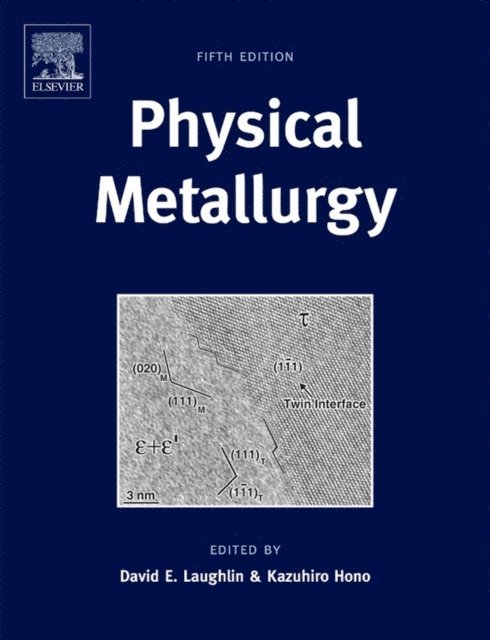
Physical Metallurgy, Sixth Edition preserves the excellence of the previous editions of this popular work, keeping everything up-to-date and offering definitive, in-depth chapters with superb coverage and clarity of explanations. The book provides comprehensive and in-depth coverage of both ferrous and non-ferrous materials, written by leaders in the respective field, going from fundamental and foundational understanding to a higher level of knowledge. The book expertly integrates fundamental theory with advanced materials characterization techniques. It is an excellent resource for students and early-career metallurgists, while also offering great depth and insight for more experienced readers.The chapters have been revised and expanded, with new chapters on the physical metallurgy of light alloys and titanium alloys, as well as atom probe field ion microscopy, computational metallurgy, and orientational imaging microscopy. Emphasis on sustainability is encouraged throughout, and the volumes incorporate the latest experimental research results and theoretical insights.

10 923 kr
Skickas inom 5-8 vardagar
This fifth edition of the highly regarded family of titles that first published in 1965 is now a three-volume set and over 3,000 pages. All chapters have been revised and expanded, either by the fourth edition authors alone or jointly with new co-authors. Chapters have been added on the physical metallurgy of light alloys, the physical metallurgy of titanium alloys, atom probe field ion microscopy, computational metallurgy, and orientational imaging microscopy. The books incorporate the latest experimental research results and theoretical insights. Several thousand citations to the research and review literature are included.
1 773 kr
Skickas inom 10-15 vardagar
Maintaining the substance that has made Introduction to the Thermodynamics of Materials a perennial bestseller for decades, the Seventh Edition is updated to reflect the broadening field of materials science and engineering. Chapters are updated and revised throughout to be more useful and logical for students.Features more than 60 new homework problems for the students, a listing of terms and concepts introduced, and a summary sectionIncludes more on mathematical and graphical analysis of the various state functions utilized in classical thermodynamicsIncludes a more extensive discussion of the third law of thermodynamicsFeatures a new appendix on exact differential equations and mathematical relationships, including all mathematical relations among differentials of homogeneous functions utilized in the textWritten as the definitive introduction to the thermodynamic behavior of materials systems, this text presents the underlying thermodynamic principles of materials and their applications and continues to be the best undergraduate textbook in thermodynamics for materials science students. An updated solutions manual is also available for qualifying adopting professors.
1 967 kr
Skickas
Maintaining the substance that made Introduction to the Thermodynamic of Materials a perennial best seller for decades, this Sixth Edition is updated to reflect the broadening field of materials science and engineering. The new edition is reorganized into three major sections to align the book for practical coursework, with the first (Thermodynamic Principles) and second (Phase Equilibria) sections aimed at use in a one semester undergraduate course. The third section (Reactions and Transformations) can be used in other courses of the curriculum that deal with oxidation, energy, and phase transformations. The book is updated to include the role of work terms other than PV work (e.g., magnetic work) along with their attendant aspects of entropy, Maxwell equations, and the role of such applied fields on phase diagrams. There is also an increased emphasis on the thermodynamics of phase transformations and the Sixth Edition features an entirely new chapter 15 that links specific thermodynamic applications to the study of phase transformations. The book also features more than 50 new end of chapter problems and more than 50 new figures.