David H. Miller – författare
Visar alla böcker från författaren David H. Miller. Handla med fri frakt och snabb leverans.
2 produkter
2 produkter
E-bok
PDF, Engelska, 2013979 kr
Läs direkt efter köp
For advanced undergraduate and beginning graduate students in atmospheric, oceanic, and climate science, Atmosphere, Ocean and Climate Dynamics is an introductory textbook on the circulations of the atmosphere and ocean and their interaction, with an emphasis on global scales. It will give students a good grasp of what the atmosphere and oceans look like on the large-scale and why they look that way. The role of the oceans in climate and paleoclimate is also discussed. The combination of observations, theory and accompanying illustrative laboratory experiments sets this text apart by making it accessible to students with no prior training in meteorology or oceanography.* Written at a mathematical level that is appealing for undergraduates andbeginning graduate students* Provides a useful educational tool through a combination of observations andlaboratory demonstrations which can be viewed over the web* Contains instructions on how to reproduce the simple but informativelaboratory experiments* Includes copious problems (with sample answers) to help students learn thematerial.
E-bok
PDF, Engelska, 2016979 kr
Läs direkt efter köp
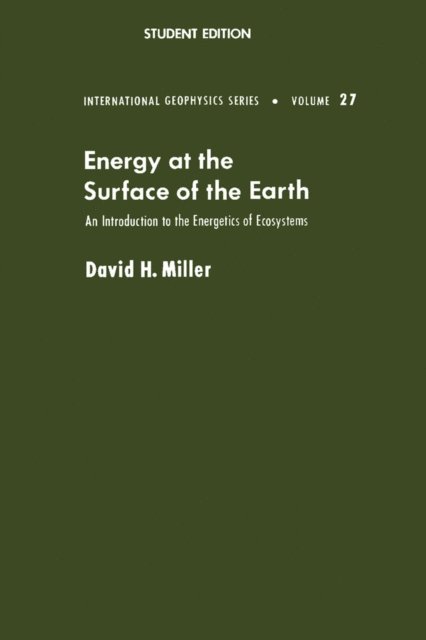
Energy at the Surface of the Earth: An Introduction to the Energetics of Ecosystems presents way of looking at the manner in which the biological, physical, and cultural systems that mantle the landmasses of our planet receive, transform, and give off energy, which is an essential condition of existence that takes many forms. Energy conversions establish the climate in which these systems operate. The principal forms of energy that are converted at the ecosystem scale include radiant, latent, mechanical, chemical and fossil, and thermal. The book begins with radiant energy absorbed by ecosystems—a phenomenon that is independent of their surface temperature and that can be looked on as a burden or a gift, depending on circumstances. An increase in such absorption raises surface temperature, as described in the fulcrum chapter of the book, Chapter VIII. This increase in turn sets into action outflows of energy that by the first law of thermodynamics are equal in energy units, although not necessarily equal in quality to the inflows. The final chapters deal with vertical stratification and areal contrasts in energy budgets, the augmented energy budget of the city, and the responses that serve to keep the budget balanced.