David Leon Higdon - Böcker
Visar alla böcker från författaren David Leon Higdon. Handla med fri frakt och snabb leverans.
6 produkter
6 produkter
1 874 kr
Skickas inom 10-15 vardagar
Originally published in 1983, this volume follows others in the series. The user is provided with a Verbal Index, citing each type and its location, a Word Frequency Table, and a Field of Reference. This volume is part of a series which produced verbal indexes, concordances, and related data for all of Conrad’s works.
552 kr
Skickas inom 10-15 vardagar
Originally published in 1983, this volume follows others in the series. The user is provided with a Verbal Index, citing each type and its location, a Word Frequency Table, and a Field of Reference. This volume is part of a series which produced verbal indexes, concordances, and related data for all of Conrad’s works.
1 874 kr
Skickas inom 10-15 vardagar
Originally published in 1985, as with the earlier volumes in the series, the reader of The Rover is here provided a Verbal Index, citing each type and its location, a Word Frequency Table, and a Field of Reference. Using the tables in this concordance, the reader should be better able to address the issue of style and determine on a more informed basis whether Conrad has deliberately eschewed the adjectival and even the figurative in favour of a lean, spare style, or whether he has simply tangled his style in rhetorical excesses and imprecisions.
552 kr
Skickas inom 10-15 vardagar
Originally published in 1985, as with the earlier volumes in the series, the reader of The Rover is here provided a Verbal Index, citing each type and its location, a Word Frequency Table, and a Field of Reference. Using the tables in this concordance, the reader should be better able to address the issue of style and determine on a more informed basis whether Conrad has deliberately eschewed the adjectival and even the figurative in favour of a lean, spare style, or whether he has simply tangled his style in rhetorical excesses and imprecisions.
1 723 kr
Skickas inom 7-10 vardagar
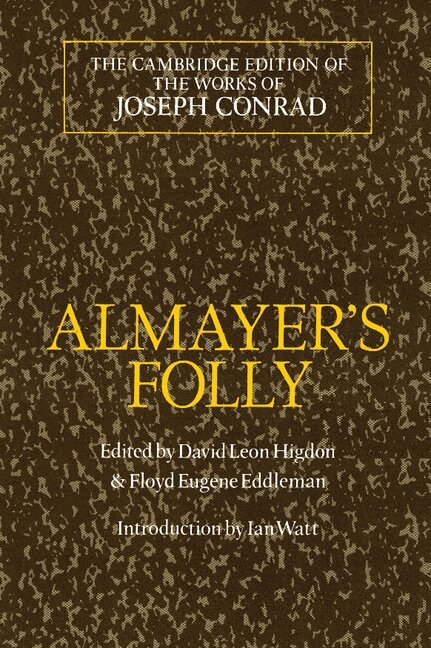
Set in eastern Borneo during the 1880s, Almayer's Folley recreates the conflicts of imperial Europe with the colonised East Indies through Joseph Conrad's story of Kaspar Almayer's personal tragedy: his loss of both his daughter of mixed race to her native lover and his dream of finding enough gold to return to Amsterdam in triumph. The introduction gives the history of the composition over almost five years as Conrad went to the Congo, Australia, the Ukraine, Belgium, Switzerland, and France as a seaman and on holiday. The novel has suffered seven layers of unauthorised intervention by typists and publishers, as set out in the essay on the text and the apparatus. The notes explain Malay terms and historical references, and there are two regional maps. This is the text of Almayer's Folley, established through modern textual scholarship, as Conrad would have like it to have appeared in 1895.
1 563 kr
Skickas inom 5-8 vardagar
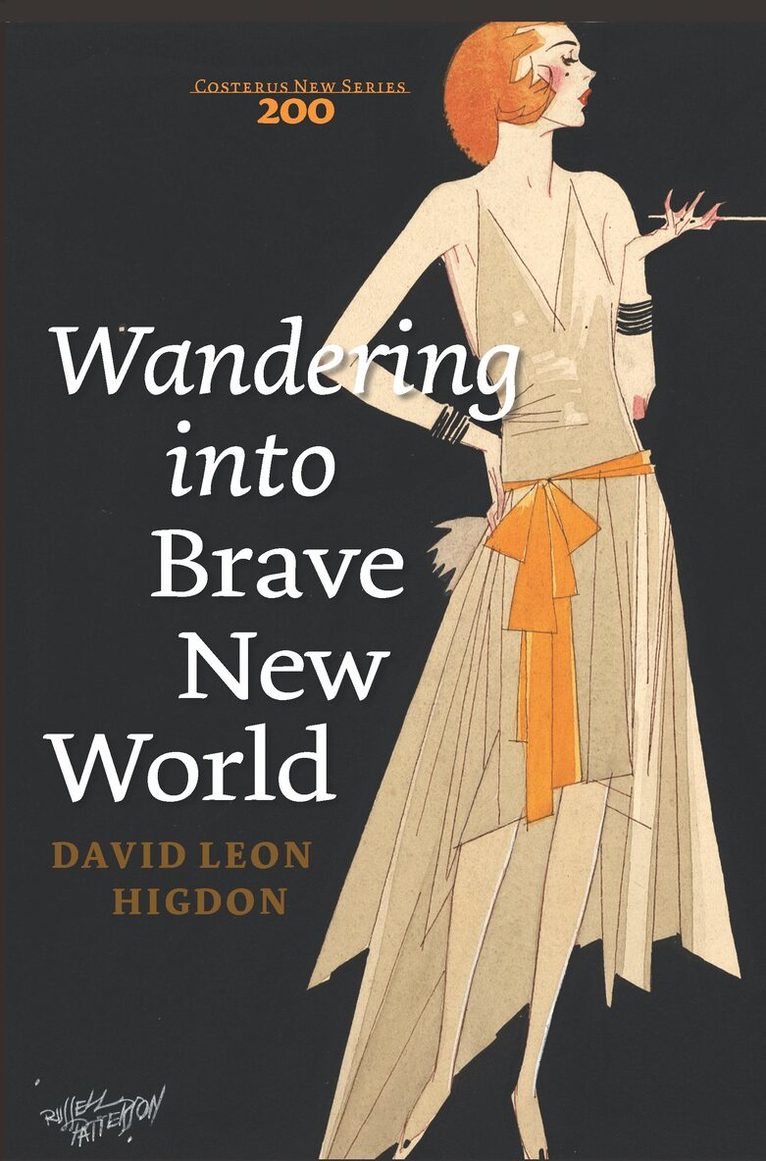
Wandering into Brave New World explores the historical contexts and contemporary sources of Aldous Huxley’s 1932 novel which, seventy years after its initial publication remains the best known and most discussed dystopian work of the twentieth century. This new study addresses a number of questions which still remain open. Did his round-the-world trip in 1925-1926 provide material for the novel? Did India’s caste system contribute to the novel’s human levels? Is there an overarching pattern to the names of the novel/s characters? Has the role of Hollywood in the novel been underestimated? Is Lenina Crown a representative 1920s “flapper”? Did Huxley have knowledge of and sources for his Indian reservation characters and scenes quite independent of and more accurate than those of D. H. Lawrence’s writings? Did Huxley’s visit to Borneo contribute anything to the novel? New research allows substantive answers and even explains why Huxley linked such figures as Henry Ford and Sigmund Freud. It also shows how the novel overcomes its intense grounding in 1920s political turmoil to escape into the timelessness of dystopian fiction.