David Sanson – författare
Visar alla böcker från författaren . Handla med fri frakt och snabb leverans.
3 produkter
3 produkter
Inbunden, Engelska, 2026
949 kr
Skickas inom 5-8 vardagar
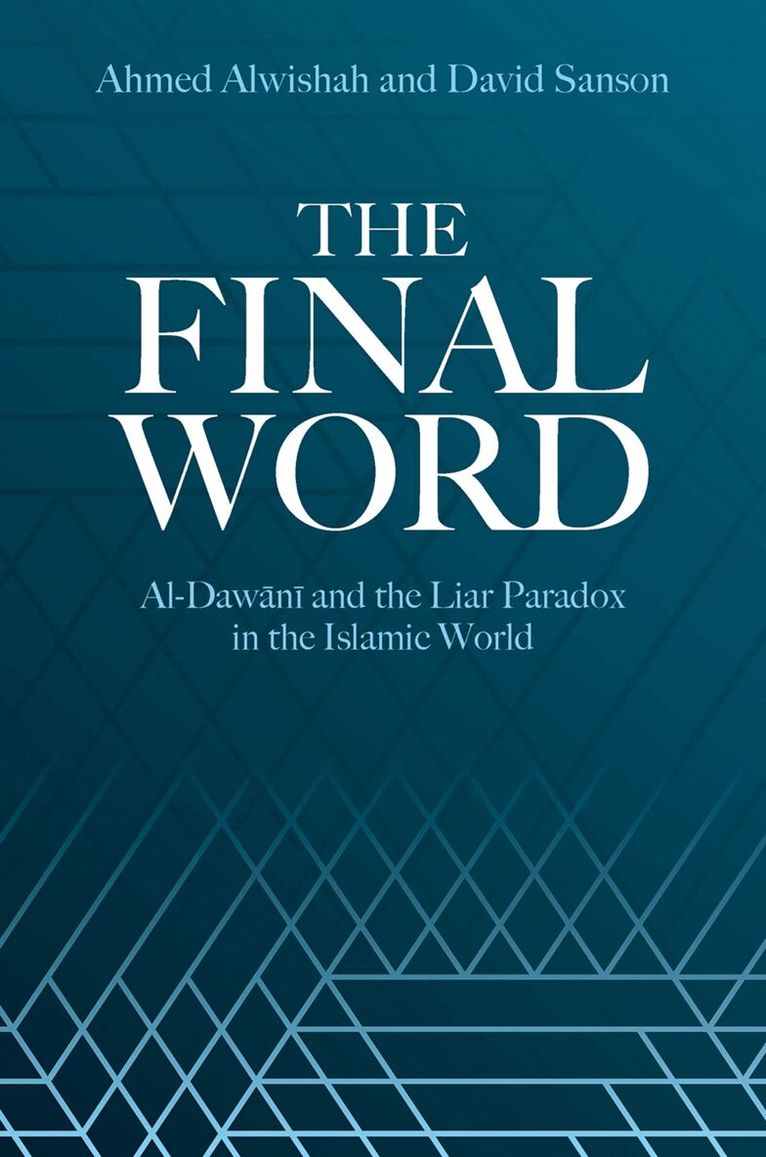
This book offers a comprehensive study of the history of the Liar Paradox in the Islamic philosophical tradition up to the 15th century, including the first complete English translation of Jalāl al-Dīn al-Dawānī's treatise, Final Word. The book explores connections in the tradition between the Liar and topics in philosophical logic, philosophy of language, and theological ethics. These include theories of truth, the principle of bivalence, puzzles about negation and empty terms, the Frege-Geach problem, theories of quotation, the distinction between declarative and non-declarative speech acts, and the opposition between truth as good and falsehood as evil. Solutions are grouped into four categories: that the Liar is, or needs to be, two declaratives rather than one; that the Liar is false because self-contradictory; that self-referential declaratives like the Liar cannot be true or false; al-Dawānī's claim, that the Liar fails to establish an imitation relation between itself and an imitation-independent fact, and so fails to be a truth-apt representation. The authors suggest a connection between this last idea and Kripke's claim that the Liar fails to be a statement because its truth conditions are ungrounded.
E-bok
PDF, Engelska, 20261 009 kr
Läs direkt efter köp
This book offers a comprehensive study of the history of the Liar Paradox in the Islamic philosophical tradition up to the 15th century, including the first complete English translation of Jalal al-Din al-Dawani's treatise, Final Word. The book explores connections in the tradition between the Liar and topics in philosophical logic, philosophy of language, and theological ethics. These include theories of truth, the principle of bivalence, puzzles about negation and empty terms, the Frege-Geach problem, theories of quotation, the distinction between declarative and non-declarative speech acts, and the opposition between truth as good and falsehood as evil. Solutions are grouped into four categories: that the Liar is, or needs to be, two declaratives rather than one; that the Liar is false because self-contradictory; that self-referential declaratives like the Liar cannot be true or false; al-Dawani's claim, that the Liar fails to establish an imitation relation between itself and an imitation-independent fact, and so fails to be a truth-apt representation. The authors suggest a connection between this last idea and Kripke's claim that the Liar fails to be a statement because its truth conditions are ungrounded.
E-bok
Engelska, 20261 009 kr
Läs direkt efter köp
This book offers a comprehensive study of the history of the Liar Paradox in the Islamic philosophical tradition up to the 15th century, including the first complete English translation of Jalal al-Din al-Dawani's treatise, Final Word. The book explores connections in the tradition between the Liar and topics in philosophical logic, philosophy of language, and theological ethics. These include theories of truth, the principle of bivalence, puzzles about negation and empty terms, the Frege-Geach problem, theories of quotation, the distinction between declarative and non-declarative speech acts, and the opposition between truth as good and falsehood as evil. Solutions are grouped into four categories: that the Liar is, or needs to be, two declaratives rather than one; that the Liar is false because self-contradictory; that self-referential declaratives like the Liar cannot be true or false; al-Dawani's claim, that the Liar fails to establish an imitation relation between itself and an imitation-independent fact, and so fails to be a truth-apt representation. The authors suggest a connection between this last idea and Kripke's claim that the Liar fails to be a statement because its truth conditions are ungrounded.