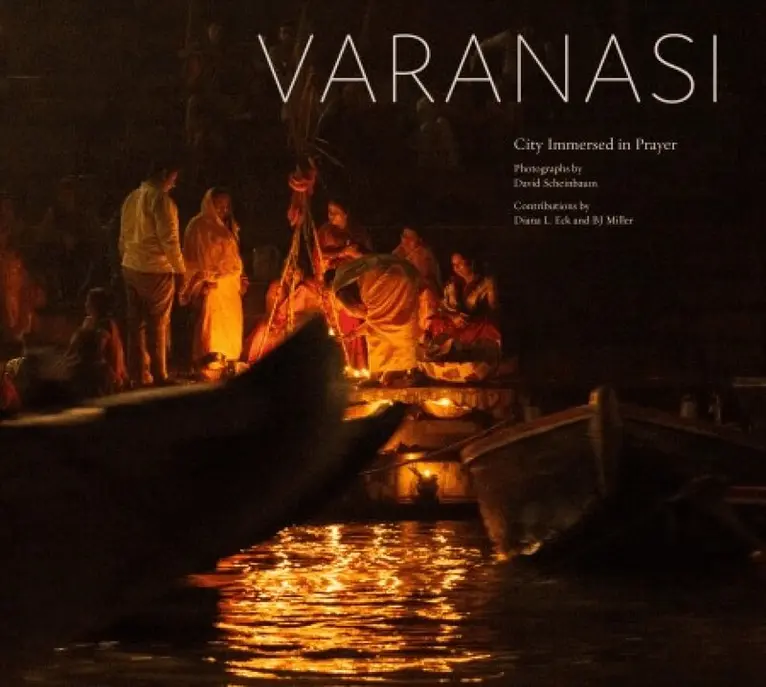
Varanasi, also known as Kashi and Banaras, is a city in the northern Indian state of Uttar Pradesh dating to the 11th century B.C.E. Regarded as the spiritual capital of India, the city draws Hindu pilgrims who bathe in the Ganges River’s sacred waters for prayer and ritual. In Varanasi, one is in a time warp where one is living in history as if time has never stopped, for the people, both residents and pilgrims, continue their daily practices and worship in ways relatively unchanged for millennia, a continuum of thousands of years. Being in Varanasi is like being on a thread pulled from a cloth that dates back to the beginning of time. Here, one doesn’t “see” a ruin, as one does in other ancient civilizations, but a living city where history hasn’t stopped. David Scheinbaum guides us, with his camera, through the city’s winding streets that are filled with thousands of shrines and temples at virtually every turn. He takes us on an incredible visual journey to the Ganges, the sacred river where bathers are in prayer, and to the funerary Ghats, steps that lead down to the river where cremations take place, filling the air with incense and burning pyres. Hindus believe that being cremated along the banks of the holy Ganges allows one to break the cycle of death and rebirth and attain Moksha, (salvation) making it a major center for pilgrimages. David Scheinbaum’s beautiful, soulful photographs present an ancient, holy city immersed in prayer. Woven through are the words of B. J. Miller and Diana L. Eck, noted scholars and writers who each shed light on the special qualities that make Varanasi the holy city it has always been.
Claude Monet is one of most influential French painters and a founder of the Impressionist movement. When he purchased a house and land in Giverny, France, during the 1890s, he soon set about creating gardens on his property, including a water garden inspired by the Japanese art that influenced so much of his work. These gardens would become a focal point for his art for the rest of his life. He made more than 250 paintings of them, including hundreds of paintings of the water garden that make up his famous Water Lilies series. In Giverny—A Colorful Silence: Four Seasons in the Gardens of Monet, Monet’s gardens are the subject of photographers Janet Russek and David Scheinbaum, who first visited the gardens in 2015. That experience inspired them to delve more deeply into Monet’s life and work and to seek special permission from the Monet Foundation to visit and photograph the gardens in Giverny. They proceeded to make four more trips over three years to photograph the gardens in each of the four seasons, and the stunning photographs they made reveal the changing beauty, light, and color palettes of the gardens throughout the year. In their own way, Russek and Scheinbaum captured unforgettable views and perspectives that even those fortunate enough to visit the gardens in person may not see. Their photographs embrace the spirit of Monet’s magical gardens while also honoring their history and Monet’s legacy and vision. Russek and Scheinbaum’s color photographs are accompanied by heartfelt and informative essays (presented in both English and French) by Jean-Marie Avisard, the current Head Gardener at Monet’s gardens, Jan Huntley, Head of the Artist and Volunteer Program at the Versailles Foundation Inc.’s Foundation Claude Monet à Giverny, and Paul Hayes Tucker, an esteemed art historian and expert on Monet’s life and works. Giverny—A Colorful Silence is a gift for all who revere Monet and his gardens. As the world celebrates the 100th anniversary of Monet’s passing on December 5, 2026, readers will treasure this book in unforgettable ways.