David Skarbek – författare
Visar alla böcker från författaren David Skarbek. Handla med fri frakt och snabb leverans.
9 produkter
9 produkter
Inbunden, Engelska, 2020
1 114 kr
Skickas inom 5-8 vardagar
Many people think prisons are all the same-rows of cells filled with violent men who officials rule with an iron fist. Yet, life behind bars varies in incredible ways. In some facilities, prison officials govern with care and attention to prisoners' needs. In others, officials have remarkably little influence on the everyday life of prisoners, sometimes not even providing necessities like food and clean water. Why does prison social order around the world look so remarkably different? In The Puzzle of Prison Order, David Skarbek develops a theory of why prisons and prison life vary so much. He finds that how they're governed-sometimes by the state, and sometimes by the prisoners-matters the most. He investigates life in a wide array of prisons-in Brazil, Bolivia, Norway, a prisoner of war camp, England and Wales, women's prisons in California, and a gay and transgender housing unit in the Los Angeles County Jail-to understand the hierarchy of life on the inside. Drawing on economics and a vast empirical literature on legal systems, Skarbek offers a framework to not only understand why life on the inside varies in such fascinating and novel ways, but also how social order evolves and takes root behind bars.
Häftad, Engelska, 2020
351 kr
Skickas inom 5-8 vardagar
Many people think prisons are all the same-rows of cells filled with violent men who officials rule with an iron fist. Yet, life behind bars varies in incredible ways. In some facilities, prison officials govern with care and attention to prisoners' needs. In others, officials have remarkably little influence on the everyday life of prisoners, sometimes not even providing necessities like food and clean water. Why does prison social order around the world look so remarkably different? In The Puzzle of Prison Order, David Skarbek develops a theory of why prisons and prison life vary so much. He finds that how they're governed-sometimes by the state, and sometimes by the prisoners-matters the most. He investigates life in a wide array of prisons-in Brazil, Bolivia, Norway, a prisoner of war camp, England and Wales, women's prisons in California, and a gay and transgender housing unit in the Los Angeles County Jail-to understand the hierarchy of life on the inside. Drawing on economics and a vast empirical literature on legal systems, Skarbek offers a framework to not only understand why life on the inside varies in such fascinating and novel ways, but also how social order evolves and takes root behind bars.
E-bok
PDF, Engelska, 2020344 kr
Läs direkt efter köp
Many people think prisons are all the same-rows of cells filled with violent men who officials rule with an iron fist. Yet, life behind bars varies in incredible ways. In some facilities, prison officials govern with care and attention to prisoners'' needs. In others, officials have remarkably little influence on the everyday life of prisoners, sometimes not even providing necessities like food and clean water. Why does prison social order around the world look so remarkably different? In The Puzzle of Prison Order, David Skarbek develops a theory of why prisons and prison life vary so much. He finds that how they''re governed-sometimes by the state, and sometimes by the prisoners-matters the most. He investigates life in a wide array of prisons-in Brazil, Bolivia, Norway, a prisoner of war camp, England and Wales, women''s prisons in California, and a gay and transgender housing unit in the Los Angeles County Jail-to understand the hierarchy of life on the inside. Drawing on economics and a vast empirical literature on legal systems, Skarbek offers a framework to not only understand why life on the inside varies in such fascinating and novel ways, but also how social order evolves and takes root behind bars.
E-bok
Engelska, 2020344 kr
Läs direkt efter köp
Many people think prisons are all the same-rows of cells filled with violent men who officials rule with an iron fist. Yet, life behind bars varies in incredible ways. In some facilities, prison officials govern with care and attention to prisoners'' needs. In others, officials have remarkably little influence on the everyday life of prisoners, sometimes not even providing necessities like food and clean water. Why does prison social order around the world look so remarkably different? In The Puzzle of Prison Order, David Skarbek develops a theory of why prisons and prison life vary so much. He finds that how they''re governed-sometimes by the state, and sometimes by the prisoners-matters the most. He investigates life in a wide array of prisons-in Brazil, Bolivia, Norway, a prisoner of war camp, England and Wales, women''s prisons in California, and a gay and transgender housing unit in the Los Angeles County Jail-to understand the hierarchy of life on the inside. Drawing on economics and a vast empirical literature on legal systems, Skarbek offers a framework to not only understand why life on the inside varies in such fascinating and novel ways, but also how social order evolves and takes root behind bars.
Inbunden, Engelska, 2014
1 791 kr
Skickas inom 5-8 vardagar
This book challenges the widely held view that inmates create prison gangs to promote racism and violence. On the contrary, gangs form to create order. Most people assume that violent inmates left to themselves will descend into a chaotic anarchy, but that's not necessarily the case. This book studies the hidden order of the prison underworld to understand how order arises among outlaws. It uses economics to explore the secret world of the convict culture, inmate hierarchy, and prison gang politics. Inmates engaged in illegal activity cannot rely entirely on state-based governance institutions, such as courts of law and the police, to create order. Correctional officers will not resolve a dispute over a heroin deal gone wrong or help kill a predatory rapist. Yet, the inmate social system is relatively orderly and underground markets flourish. In today's prisons, gangs play a pivotal role in protecting inmates and facilitating illicit commerce. They have sophisticated internal structures and often rely on elaborate written constitutions. To maintain social order, gangs adjudicate conflicts and orchestrate strategic acts of violence to negotiate the competing demands of inmates, gang members, and correctional officers. This book uses economics to explain why prison gangs form, how formal institutions affect them, and why they have a powerful influence even over crime beyond prison walls. Economics explains the seemingly irrational, truly astonishing, and often tragic world of life among the society of captives.
Häftad, Engelska, 2014
351 kr
Skickas inom 5-8 vardagar
This book challenges the widely held view that inmates create prison gangs to promote racism and violence. On the contrary, gangs form to create order. Most people assume that violent inmates left to themselves will descend into a chaotic anarchy, but that's not necessarily the case. This book studies the hidden order of the prison underworld to understand how order arises among outlaws. It uses economics to explore the secret world of the convict culture, inmate hierarchy, and prison gang politics. Inmates engaged in illegal activity cannot rely entirely on state-based governance institutions, such as courts of law and the police, to create order. Correctional officers will not resolve a dispute over a heroin deal gone wrong or help kill a predatory rapist. Yet, the inmate social system is relatively orderly and underground markets flourish. In today's prisons, gangs play a pivotal role in protecting inmates and facilitating illicit commerce. They have sophisticated internal structures and often rely on elaborate written constitutions. To maintain social order, gangs adjudicate conflicts and orchestrate strategic acts of violence to negotiate the competing demands of inmates, gang members, and correctional officers. This book uses economics to explain why prison gangs form, how formal institutions affect them, and why they have a powerful influence even over crime beyond prison walls. Economics explains the seemingly irrational, truly astonishing, and often tragic world of life among the society of captives.
E-bok
PDF, Engelska, 2014413 kr
Läs direkt efter köp
When most people think of prison gangs, they think of chaotic bands of violent, racist thugs. Few people think of gangs as sophisticated organizations (often with elaborate written constitutions) that regulate the prison black market, adjudicate conflicts, and strategically balance the competing demands of inmates, gang members, and correctional officers. Yet as David Skarbek argues, gangs form to create order among outlaws, producing alternative governance institutions to facilitate illegal activity. He uses economics to explore the secret world of the convict culture, inmate hierarchy, and prison gang politics, and to explain why prison gangs form, how formal institutions affect them, and why they have a powerful influence over crime even beyond prison walls. The ramifications of his findings extend far beyond the seemingly irrational and often tragic society of captives. They also illuminate how social and political order can emerge in conditions where the traditional institutions of governance do not exist.
E-bok
PDF, Engelska, 2017286 kr
Läs direkt efter köp
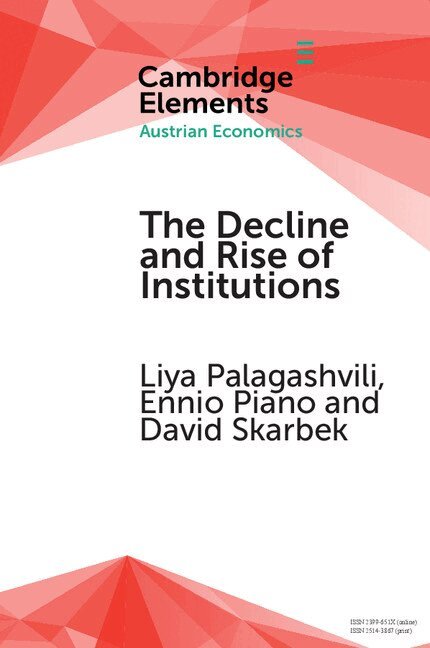
Institutions are the formal or informal ''rules of the game'' that facilitate economic, social, and political interactions. These include such things as legal rules, property rights, constitutions, political structures, and norms and customs. The main theoretical insights from Austrian economics regarding private property rights and prices, entrepreneurship, and spontaneous order mechanisms play a key role in advancing institutional economics. The Austrian economics framework provides an understanding for which institutions matter for growth, how they matter, and how they emerge and can change over time. Specifically, Austrians have contributed significantly to the areas of institutional stickiness and informal institutions, self-governance and self-enforcing contracts, institutional entrepreneurship, and the political infrastructure for development.
Häftad, Engelska, 2017
237 kr
Skickas inom 7-10 vardagar
Institutions are the formal or informal 'rules of the game' that facilitate economic, social, and political interactions. These include such things as legal rules, property rights, constitutions, political structures, and norms and customs. The main theoretical insights from Austrian economics regarding private property rights and prices, entrepreneurship, and spontaneous order mechanisms play a key role in advancing institutional economics. The Austrian economics framework provides an understanding for which institutions matter for growth, how they matter, and how they emerge and can change over time. Specifically, Austrians have contributed significantly to the areas of institutional stickiness and informal institutions, self-governance and self-enforcing contracts, institutional entrepreneurship, and the political infrastructure for development.