Dawid Friedrich – författare
Visar alla böcker från författaren Dawid Friedrich. Handla med fri frakt och snabb leverans.
5 produkter
Representative Turn in EU Studies
Av Sandra Kröger, Dawid Friedrich
Inbunden, 2013
1524 kr
Lägg i varukorg
After the participative and deliberative turns in both democratic theory and EU studies, we are currently witnessing a ‘representative turn’ to which this volume contributes by addressing the relation between representation and democracy in the EU. Although in the Lisbon Treaty the EU conceives …
Representative Turn in EU Studies
Av Sandra Kröger, Dawid Friedrich
Häftad, 2024
649 kr
Lägg i varukorg
After the participative and deliberative turns in both democratic theory and EU studies, we are currently witnessing a ‘representative turn’ to which this volume contributes by addressing the relation between representation and democracy in the EU. Although in the Lisbon Treaty the EU conceives …
Representative Turn in EU Studies
Av Dawid Friedrich, Sandra Kroger
E-bok, 2016
762 kr
Lägg i varukorg
After the participative and deliberative turns in both democratic theory and EU studies, we are currently witnessing a ‘representative turn’ to which this volume contributes by addressing the relation between representation and democracy in the EU. Although in the Lisbon Treaty the EU conceives …
Representative Turn in EU Studies
Av Dawid Friedrich, Sandra Kroger
E-bok, 2016
740 kr
Lägg i varukorg
After the participative and deliberative turns in both democratic theory and EU studies, we are currently witnessing a ‘representative turn’ to which this volume contributes by addressing the relation between representation and democracy in the EU. Although in the Lisbon Treaty the EU conceives …
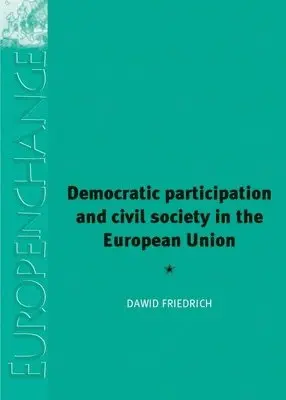
Democratic Participation and Civil Society in the European Union
Inbunden, 2011
1123 kr
Tillfälligt slut
Can the participation of civil society organisations democratise policy making in the European Union? This book challenges the widespread optimism about civil society participation in European governance and offers a nuanced and realistic evaluation of its democratic potential. Friedrich argues …