Deji Chen – författare
Visar alla böcker från författaren Deji Chen. Handla med fri frakt och snabb leverans.
4 produkter
4 produkter
Inbunden, Engelska, 2010
1 084 kr
Skickas inom 10-15 vardagar
The process control industry has seen generations of technology advancement, from pneumatic communication to electrical communication to electronic c- munication, from centralized control to distributed control. At the center of today’s distributed control systems are operator workstations. These operator wo- stations provide the connection between those overseeing and running plant operations to the process itself. With each new generation of products the operator workstation has become increasingly more intelligent. Newer applications provide advanced alarming, control, and diagnostics. Behind all of these applications are smarter devices. These smart devices provide greater process insight, reduce en- neering costs, and contribute to improving the overall operational performance of the plant. Smart devices include advanced diagnostics that can report the health of the device and in many cases, the health of the process that the device is connected to. It is not uncommon for smart devices to include diagnostics that can detect plugged lines, burner flame instability, agitator loss, wet gas, orifice wear, leaks, and cavitations. These devices tell the user how well they are operating and when they need maintenance. Improvements in sensor technology and diagnostics have lead to a large variety of smart devices. So how do users connect the capabilities of these smart devices to their existing control system infrastructures? The answer is wireless. Wireless technology has matured to the point that it now can be safely applied in industrial control, monitor, and asset management applications.
E-bok
PDF, Engelska, 20101 367 kr
Läs direkt efter köp
The process control industry has seen generations of technology advancement, from pneumatic communication to electrical communication to electronic c- munication, from centralized control to distributed control. At the center of today’s distributed control systems are operator workstations. These operator wo- stations provide the connection between those overseeing and running plant operations to the process itself. With each new generation of products the operator workstation has become increasingly more intelligent. Newer applications provide advanced alarming, control, and diagnostics. Behind all of these applications are smarter devices. These smart devices provide greater process insight, reduce en- neering costs, and contribute to improving the overall operational performance of the plant. Smart devices include advanced diagnostics that can report the health of the device and in many cases, the health of the process that the device is connected to. It is not uncommon for smart devices to include diagnostics that can detect plugged lines, burner flame instability, agitator loss, wet gas, orifice wear, leaks, and cavitations. These devices tell the user how well they are operating and when they need maintenance. Improvements in sensor technology and diagnostics have lead to a large variety of smart devices. So how do users connect the capabilities of these smart devices to their existing control system infrastructures? The answer is wireless. Wireless technology has matured to the point that it now can be safely applied in industrial control, monitor, and asset management applications.
Häftad, Engelska, 2014
1 084 kr
Skickas inom 10-15 vardagar
The process control industry has seen generations of technology advancement, from pneumatic communication to electrical communication to electronic c- munication, from centralized control to distributed control. At the center of today’s distributed control systems are operator workstations. These operator wo- stations provide the connection between those overseeing and running plant operations to the process itself. With each new generation of products the operator workstation has become increasingly more intelligent. Newer applications provide advanced alarming, control, and diagnostics. Behind all of these applications are smarter devices. These smart devices provide greater process insight, reduce en- neering costs, and contribute to improving the overall operational performance of the plant. Smart devices include advanced diagnostics that can report the health of the device and in many cases, the health of the process that the device is connected to. It is not uncommon for smart devices to include diagnostics that can detect plugged lines, burner flame instability, agitator loss, wet gas, orifice wear, leaks, and cavitations. These devices tell the user how well they are operating and when they need maintenance. Improvements in sensor technology and diagnostics have lead to a large variety of smart devices. So how do users connect the capabilities of these smart devices to their existing control system infrastructures? The answer is wireless. Wireless technology has matured to the point that it now can be safely applied in industrial control, monitor, and asset management applications.
E-bok
Engelska, 20151 424 kr
Läs direkt efter köp
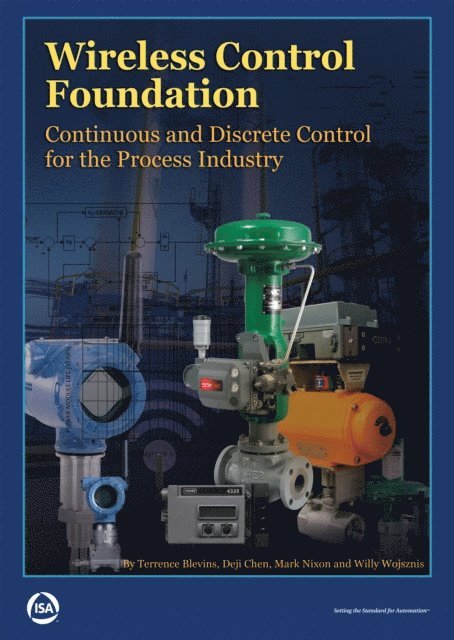
In this book, the authors address the wireless communication concepts and terminology that are needed to apply wireless control in the process industry. The control system interfaces and wireless field devices described in this book are based on wireless standards for industrial settings and can be used in monitoring and control applications.Wireless transmitters were initially used only to monitor the process, not control it. However, over the last six years, wireless measurements have earned high user confidence, and new control techniques have been devised to deal with the characteristics of wireless operation. Based on the broad acceptance of wireless transmitters, many manufacturers are in the process of developing and introducing wireless final control elements such as on/off and throttling valves.The book details the recent technical innovations that address control using wireless measurements and final control elements. It presents how control can be structured to manage the slow and non-periodic measurement update rates provided by a wireless transmitter and to compensate for communication delay to the final control element. These new control techniques make it possible to use wireless measurements and wireless valves in closed loop control. The book also presents how wireless measurements may be utilized with model predictive control (MPC).Multiple application examples are used to show what is required to utilize wireless control. Workshops are included in the book that explore key concepts associated with wireless control. The reader may view the workshop solution by going to the website that accompanies the book.The book is written for the process or control engineer, who is familiar with traditional control but has little or no experience in designing, installing, checking out or commissioning control using wireless transmitters and/or wireless valves. The book provides comprehensive coverage of wireless control for both continuous and discrete applications in the process industry. Information is provided on commercially available analog and discrete wireless transmitters and on-off valves.Since some readers may work with an existing distributed control system (DCS) that does not provide native support for wireless field devices, information is provided on how a wireless network may be integrated into a control system using supported serial and Ethernet interfaces. In addition, information is provided on how the PID modifications needed for wireless control may be created using tools supported by the DCS. One chapter of the book addresses how a dynamic simulation of the process and wireless field devices may be easily created in a DCS to support checkout and operator training on wireless control.