Denisse L. Argote – författare
Visar alla böcker från författaren Denisse L. Argote. Handla med fri frakt och snabb leverans.
12 produkter
Knowledge Discovery from Archaeological Materials
Av Pedro A. López García, Denisse L. Argote m. fl.
Häftad, 2024
317 kr
Lägg i varukorg
This Element highlights the employment within archaeology of classification methods developed in the field of chemometrics, artificial intelligence, and Bayesian statistics. These operate in both high- and low-dimensional environments and often have better results than traditional methods. The …
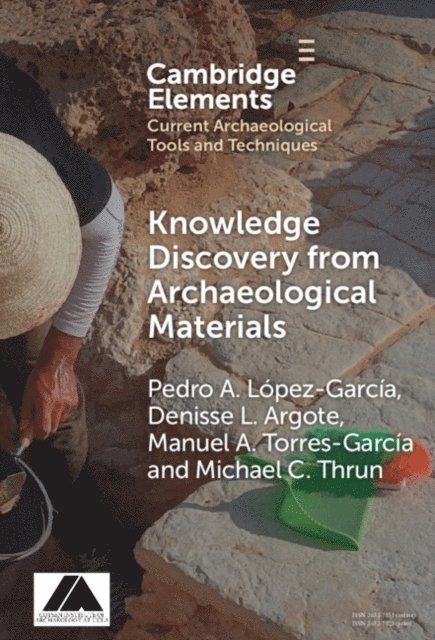
Knowledge Discovery from Archaeological Materials
Av Michael C. Thrun, Manuel A. Torres-Garcia m. fl.
E-bok, 2024
303 kr
Lägg i varukorg
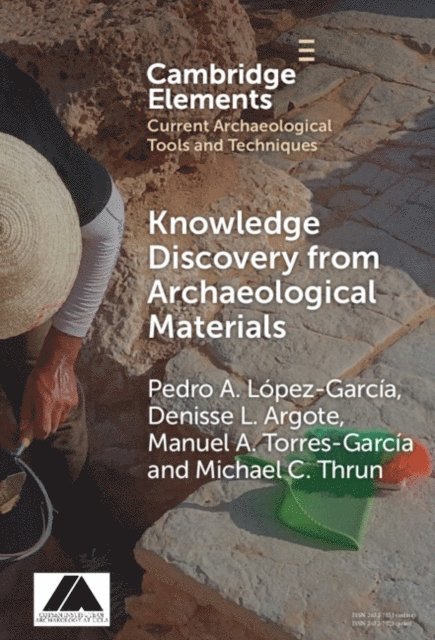
Knowledge Discovery from Archaeological Materials
Av Michael C. Thrun, Manuel A. Torres-Garcia m. fl.
E-bok, 2024
303 kr
Lägg i varukorg
This Element highlights the employment within archaeology of classification methods developed in the field of chemometrics, artificial intelligence, and Bayesian statistics. These operate in both high- and low-dimensional environments and often have better results than traditional methods. The …
Machine Learning for Archaeological Applications in R
Av Denisse L. Argote, Pedro A. López-­García m. fl.
Inbunden, 2025
938 kr
Lägg i varukorg
This Element highlights the employment within archaeology of classification methods developed in the field of chemometrics, artificial intelligence, and Bayesian statistics. These run in both high- and low-dimensional environments and often have better results than traditional methods. Instead of a …
Machine Learning for Archaeological Applications in R
Av Michael C. Thrun, Manuel A. Torres--Garcia m. fl.
E-bok, 2025
303 kr
Lägg i varukorg
Machine Learning for Archaeological Applications in R
Av Michael C. Thrun, Manuel A. Torres--Garcia m. fl.
E-bok, 2025
303 kr
Lägg i varukorg
Machine Learning for Archaeological Applications in R
Av Denisse L. Argote, Pedro A. López-­García m. fl.
Häftad, 2025
317 kr
Lägg i varukorg
This Element highlights the employment within archaeology of classification methods developed in the field of chemometrics, artificial intelligence, and Bayesian statistics. These run in both high- and low-dimensional environments and often have better results than traditional methods. Instead of a …
Knowledge Discovery from Archaeological Materials
Av Pedro A. López García, Denisse L. Argote m. fl.
Inbunden, 2024
938 kr
Lägg i varukorg
This Element highlights the employment within archaeology of classification methods developed in the field of chemometrics, artificial intelligence, and Bayesian statistics. These operate in both high- and low-dimensional environments and often have better results than traditional methods. The …
Determining Provenance from Compositional Data
Av Pedro A. López-García, Denisse L. Argote
Inbunden, 2026
938 kr
Lägg i varukorg
Traditionally, classical multivariate statistical methods have been applied to relate cultural materials recovered at archaeological sites to their respective raw material sources. However, when reviewing published research, which usually claims to have reached a high degree of confidence in the …
Determining Provenance from Compositional Data
Av Pedro A. López-García, Denisse L. Argote
Häftad, 2026
291 kr
Lägg i varukorg
Traditionally, classical multivariate statistical methods have been applied to relate cultural materials recovered at archaeological sites to their respective raw material sources. However, when reviewing published research, which usually claims to have reached a high degree of confidence in the …
Determining Provenance from Compositional Data
Av Denisse L. Argote, Pedro A. Lopez-Garcia
E-bok, 2026
293 kr
Lägg i varukorg
Determining Provenance from Compositional Data
Av Denisse L. Argote, Pedro A. Lopez-Garcia
E-bok, 2026
293 kr
Lägg i varukorg