Department of Military Science and Technology – författare
713 kr
Skickas inom 3-6 vardagar
639 kr
Läs direkt efter köp
Since the mid-1940s, when Vannevar Bush and Theodore von Karman wrote Science, the Endless Frontier and Toward New Horizons, respectively, there has been a consensus that strong Department of Defense support of science and technology (S&T) is important to the security of the United States. During the Cold War, as it faced technologically capable adversaries whose forces potentially outnumbered U.S. forces, the United States relied on a strong defense S&T program to support the development of technologically superior weapons and systems that would enable it to prevail in the event of conflict. Since the end of the Cold War, the United States has relied on its technological superiority to maintain a military advantage while at the same time reducing the size of its forces. Over the past half-century, creating and maintaining a technologically superior military capability have become fundamental to U.S. national security strategy, and investment in S&T has become a basic component of the defense budget.
In late 1998, Congress asked the Secretary of Defense to conduct a study, in cooperation with the National Research Council (NRC), on the S&T base of the U.S. Department of Defense (DoD). Congress was particularly concerned about areas of the S&T program related to air systems, space systems, and supporting information systems. Its concern was based on the Air Force''s reduction of its S&T program from the largest of the three military service programs to the smallest. Congress also wanted to ensure that the Air Force maintained an appropriately sized S&T workforce. In late 1999, the Deputy Under Secretary of Defense for Science and Technology asked the NRC to conduct a study to explore these issues.
1 039 kr
Läs direkt efter köp
Since Operation Desert Shield/Desert Storm, Gulf War veterans have expressed concerns that their postdeployment medical symptoms could have been caused by hazardous exposures or other deployment-related factors. Potential exposure to a broad range of CB and other harmful agents was not unique to Gulf operations. Hazardous exposures have been a component of all military operations in this century. Nevertheless, the Gulf War deployment focused national attention on the potential, but uncertain, relationship between the presence of CB agents in theater and symptoms reported by military personnel. Particular attention has been given to the potential long-term health effects of low-level exposures to CB agents.
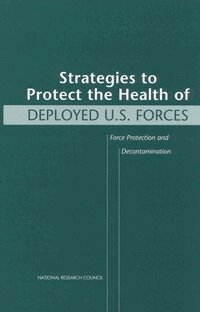
In the spring of 1996, Deputy Secretary of Defense John White met with the leadership of the National Academies to discuss the DoD''s continuing efforts to improve protection of military personnel from adverse health effects during deployments in hostile environments. Although many lessons learned from previous assessments of Operation Desert Shield/Desert Storm have been reported, prospective analyses are still needed. Strategies to Protect the Health of Deployed U.S. Forces: Force Protection and Decontamination, which addresses the issues of physical protection and decontamination, is one of four initial reports that will be submitted in response to that request.
Specifically, this report includes a review and evaluation of the following areas:
the adequacy of current protective equipment and protective measures (as well as equipment in development) the efficacy of current and proposed methods for decontaminating personnel and equipment after exposures to CB agents current policies, doctrine, and training to protect and decontaminate personnel and equipment in future deployments (i.e., major regional conflicts [MRCs], lesser regional conflicts [LRCs], and operations other than war [OOTWs]) the impact of equipment and procedures on unit effectiveness and other human performance factors current and projected military capabilities to provide emergency response438 kr
Läs direkt efter köp
Since the mid-1940s, when Vannevar Bush and Theodore von Karman wrote Science, the Endless Frontier and Toward New Horizons, respectively, there has been a consensus that strong Department of Defense support of science and technology (S&T) is important to the security of the United States. During the Cold War, as it faced technologically capable adversaries whose forces potentially outnumbered U.S. forces, the United States relied on a strong defense S&T program to support the development of technologically superior weapons and systems that would enable it to prevail in the event of conflict. Since the end of the Cold War, the United States has relied on its technological superiority to maintain a military advantage while at the same time reducing the size of its forces. Over the past half-century, creating and maintaining a technologically superior military capability have become fundamental to U.S. national security strategy, and investment in S&T has become a basic component of the defense budget.
In late 1998, Congress asked the Secretary of Defense to conduct a study, in cooperation with the National Research Council (NRC), on the S&T base of the U.S. Department of Defense (DoD). Congress was particularly concerned about areas of the S&T program related to air systems, space systems, and supporting information systems. Its concern was based on the Air Force''s reduction of its S&T program from the largest of the three military service programs to the smallest. Congress also wanted to ensure that the Air Force maintained an appropriately sized S&T workforce. In late 1999, the Deputy Under Secretary of Defense for Science and Technology asked the NRC to conduct a study to explore these issues.
979 kr
Läs direkt efter köp
Since Operation Desert Shield/Desert Storm, Gulf War veterans have expressed concerns that their postdeployment medical symptoms could have been caused by hazardous exposures or other deployment-related factors. Potential exposure to a broad range of CB and other harmful agents was not unique to Gulf operations. Hazardous exposures have been a component of all military operations in this century. Nevertheless, the Gulf War deployment focused national attention on the potential, but uncertain, relationship between the presence of CB agents in theater and symptoms reported by military personnel. Particular attention has been given to the potential long-term health effects of low-level exposures to CB agents.
In the spring of 1996, Deputy Secretary of Defense John White met with the leadership of the National Academies to discuss the DoD''s continuing efforts to improve protection of military personnel from adverse health effects during deployments in hostile environments. Although many lessons learned from previous assessments of Operation Desert Shield/Desert Storm have been reported, prospective analyses are still needed. Strategies to Protect the Health of Deployed U.S. Forces: Force Protection and Decontamination, which addresses the issues of physical protection and decontamination, is one of four initial reports that will be submitted in response to that request.
Specifically, this report includes a review and evaluation of the following areas:
the adequacy of current protective equipment and protective measures (as well as equipment in development) the efficacy of current and proposed methods for decontaminating personnel and equipment after exposures to CB agents current policies, doctrine, and training to protect and decontaminate personnel and equipment in future deployments (i.e., major regional conflicts [MRCs], lesser regional conflicts [LRCs], and operations other than war [OOTWs]) the impact of equipment and procedures on unit effectiveness and other human performance factors current and projected military capabilities to provide emergency response1 633 kr
Tillfälligt slut