Deryck Holdsworth – författare
Visar alla böcker från författaren Deryck Holdsworth. Handla med fri frakt och snabb leverans.
3 produkter
3 produkter
Häftad, Engelska, 1998
447 kr
Skickas inom 10-15 vardagar
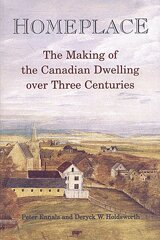
Arguing that past scholarship has provided inadequate methodological tools for understanding ordinary housing in Canada, Peter Ennals and Deryck Holdsworth present a new framework for interpreting the dwelling. Canada's settlement history, with its emphasis on staples exports, produced few early landed elite or houses in the grand style. There was, however, a preponderance of small owner-built 'folk' dwellings that reproduced patterns from the immigrants' ancestral homes in western Europe. As regional economics matured, a prospering population used the house as a material means to display their social achievement. Whereas the elites came to reveal their status and taste through careful connoisseurship of the standard international 'high style,' a new emerging middle class accomplished this through a new mode of house building that the authors describe as 'vernacular.' The vernacular dwelling selectively mimicked elements of the elite houses while departing from the older folk forms in response to new social aspirations. The vernacular revolution was accelerated by a popular press that produced inexpensive how-to guides and a manufacturing sector that made affordable standardized lumber and trim. Ultimately the triumph of vernacular housing was the 'prefab' house marketed by firms such as the T. Eaton Company. The analysis of these house-making patterns are explored from the early seventeenth century to the early twentieth century. Though the emphasis is on the ordinary single-family dwelling, the authors provide an important glimpse of counter-currents such as housing for gang labour, company housing, and the multi-occupant forms associated with urbanization. The analysis is placed in the context of a careful rendering of the historical geographical context of an emerging Canadian space, economy, and society.
E-bok
PDF, Engelska, 19901 730 kr
Läs direkt efter köp
In 1891 the young nation of Canada stood on the brink of a great surge of growth and development. During the seven decades covered in this volume Canada would be transformed from a rural, agricultural society, almost exclusively British and French in background, to an urban, industrial nation with more cultural diversity. These developments are illustrated in the exceptionally vivid plates of the Historical Atlas of Canada, III: Addressing the Twentieth Century.The first part of the volume, the Great Transformation, covers developments from 1891 to 1929, the year the stock market crashed. In this period of economic and social change are charted, among other aspects, land and resource development, the growth of financial institutions, prairie agriculture and the grain-handling system, industrial growth, and changes in education, religion, and social structures. Individual plates include detailed studies of the formation of the United Church of Canada in 1925; the evolution of suburban neighbourhoods in Edmonton; the wave of strikes in 1919; Ukrainian settlement in southern Manitoba in 1901; the interlocking business interests of Toronto financiers in 1913; the formation of the National Hockey League and the rise of spectator sport; and the development of Montreal as a great industrial city.The second part of the volume. Crisis and Response, deals with the Depression, the Second World War, and the post-war boom. Here are charted shifts in the make-up and distribution of the population, a growing range of social services, and the emergence of a national economy. The plates in this section include graphic representations of drought on the Prairies in the 1930S; the routes of unemployed people riding the rails in search of work; the development of Ottawa as the nation's capital; the rise of retail trade; the strong growth in the uranium and petroleum industries; and the spread of television.With unsurpassed clarity, the Atlas presents the forces that have shaped Canadian society today. Anyone who wishes to understand contemporary Canada will find this volume richly rewarding.
E-bok
PDF, Engelska, 1998598 kr
Läs direkt efter köp
Arguing that past scholarship has provided inadequate methodological tools for understanding ordinary housing in Canada, Peter Ennals and Deryck Holdsworth present a new framework for interpreting the dwelling. Canada's settlement history, with its emphasis on staples exports, produced few early landed elite or houses in the grand style. There was, however, a preponderance of small owner-built 'folk' dwellings that reproduced patterns from the immigrants' ancestral homes in western Europe. As regional economics matured, a prospering population used the house as a material means to display their social achievement. Whereas the elites came to reveal their status and taste through careful connoisseurship of the standard international 'high style,' a new emerging middle class accomplished this through a new mode of house building that the authors describe as 'vernacular.' The vernacular dwelling selectively mimicked elements of the elite houses while departing from the older folk forms in response to new social aspirations. The vernacular revolution was accelerated by a popular press that produced inexpensive how-to guides and a manufacturing sector that made affordable standardized lumber and trim. Ultimately the triumph of vernacular housing was the 'prefab' house marketed by firms such as the T. Eaton Company. The analysis of these house-making patterns are explored from the early seventeenth century to the early twentieth century. Though the emphasis is on the ordinary single-family dwelling, the authors provide an important glimpse of counter-currents such as housing for gang labour, company housing, and the multi-occupant forms associated with urbanization. The analysis is placed in the context of a careful rendering of the historical geographical context of an emerging Canadian space, economy, and society.