Diana M. Bowman - Böcker
Visar alla böcker från författaren Diana M. Bowman. Handla med fri frakt och snabb leverans.
7 produkter
7 produkter
791 kr
Skickas inom 7-10 vardagar
As scientists and technologists discover how to engineer matter at the nanoscale in increasingly sophisticated ways, conventional approaches to ensuring safe use are being brought into question. Nanotechnologies are challenging traditional regulatory regimes; but they are also prompting new thinking on developing and using emerging technologies safely. In this Handbook, leading international authors from industry, government, non-governmental organisations and academia examine the complex and often controversial regulatory challenges presented by nanotechnologies. Across several disciplinary boundaries, they explore how the future regulatory landscape may evolve. From the Europe Union to the United States, workplaces to personal products, and statutory instruments through to softer approaches, it is clear that considerable vigilance will be needed in governing these powerful and novel technologies. To succeed, society will need new thinking, new partnerships and new mechanisms to balance the benefits of these technologies against their possible downsides. Anything less will prompt cries of illegitimacy and potentially compromise a promising new realm of technology innovation.This Handbook draws on contributions from leading nanotechnology regulation scholars around the globe. It goes beyond articulating how certain nanotechnologies are currently regulated and the significance of existing regulatory gaps, to assessing how the future regulatory landscape may evolve. As well as considering potential legislative responses that could be employed by governments, the Handbook examines a range of other options available to stakeholders. The Handbook employs new and innovative lenses through which to view these regulatory challenges and by adopting an in-depth, systematic and whole-of-life-approach, synergistically combines contributions from many countries, many fields and many disciplines. Informative and insightful, it presents thought-provoking and stimulating perspectives on the coming nano-age and on how we as citizens will govern its future.
2 444 kr
Skickas inom 7-10 vardagar
Our growing ability to manufacture materials at the atomic scale will change our lives for the better, and tomorrow's nano-economy will outperform today's information age. Or so its proponents claim. Others maintain that a future dominated by commercial incentives risks a toxicological nightmare to rival the sorry global story of asbestos.This important volume is a timely contribution to increasing international calls to regulate nanotechnologies. By investigating the ways in which we could regulate these advances, and what we are learning from regulating existing technologies, such as biotechnologies and information technologies, the book debates the roles of government, business actors and the professions in protecting and enhancing the lives of citizens. In placing particular emphasis on the lessons of earlier technology advances, this book is unique in its broad consideration of the ethical, legal and social issues entwined within the development of the nanotechnology family.The multi-jurisdictional and interdisciplinary nature of the book will appeal to governments, academics, and civil societies across many parts of the world, while also remaining accessible to informed readers with an interest in nanotechnology and the policy and governance issues associated with technology development and regulation.
3 688 kr
Skickas inom 7-10 vardagar
As scientists and technologists discover how to engineer matter at the nanoscale in increasingly sophisticated ways, conventional approaches to ensuring safe use are being brought into question. Nanotechnologies are challenging traditional regulatory regimes; but they are also prompting new thinking on developing and using emerging technologies safely. In this Handbook, leading international authors from industry, government, non-governmental organisations and academia examine the complex and often controversial regulatory challenges presented by nanotechnologies. Across several disciplinary boundaries, they explore how the future regulatory landscape may evolve. From the Europe Union to the United States, workplaces to personal products, and statutory instruments through to softer approaches, it is clear that considerable vigilance will be needed in governing these powerful and novel technologies. To succeed, society will need new thinking, new partnerships and new mechanisms to balance the benefits of these technologies against their possible downsides. Anything less will prompt cries of illegitimacy and potentially compromise a promising new realm of technology innovation.This Handbook draws on contributions from leading nanotechnology regulation scholars around the globe. It goes beyond articulating how certain nanotechnologies are currently regulated and the significance of existing regulatory gaps, to assessing how the future regulatory landscape may evolve. As well as considering potential legislative responses that could be employed by governments, the Handbook examines a range of other options available to stakeholders. The Handbook employs new and innovative lenses through which to view these regulatory challenges and by adopting an in-depth, systematic and whole-of-life-approach, synergistically combines contributions from many countries, many fields and many disciplines. Informative and insightful, it presents thought-provoking and stimulating perspectives on the coming nano-age and on how we as citizens will govern its future.
856 kr
Skickas inom 7-10 vardagar
Our growing ability to manufacture materials at the atomic scale will change our lives for the better, and tomorrow's nano-economy will outperform today's information age. Or so its proponents claim. Others maintain that a future dominated by commercial incentives risks a toxicological nightmare to rival the sorry global story of asbestos.This important volume is a timely contribution to increasing international calls to regulate nanotechnologies. By investigating the ways in which we could regulate these advances, and what we are learning from regulating existing technologies, such as biotechnologies and information technologies, the book debates the roles of government, business actors and the professions in protecting and enhancing the lives of citizens. In placing particular emphasis on the lessons of earlier technology advances, this book is unique in its broad consideration of the ethical, legal and social issues entwined within the development of the nanotechnology family.The multi-jurisdictional and interdisciplinary nature of the book will appeal to governments, academics, and civil societies across many parts of the world, while also remaining accessible to informed readers with an interest in nanotechnology and the policy and governance issues associated with technology development and regulation.
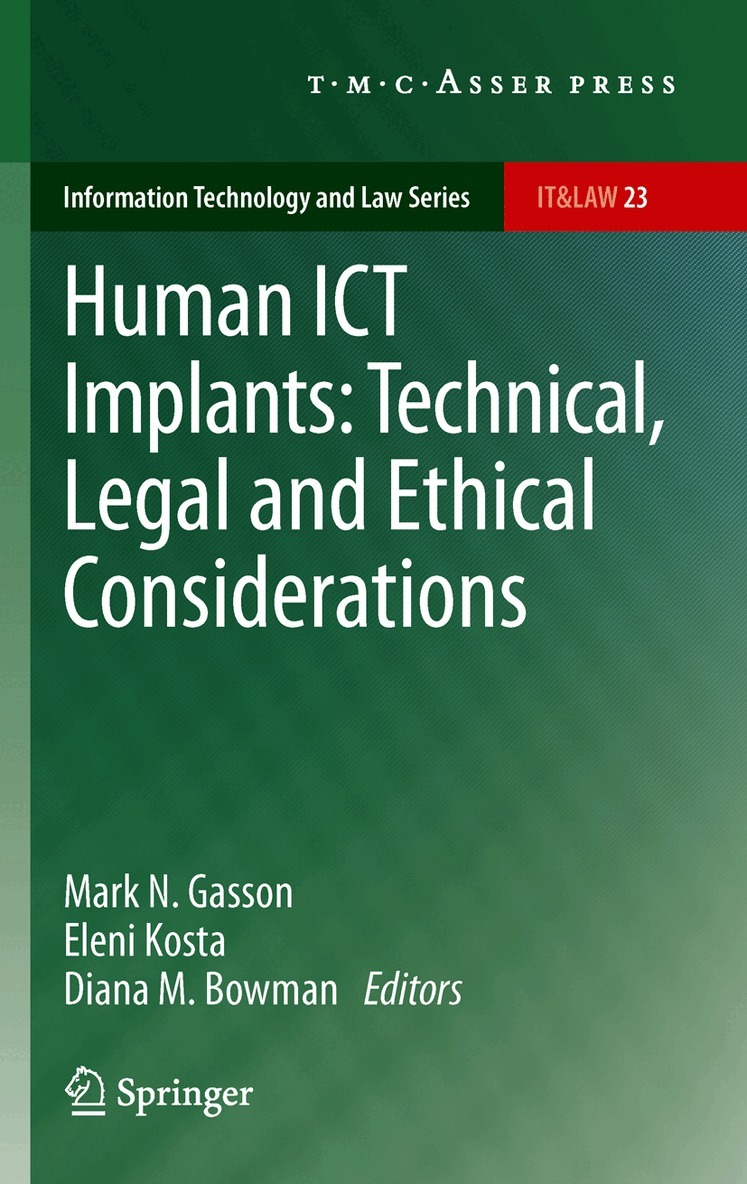
Del 23 - Information Technology and Law Series
Human ICT Implants: Technical, Legal and Ethical Considerations
Inbunden, Engelska, 2012
551 kr
Skickas inom 10-15 vardagar
Human information and communication technology (ICT) implants have developed for many years in a medical context. Such applications have become increasingly advanced, in some cases modifying fundamental brain function.Today, comparatively low-tech implants are being increasingly employed in non-therapeutic contexts, with applications ranging from the use of ICT implants for VIP entry into nightclubs, automated payments for goods, access to secure facilities and for those with a high risk of being kidnapped. Commercialisation and growing potential of human ICT implants have generated debate over the ethical, legal and social aspects of the technology, its products and application. Despite stakeholders calling for greater policy and legal certainty within this area, gaps have already begun to emerge between the commercial reality of human ICT implants and the current legal frameworks designed to regulate these products.This book focuses on the latest technological developments and onthe legal, social and ethical implications of the use and further application of these technologies.
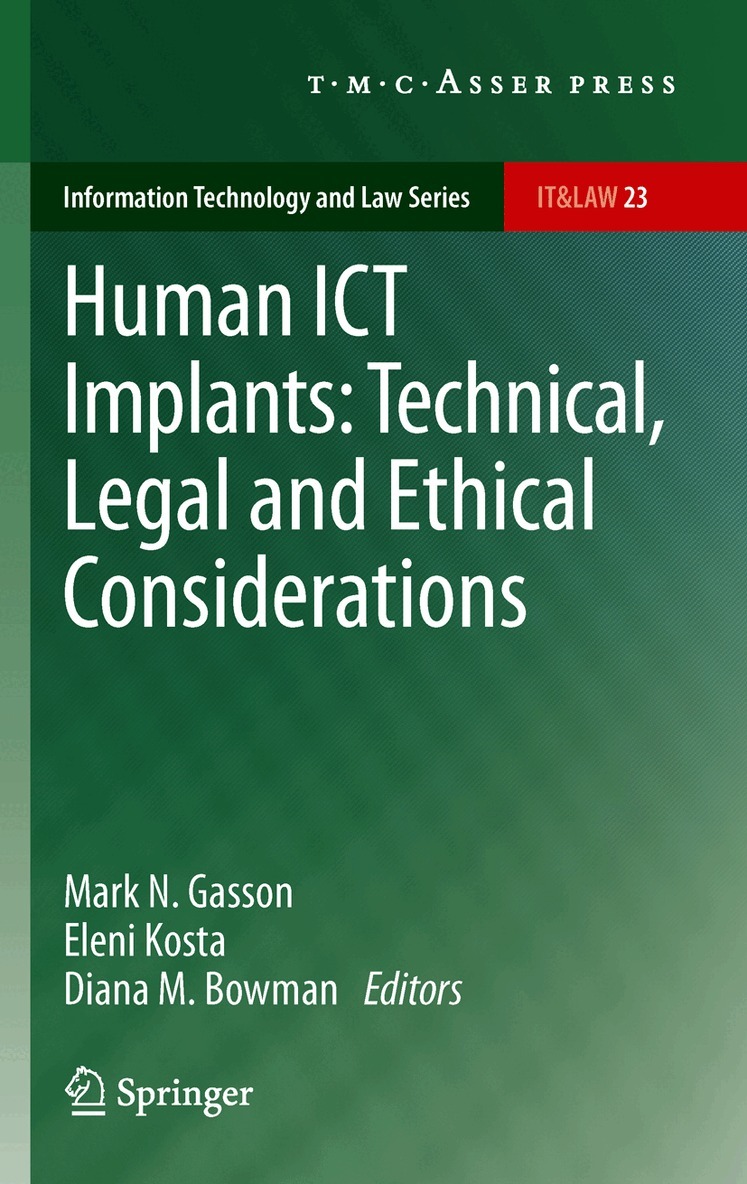
Del 23 - Information Technology and Law Series
Human ICT Implants: Technical, Legal and Ethical Considerations
Häftad, Engelska, 2014
551 kr
Skickas inom 10-15 vardagar
Human information and communication technology (ICT) implants have developed for many years in a medical context. Such applications have become increasingly advanced, in some cases modifying fundamental brain function.Today, comparatively low-tech implants are being increasingly employed in non-therapeutic contexts, with applications ranging from the use of ICT implants for VIP entry into nightclubs, automated payments for goods, access to secure facilities and for those with a high risk of being kidnapped. Commercialisation and growing potential of human ICT implants have generated debate over the ethical, legal and social aspects of the technology, its products and application. Despite stakeholders calling for greater policy and legal certainty within this area, gaps have already begun to emerge between the commercial reality of human ICT implants and the current legal frameworks designed to regulate these products.This book focuses on the latest technological developments and onthe legal, social and ethical implications of the use and further application of these technologies.
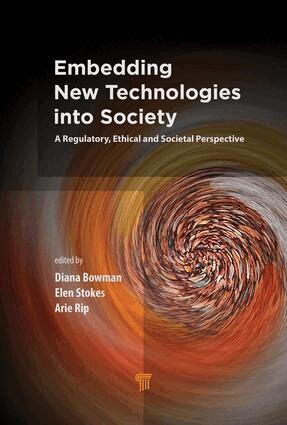
Embedding New Technologies into Society
A Regulatory, Ethical and Societal Perspective
Inbunden, Engelska, 2017
870 kr
Skickas inom 7-10 vardagar
The embedding of any new technologies in society is challenging. The evolving state of the scientific art, often-unquantifiable risks and ill-defined developmental trajectories have the potential to hinder innovation and/or the commercial success of a technology. The are, however, a number of tools that can now be utilized by stakeholders to bridge the chasm that exists between the science and innovation dimensions on the one hand, and the societal dimensions on the other. This edited volume will draw together leading researchers from the domains of law, philosophy, political science, public administration and the natural sciences in order to demonstrate how tools such as, for example, constructive technology assessment, regulatory governance and societal scenarios, may be employed by stakeholders to assist in successfully embedding new technologies into society. This volume will focus primarily on the embedding of two emergent and emerging technologies: nanotechnologies and synthetic biology. Government, industry and the epistemic community continue to struggle with how best to balance the promised benefits of an emerging technology with concerns about its potential impacts. There is a growing body of literature that has examined these challenges from various cultural, scientific and jurisdictional dimensions. There is, however, much work that still needs to be done; this includes articulating the successes and failures of attempts to the societal embedding of technologies and their associated products. This edited volume is significant and timely, as unlike other books currently on the market, it shall draw from real work experiences and experiments designed anticipate the societal embedding of emerging technologies. This empirical work shall be supported by robust theoretical underpinnings.