Didier Ruedin – författare
Visar alla böcker från författaren Didier Ruedin. Handla med fri frakt och snabb leverans.
6 produkter
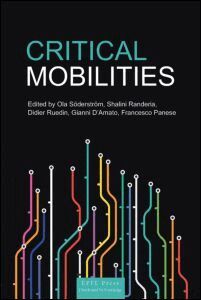
Critical Mobilities
Av Ola Soderstrom, Didier Ruedin m. fl.
Inbunden, 2013
643 kr
Lägg i varukorg
The field of mobility studies examines social phenomena through the lens of movement. In this perspective, societies are regarded as being constantly reconfigured as they are shaped by a series of mobile entities (capital, people, information).This book engages critically with many of the claims …
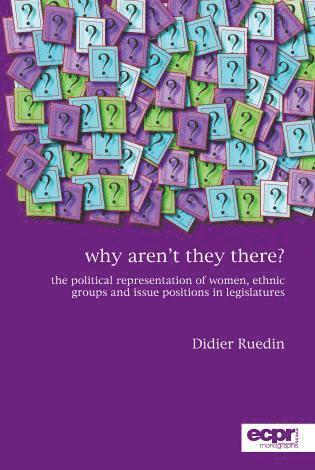
Why Aren't They There?
The Political Representation of Women, Ethnic Groups and Issue Positions in Legislatures
Häftad, 2013
699 kr
Lägg i varukorg
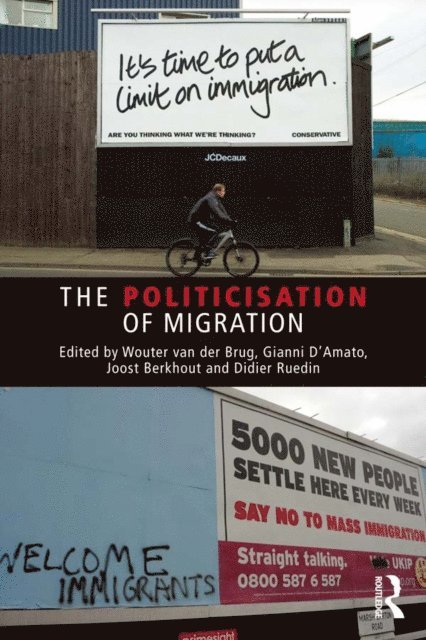
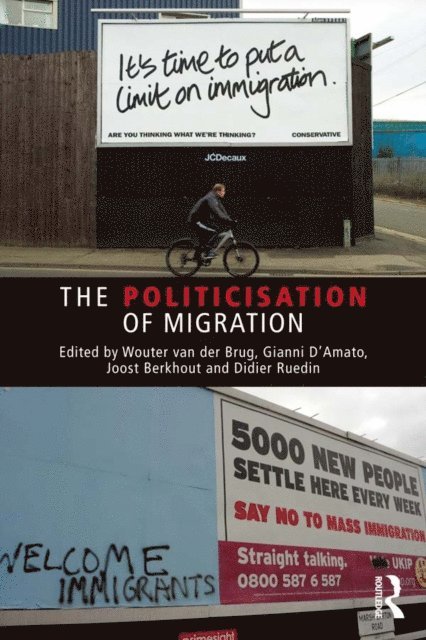
Politicisation of Migration
Av Wouter van der Brug, Gianni D'Amato m. fl.
Inbunden, 2015
2516 kr
Lägg i varukorg
Why are migration policies sometimes heavily contested and high on the political agenda? And why do they, at other moments and in other countries, hardly lead to much public debate? The entrance and settlement of migrants in Western Europe has prompted various political reactions. In some countries …
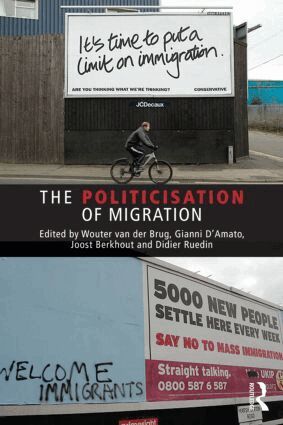
Politicisation of Migration
Av Wouter van der Brug, Gianni D'Amato m. fl.
Häftad, 2015
824 kr
Lägg i varukorg
Why are migration policies sometimes heavily contested and high on the political agenda? And why do they, at other moments and in other countries, hardly lead to much public debate? The entrance and settlement of migrants in Western Europe has prompted various political reactions. In some countries …
Politicisation of Migration
Av Joost Berkhout, Didier Ruedin m. fl.
E-bok, 2015
970 kr
Lägg i varukorg
Why are migration policies sometimes heavily contested and high on the political agenda? And why do they, at other moments and in other countries, hardly lead to much public debate? The entrance and settlement of migrants in Western Europe has prompted various political reactions. In some countries …
Politicisation of Migration
Av Joost Berkhout, Didier Ruedin m. fl.
E-bok, 2015
949 kr
Lägg i varukorg
Why are migration policies sometimes heavily contested and high on the political agenda? And why do they, at other moments and in other countries, hardly lead to much public debate? The entrance and settlement of migrants in Western Europe has prompted various political reactions. In some countries …