Diganta Sengupta - Böcker
Visar alla böcker från författaren Diganta Sengupta. Handla med fri frakt och snabb leverans.
3 produkter
3 produkter
2 110 kr
Skickas inom 10-15 vardagar
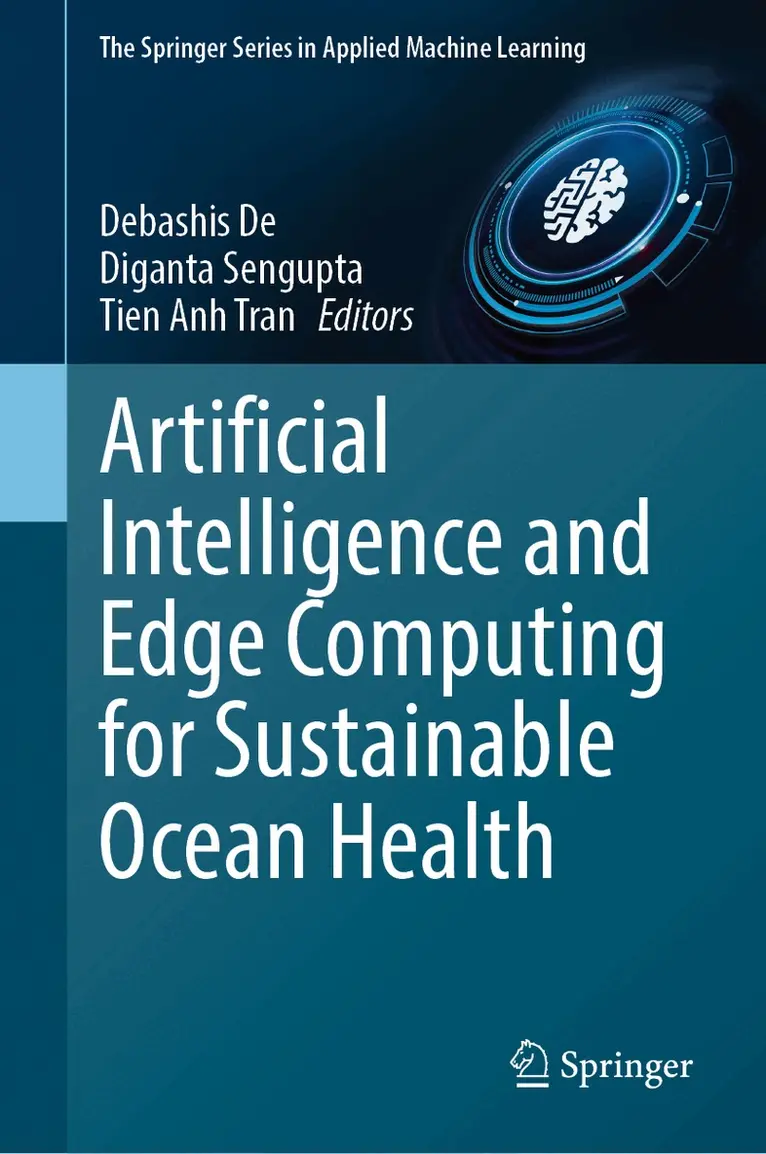
Artificial Intelligence and Edge Computing for Sustainable Ocean Health explores the transformative role of AI and edge computing in preserving and enhancing ocean health. The growing influence of Artificial Intelligence (AI), along with the Internet of Things (IoT) in generating wide coverage of sensor networks, and Edge Computing (EC) has paved the way for investigation of underwater as well as massive marine data, thereby generating huge potential for credible research opportunities for these domains. This book’s journey begins with a broad overview of Artificial Intelligence for Sustainable Ocean Health, setting the foundation for understanding AI's potential in marine conservation. The subsequent chapter, Role of Artificial Intelligence and Technologies in Improving Ocean Health in Promoting Tourism, illustrates the synergy between technological advancements and sustainable tourism practices, demonstrating how AI can enhance the attractiveness and preservation of marine destinations. The identification, restoration, and monitoring of marine resources along with the utilization of technology continues in Utilization of Underwater Wireless Sensor Network through Supervising a Random Network Environment in the Ocean Environment has been extensively dealt with. The technical challenges of underwater imaging, essential for accurate data collection and analysis has been discussed.The importance of Explainable AI is discussed in chapters like Sustainable Development Goal 14: Explainable AI (XAI) for Ocean Health, Explainable AI (XAI) for Ocean Health: Exploring the Role of Explainable AI in Enhancing Ocean Health, and A Comprehensive Study of AI (XAI) for Ocean Health Monitoring, which emphasize transparency and trust in AI systems. Further, Revolutionizing Internet of Underwater Things with Federated Learning, Underwater Drone, Underwater Imagery with AI/ML and IoT in ROV Technology and Ocean Cleanup has been demonstrated using innovative approaches to addressing underwater challenges. The book also includes a Review on the Optics and Photonics in Environmental Sustainability, focusing on the role of optics in marine conservation. Security issues are tackled in Intelligent Hash Function Based Key-Exchange Scheme for Ocean Underwater Data Transmission, and the overarching potential of AI in marine resource management is discussed in Artificial Intelligence as Key-enabler for Safeguarding the Marine Resources.
2 110 kr
Skickas inom 10-15 vardagar
Artificial Intelligence and Edge Computing for Sustainable Ocean Health explores the transformative role of AI and edge computing in preserving and enhancing ocean health. The growing influence of Artificial Intelligence (AI), along with the Internet of Things (IoT) in generating wide coverage of sensor networks, and Edge Computing (EC) has paved the way for investigation of underwater as well as massive marine data, thereby generating huge potential for credible research opportunities for these domains. This book’s journey begins with a broad overview of Artificial Intelligence for Sustainable Ocean Health, setting the foundation for understanding AI's potential in marine conservation. The subsequent chapter, Role of Artificial Intelligence and Technologies in Improving Ocean Health in Promoting Tourism, illustrates the synergy between technological advancements and sustainable tourism practices, demonstrating how AI can enhance the attractiveness and preservation of marine destinations. The identification, restoration, and monitoring of marine resources along with the utilization of technology continues in Utilization of Underwater Wireless Sensor Network through Supervising a Random Network Environment in the Ocean Environment has been extensively dealt with. The technical challenges of underwater imaging, essential for accurate data collection and analysis has been discussed.The importance of Explainable AI is discussed in chapters like Sustainable Development Goal 14: Explainable AI (XAI) for Ocean Health, Explainable AI (XAI) for Ocean Health: Exploring the Role of Explainable AI in Enhancing Ocean Health, and A Comprehensive Study of AI (XAI) for Ocean Health Monitoring, which emphasize transparency and trust in AI systems. Further, Revolutionizing Internet of Underwater Things with Federated Learning, Underwater Drone, Underwater Imagery with AI/ML and IoT in ROV Technology and Ocean Cleanup has been demonstrated using innovative approaches to addressing underwater challenges. The book also includes a Review on the Optics and Photonics in Environmental Sustainability, focusing on the role of optics in marine conservation. Security issues are tackled in Intelligent Hash Function Based Key-Exchange Scheme for Ocean Underwater Data Transmission, and the overarching potential of AI in marine resource management is discussed in Artificial Intelligence as Key-enabler for Safeguarding the Marine Resources.
Cloud-Native Modernization Unleashed
Revolutionizing Legacy Systems with Spring, AI, Cloud, and Microservices
Häftad, Engelska, 2026
448 kr
Kommande
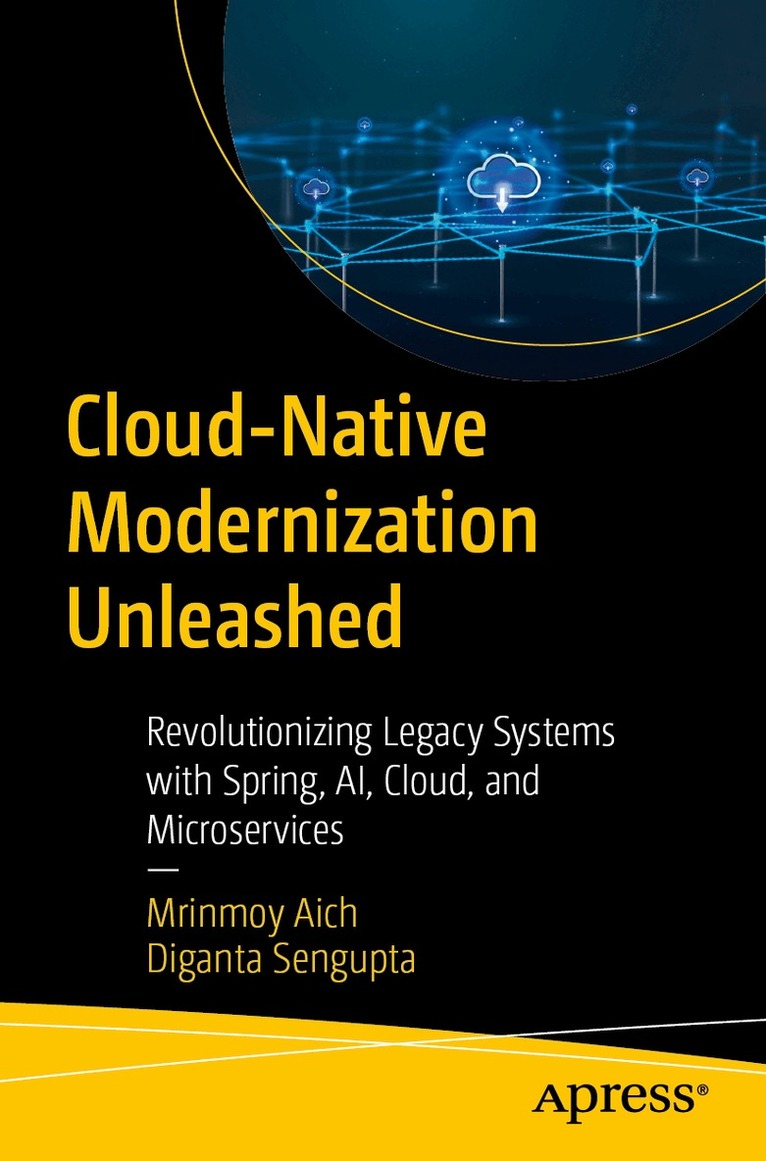
This book is a comprehensive roadmap for transitioning legacy systems into agile, cloud-native, and intelligent architectures. Whether you’re a software architect, DevOps engineer, or technology decision-maker, this book is your essential guide to navigating the evolving landscape of modern application development.The book starts with an overview of why modernisation is imperative in today’s fast-paced environment, highlighting the limitations of legacy architectures and the advantages of embracing cloud-native models. From building a solid modernisation roadmap to understanding the anatomy of legacy systems like monoliths and N-tier applications, readers will gain practical insights into planning and execution. As the book progresses, it delves into the core of modern software architecture—microservices, containers, Kubernetes, and API-first design—explaining how to design, deploy, and scale distributed systems. Real-world implementations using Spring Boot, Node.js, React, and cloud platforms provide hands-on guidance for developers. Further, chapters cover performance optimisation, observability with Prometheus and Grafana, centralised logging, and CI/CD pipeline automation with Jenkins and GitHub Actions. Security is woven throughout, with detailed chapters on OAuth, API gateway protection, DevSecOps, and regulatory compliance, including GDPR and HIPAA. The book culminates with cutting-edge applications of AI and ML—chatbots, predictive analytics, and intelligent automation—showing how AI can enhance both customer experience and backend operations.The book is a collection of multiple patterns, best practices, and real-world use cases, which equips the reader to lead successful modernisation initiatives that are secure, scalable, and future-ready.What you will learn:What are the limitations of legacy architectures and the advantages of embracing cloud-native models.Understand the principles and strategies behind modernising legacy applications for cloud-native environments.How to design, implement, and scale microservices using technologies like Spring Boot, Node.js, React, Docker, and Kubernetes.How to secure modern applications through authentication, authorisation, API protection, and compliance with industry standards.Who this book is for:This book is designed for cloud architects and engineers, software developers, DevOps engineers, and IT leaders looking to modernize applications without starting from scratch.