Dionysis D. Bochtis – författare
2 179 kr
Skickas inom 10-15 vardagar
567 kr
Skickas inom 10-15 vardagar
668 kr
Läs direkt efter köp
Today, one of the top priorities of an organization’s modern corporate strategy is to portray itself as socially responsible and environmentally sustainable. As a focal point of sustainability initiatives, green supply chain management has emerged as a key strategy that can provide competitive advantages with significant parallel gains for company profitability. In designing a green supply chain, the intent is the adoption of comprehensive and cross-business sustainability principles, from the product conception stage to the end-of-life stage. In this context, green initiatives relate to tangible and intangible corporate benefits. Sustainability reports from numerous companies reveal that greening their supply chains has helped reduce operating cost, thus boosting effectiveness and efficiency while increasing sustainability of the business.
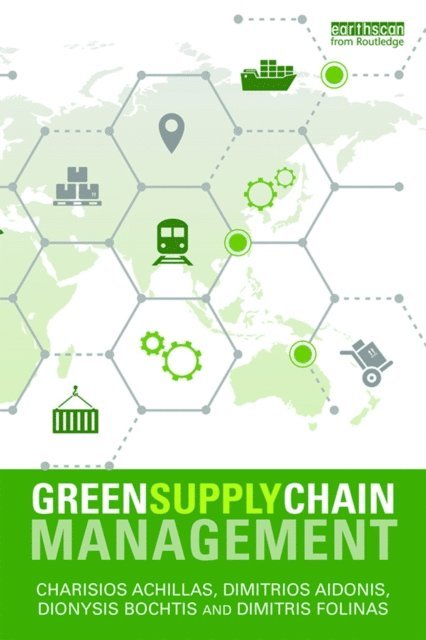
Green Supply Chain Management provides a strategic overview of sustainable supply chain management, shedding light on the theoretical background and key principles of the topic. Specifically, this book covers various thematic areas including benefits and impact of green supply chain management; enablers and barriers on supply chain operations; inbound and outbound logistics considerations; and production, packaging and reverse logistics under the notion of "greening". The ultimate aim of this textbook is to highlight the challenges in the implementation of green supply chain management in modern companies and to provide a roadmap for decision-making in real-life cases.
Combining chapter summaries and discussion questions, this book provides an accessible and student-friendly introduction to green supply change management and will be of great interest to students, scholars and practitioners in the fields of sustainable business and supply chain management.
668 kr
Läs direkt efter köp
Today, one of the top priorities of an organization’s modern corporate strategy is to portray itself as socially responsible and environmentally sustainable. As a focal point of sustainability initiatives, green supply chain management has emerged as a key strategy that can provide competitive advantages with significant parallel gains for company profitability. In designing a green supply chain, the intent is the adoption of comprehensive and cross-business sustainability principles, from the product conception stage to the end-of-life stage. In this context, green initiatives relate to tangible and intangible corporate benefits. Sustainability reports from numerous companies reveal that greening their supply chains has helped reduce operating cost, thus boosting effectiveness and efficiency while increasing sustainability of the business.
Green Supply Chain Management provides a strategic overview of sustainable supply chain management, shedding light on the theoretical background and key principles of the topic. Specifically, this book covers various thematic areas including benefits and impact of green supply chain management; enablers and barriers on supply chain operations; inbound and outbound logistics considerations; and production, packaging and reverse logistics under the notion of "greening". The ultimate aim of this textbook is to highlight the challenges in the implementation of green supply chain management in modern companies and to provide a roadmap for decision-making in real-life cases.
Combining chapter summaries and discussion questions, this book provides an accessible and student-friendly introduction to green supply change management and will be of great interest to students, scholars and practitioners in the fields of sustainable business and supply chain management.
Information and Communication Technologies for Agriculture—Theme I: Sensors
763 kr
Skickas inom 5-8 vardagar
1 672 kr
Läs direkt efter köp
Information and Communication Technologies for Agriculture—Theme I: Sensors
763 kr
Skickas inom 5-8 vardagar
Information and Communication Technologies for Agriculture—Theme II: Data
763 kr
Skickas inom 5-8 vardagar
1 672 kr
Läs direkt efter köp
Information and Communication Technologies for Agriculture—Theme II: Data
763 kr
Skickas inom 5-8 vardagar
Information and Communication Technologies for Agriculture—Theme III: Decision
763 kr
Skickas inom 5-8 vardagar
1 672 kr
Läs direkt efter köp
This volume is the third (III) of four under the main themes of Digitizing Agriculture and Information and Communication Technologies (ICT). The four volumes cover rapidly developing processes including Sensors (I), Data (II), Decision (III), and Actions (IV). Volumes are related to ‘digital transformation” within agricultural production and provision systems, and in the context of Smart Farming Technology and Knowledge-based Agriculture. Content spans broadly from data mining and visualization to big data analytics and decision making, alongside with the sustainability aspects stemming from the digital transformation of farming. The four volumes comprise the outcome of the 12th EFITA Congress, also incorporating chapters that originated from select presentations of the Congress.
The focus of this book (III) is on the transformation of collected information into valuable decisions and aims to shed light on how best to use digital technologies to reduce cost, inputs,and time, toward becoming more efficient and transparent. Fourteen chapters are grouped into 3 Sections. The first section of is dedicated to decisions in the value chain of agricultural products. The next section, titled Primary Production, elaborates on decision making for the improvement of processes taking place with the farm under the implementation of ICT. The last section is devoted to the development of innovative decision applications that also consider the protection of the environment, recognizing its importance in the preservation and considerate use of resources, as well as the mitigation of adverse impacts that are related to agricultural production.
Planning and modeling the assessment of agricultural practices can provide farmers with valuable information prior to the execution of any task. This book provides a valuable reference for them as well as for those directly involved with decision making in planning and assessment of agricultural production.
Specific advances covered in the volume:
Modelling and Simulation of ICT-based agricultural systemsFarm Management Information Systems (FMIS) Planning for unmanned aerial systems Agri-robotics awareness and planning Smart livestock farming Sustainable strategic planning in agri-production Food business information systemsInformation and Communication Technologies for Agriculture—Theme III: Decision
763 kr
Skickas inom 5-8 vardagar
Information and Communication Technologies for Agriculture—Theme IV: Actions
763 kr
Skickas inom 5-8 vardagar
1 687 kr
Läs direkt efter köp
This volume is the last (IV) of four under the main themes of Digitizing Agriculture and Information and Communication Technologies (ICT). The four volumes cover rapidly developing processes including Sensors (I), Data (II), Decision (III), and Actions (IV). Volumes are related to ‘digital transformation” within agricultural production and provision systems, and in the context of Smart Farming Technology and Knowledge-based Agriculture. Content spans broadly from data mining and visualization to big data analytics and decision making, alongside with the sustainability aspects stemming from the digital transformation of farming. The four volumes comprise the outcome of the 12th EFITA Congress, also incorporating chapters that originated from select presentations of the Congress.
The focus in this volume is on the directions of Agriculture 4.0 which incorporates the transition to a new era of action in the Agricultural sector, represented by the evolution of digital technologies in 4 aspects: Big Data, Open Data, Internet of Things (IoT), and Cloud Computing. Under the heading of “Action,” 14 Chapters investigate the implementation of cutting-edge technologies on real world applications. It will become apparent to the reader that the penetration of ICT in agriculture can result in several benefits related to the sustainability of the sector and to yield the maximum benefits, successful management is required. The entire discussion highlights the importance of proper education in the adoption of innovative technologies starting with the adaption of educational systems to the new era and moving to the familiarization of farmers to the new technologies.
This book covers topics that relate to the digital transformation of farming. It provides examples and case studies of this transformation from around the world, examines the process of diffusion of digital technologies, and assesses the current and future sustainability aspects of digital agriculture. More specifically, it deals with issues such as:
Challenges and opportunities from the transition to Agriculture 4.0Safety and health in agricultural work automationThe role of digital farming on regional-spatial planningThe enrollment of Social Media in IoT-based agricultureThe role of education in digital agricultureReal-life implementation cases of smart agriculture around the worldInformation and Communication Technologies for Agriculture—Theme IV: Actions
769 kr
Skickas inom 5-8 vardagar