Donald Rothchild - Böcker
Visar alla böcker från författaren Donald Rothchild. Handla med fri frakt och snabb leverans.
11 produkter
11 produkter
581 kr
Skickas inom 10-15 vardagar
Africa has undergone significant political, economic, and social change since the first edition of this book was published in early 1988. Now revised and updated throughout, this new edition includes current economic, social, and political data, as well as entirely new sections on the dismantling of apartheid, civil society, democratization and multiparty politics, economic reform and structural adjustment, and the prospects for African development in the twenty-first century. Review comments on the first edition: 'Required reading for any course on politics and society of the African continent' West Africa. 'The best available textbook on the subject ... this volume stands unchallenged in its comprehensiveness and sophistication.' - Choice
2 103 kr
Skickas inom 10-15 vardagar
The idea for this book can be traced to an informal brainstorming session among four very good friends -- Ali Mazrui, Victor Olorunsola, Donald Rothchild and Dunstan Wai. In a real sense, then, as editors we owe a lot to Dunstan and Ali for their intellectual stimulation and for encouraging us to pursue a follow-up to ~.f.2l.i::. ,lla .Qt Cultyral ~Natignalism .in A..f'.da
2 103 kr
Skickas inom 10-15 vardagar
Since independence, the political institutions of many African states have undergone a process of consolidation and subsequent deterioration. Constrained by external economic dependency and an acute scarcity of economic and technical resources, state officials have demonstrated a diminished capacity to regulate their societies. Public policies are agreed upon but ineffectively implemented by the weak institutions of the state. Although scholars have analyzed the various facets of state-building in detail, little systematic attention has been given to the issue of the decline of the state and mechanisms to cope with state ineffectiveness in Africa. This book focuses especially on the character of the postcolonial state in Africa, the nature of and reasons for state deterioration, and the mechanisms and policies for coping with state malfunction. Scholars from Africa, the United States, Europe, and the Middle East combine a broad understanding of African political processes with expertise on specific regions. Their analytic and comparative perspective provides a comprehensive and timely treatment of this vital and heretofore neglected theme in African politics.
539 kr
Skickas inom 10-15 vardagar
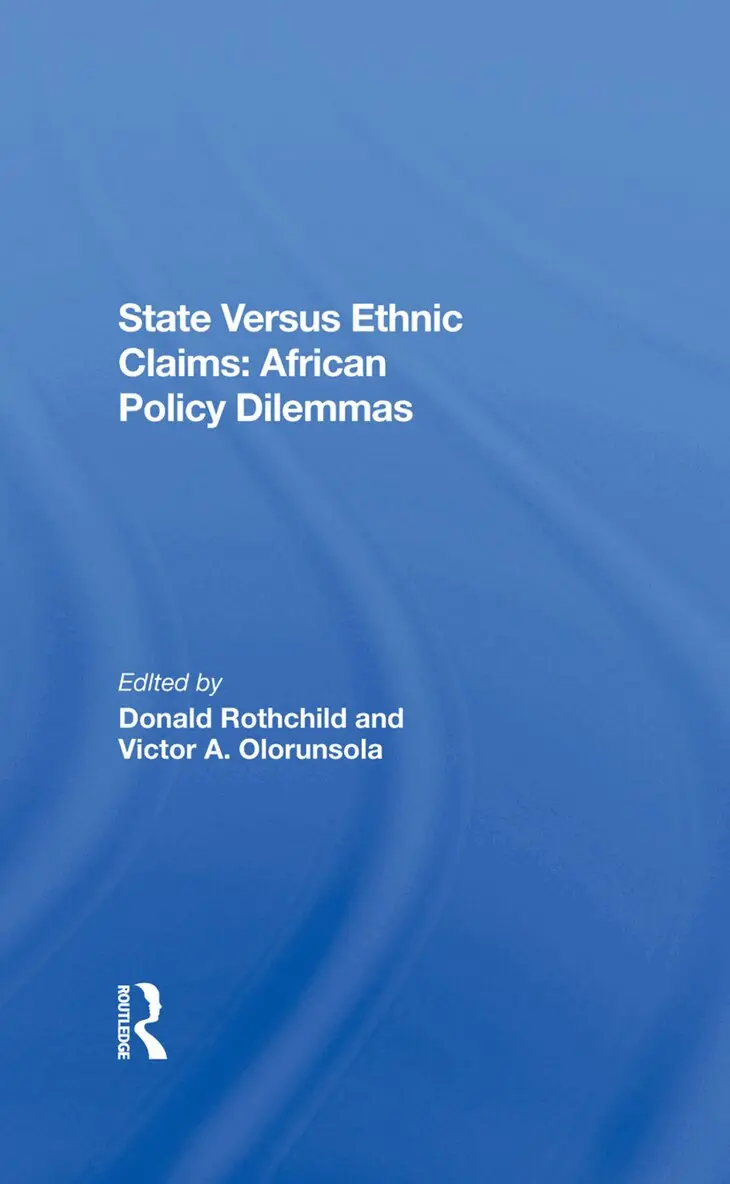
How can today's independent African states preserve and enhance their coherence while accommodating the legitimate demands advanced by ethnic groups for autonomy and particular interests? This problem is critically important not only in Africa, but also in efforts to establish mutually beneficial state-ethnic relations the world over. To analyze th
539 kr
Skickas inom 10-15 vardagar
Since independence, the political institutions of many African states have undergone a process of consolidation and subsequent deterioration. Constrained by external economic dependency and an acute scarcity of economic and technical resources, state officials have demonstrated a diminished capacity to regulate their societies. Public policies are agreed upon but ineffectively implemented by the weak institutions of the state. Although scholars have analyzed the various facets of state-building in detail, little systematic attention has been given to the issue of the decline of the state and mechanisms to cope with state ineffectiveness in Africa. This book focuses especially on the character of the postcolonial state in Africa, the nature of and reasons for state deterioration, and the mechanisms and policies for coping with state malfunction. Scholars from Africa, the United States, Europe, and the Middle East combine a broad understanding of African political processes with expertise on specific regions. Their analytic and comparative perspective provides a comprehensive and timely treatment of this vital and heretofore neglected theme in African politics.
557 kr
Skickas inom 7-10 vardagar
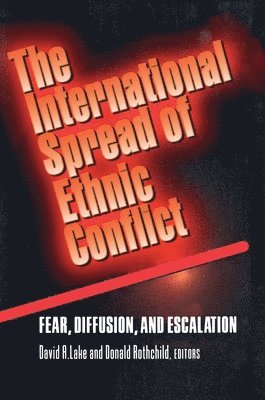
The wave of ethnic conflict that has recently swept across parts of Eastern Europe, the former Soviet Union, and Africa has led many political observers to fear that these conflicts are contagious. Initial outbreaks in such places as Bosnia, Chechnya, and Rwanda, if not contained, appear capable of setting off epidemics of catastrophic proportions. In this volume, David Lake and Donald Rothchild have organized an ambitious, sophisticated exploration of both the origins and spread of ethnic conflict, one that will be useful to policymakers and theorists alike. The editors and contributors argue that ethnic conflict is not caused directly by intergroup differences or centuries-old feuds and that the collapse of the Soviet Union did not simply uncork ethnic passions long suppressed. They look instead at how anxieties over security, competition for resources, breakdown in communication with the government, and the inability to make enduring commitments lead ethnic groups into conflict, and they consider the strategic interactions that underlie ethnic conflict and its effective management.How, why, and when do ethnic conflicts either diffuse by precipitating similar conflicts elsewhere or escalate by bringing in outside parties? How can such transnational ethnic conflicts best be managed? Following an introduction by the editors, which lays a strong theoretical foundation for approaching these questions, Timur Kuran, Stuart Hill, Donald Rothchild, Colin Cameron, Will H. Moore, and David R. Davis examine the diffusion of ideas across national borders and ethnic alliances. Without disputing that conflict can spread, James D. Fearon, Stephen M. Saideman, Sandra Halperin, and Paula Garb argue that ethnic conflict today is primarily a local phenomenon and that it is breaking out in many places simultaneously for similar but largely independent reasons. Stephen D. Krasner, Daniel T. Froats, Cynthia S. Kaplan, Edmond J. Keller, Bruce W. Jentleson, and I. William Zartman focus on the management of transnational ethnic conflicts and emphasize the importance of domestic confidence-building measures, international intervention, and preventive diplomacy.
1 518 kr
Skickas inom 10-15 vardagar
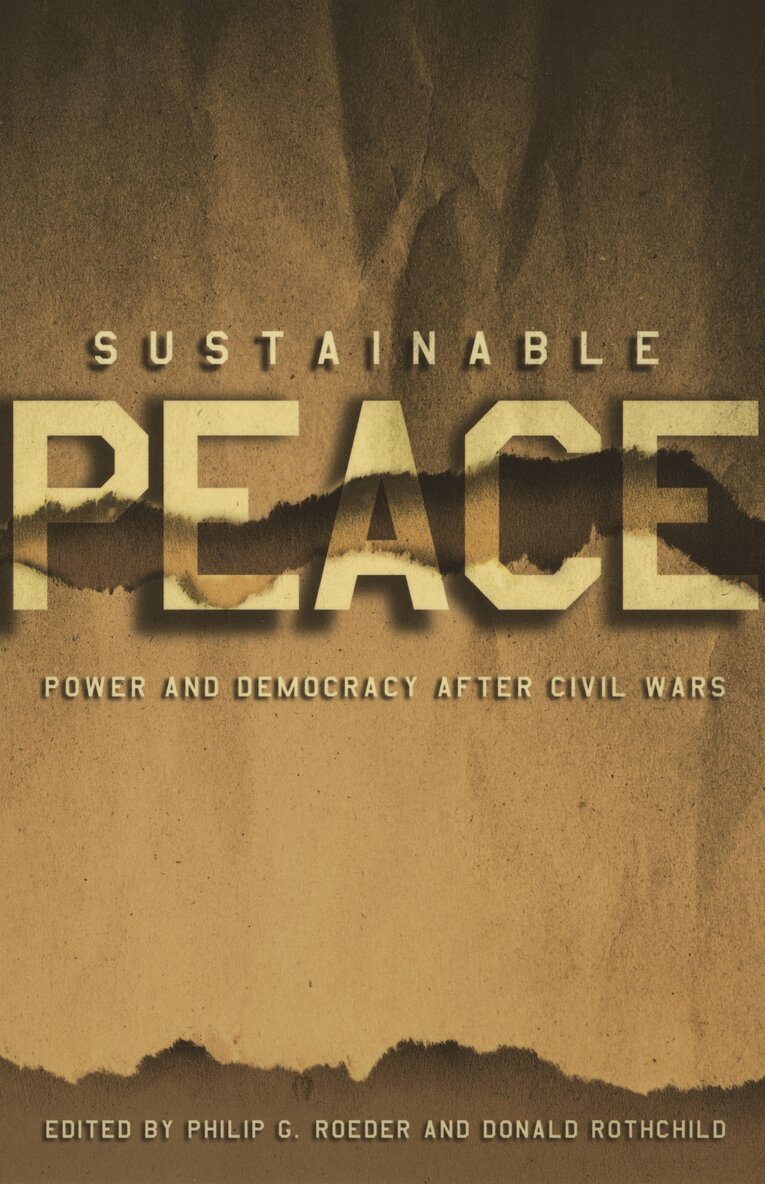
How can leaders craft political institutions that will sustain the peace and foster democracy in ethnically divided societies after conflicts as destructive as civil wars? Under turbulent conditions the leaders of ethnic groups, governments, and international organizations face the challenge of designing political arrangements that can simultaneously meet the tests of equal representation, democratic accountability, effective governance, and political stability. At critical junctures in the transition from intense (often violent) conflict, power-sharing arrangements may offer a compromise acceptable to most ethnic elites. Philip G. Roeder and Donald Rothchild find that these short-term accommodations come with high longer-term costs: the very institutions that provide a basis to end a conflict in an ethnically divided country may hinder the consolidation of peace and democracy over the longer term.The contributors to Sustainable Peace examine institutional settlements in Ethiopia, Lebanon, India, and South Africa as well as the Soviet successor states, south Asia, central Africa, west Africa, and the Balkans. Roeder, Rothchild, and most of the contributors conclude that power-dividing, rather than power-sharing, solutions are more likely to result in durable political compacts and peace.
367 kr
Skickas inom 10-15 vardagar
How can leaders craft political institutions that will sustain the peace and foster democracy in ethnically divided societies after conflicts as destructive as civil wars? Under turbulent conditions the leaders of ethnic groups, governments, and international organizations face the challenge of designing political arrangements that can simultaneously meet the tests of equal representation, democratic accountability, effective governance, and political stability. At critical junctures in the transition from intense (often violent) conflict, power-sharing arrangements may offer a compromise acceptable to most ethnic elites. Philip G. Roeder and Donald Rothchild find that these short-term accommodations come with high longer-term costs: the very institutions that provide a basis to end a conflict in an ethnically divided country may hinder the consolidation of peace and democracy over the longer term.The contributors to Sustainable Peace examine institutional settlements in Ethiopia, Lebanon, India, and South Africa as well as the Soviet successor states, south Asia, central Africa, west Africa, and the Balkans. Roeder, Rothchild, and most of the contributors conclude that power-dividing, rather than power-sharing, solutions are more likely to result in durable political compacts and peace.
274 kr
Skickas inom 10-15 vardagar
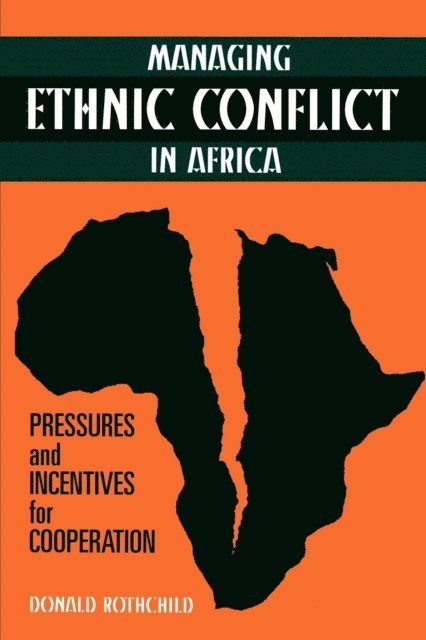
Ethnic conflict in Africa is reaching critical levels. Governments are being toppled. National economies are collapsing. And the potential for civil unrest--even violent encounters--throughout the continent threatens to engulf not only Africa, but much of the world.Africa's salvation depends on the development and implementation of effective institutions of ethnic conflict management. In this book, Donald Rothchild analyzes the successes and failures of attempts at conflict resolution in different African countries and offers comprehensive ideas for successful mediation.To provide a clear picture of the current situation, Rothchild traces Africa's ethnic unrest back to its beginnings during the period of colonial rule, through the post-independence era, when governments built the institutions of government control and consolidated power; and into its more recent period when it is possible to discern greater democratic governance.Managing Ethnic Conflict in Africa demonstrates how negotiation and mediation can promote conflict resolution and a political environment that fosters economic development. It offers a compelling case for the use of both political incentives (power sharing, elections, and fiscal programs) and a variety of actions (including principles of inclusiveness, coercion, and punishment) to support reconciliation. This ""carrot and stick"" approach can be employed by a state to promote increased political bargaining while maintaining stability, and by outside intermediaries to cope with conflict brought on by the breakdown of domestic regimes.
620 kr
Skickas inom 10-15 vardagar
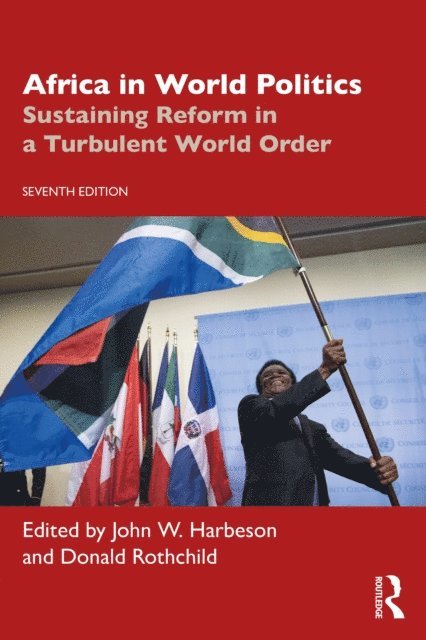
Africa in World Politics provides advanced undergraduate and graduate students with the perfect introduction to the challenges faced by African states on an increasingly turbulent world stage.Africa in World Politics has long served as the go-to resource for students of African politics seeking to navigate the continent’s complex political and economic landscapes. Updated throughout, this new edition includes new chapters on the unprecedented challenges the continent faces from climate change and the fallout of the COVID-19 global pandemic. Adding to existing coverage of international diplomacy, peacebuilding, women in politics, and the building blocks of political economy, the book also includes expanded coverage of the role of China in Africa, and fresh perspectives on decolonization.Drawing together insights from some of the world’s leading scholars of African politics, this textbook is an essential read for advanced students of political science and African studies.
1 963 kr
Skickas inom 10-15 vardagar
Africa in World Politics provides advanced undergraduate and graduate students with the perfect introduction to the challenges faced by African states on an increasingly turbulent world stage.Africa in World Politics has long served as the go-to resource for students of African politics seeking to navigate the continent’s complex political and economic landscapes. Updated throughout, this new edition includes new chapters on the unprecedented challenges the continent faces from climate change and the fallout of the COVID-19 global pandemic. Adding to existing coverage of international diplomacy, peacebuilding, women in politics, and the building blocks of political economy, the book also includes expanded coverage of the role of China in Africa, and fresh perspectives on decolonization.Drawing together insights from some of the world’s leading scholars of African politics, this textbook is an essential read for advanced students of political science and African studies.