Douglas Cameron - Böcker
Visar alla böcker från författaren Douglas Cameron. Handla med fri frakt och snabb leverans.
3 produkter
3 produkter
712 kr
Skickas inom 5-8 vardagar
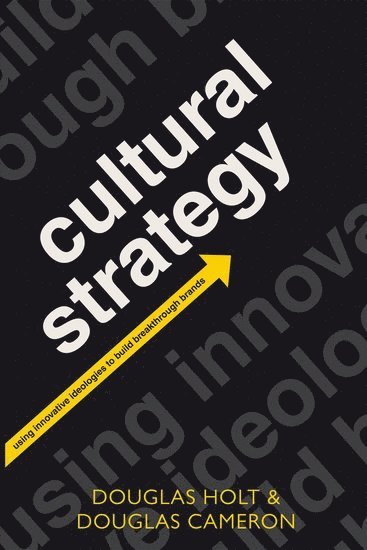
Market innovation has long been dominated by the worldview of engineers and economists: build a better mousetrap and the world will take notice. But there's another important way to build new businesses: with innovative ideologies rather than innovative mousetraps. Consider Coca-Cola, Nike, Jack Daniel's, Marlboro, Starbucks, Corona, Oprah, The Body Shop: all built with innovative ideologies. Further many "better mousetraps" are much more compelling to consumers when bundled with innovative ideologies; consider BMW, Apple, and Whole Foods. Cultural Strategy provides a step-by-step guide for managers and entrepreneurs to build businesses in this simple but effective way. Holt and Cameron analyse a series of classic cases that relied on these bold, innovative strategies: Nike, Marlboro, Starbucks, Jack Daniels, vitaminwater, and Ben & Jerry's. They then demonstrate how the theory works as an actionable strategy model, drawing upon their consulting work. They show how cultural strategy takes start-up brands into the mass market (Fat Tire beer), overcomes "better mousetraps" wars in a technology driven category (ClearBlue pregnancy test), effectively challenges a seemingly insurmountable incumbent (FUSE music channel vs MTV), and develops a social innovation (The Freelancers Union). Holt and Cameron also describe the best organizational model for pursuing this approach, which they term "the cultural studio". The book demonstrates that the top consumer marketing companies are consistently poor at this type of innovation because they rely on an antithetic organization structure, what the authors term "the brand bureaucracy". To succeed at cultural innovation requires not only a very different approach to strategy, but a new way of organizing as well.
419 kr
Skickas inom 5-8 vardagar
How do we explain the breakthrough market success of businesses like Nike, Starbucks, Ben & Jerry's, and Jack Daniel's? Conventional models of strategy and innovation simply don't work. The most influential ideas on innovation are shaped by the worldview of engineers and economists - build a better mousetrap and the world will take notice. Holt and Cameron challenge this conventional wisdom and take an entirely different approach: champion a better ideology and the world will take notice as well. Holt and Cameron build a powerful new theory of cultural innovation. Brands in mature categories get locked into a form of cultural mimicry, what the authors call a cultural orthodoxy. Historical changes in society create demand for new culture - ideological opportunities that upend this orthodoxy. Cultural innovations repurpose cultural content lurking in subcultures to respond to this emerging demand, leapfrogging entrenched incumbents.Cultural Strategy guides managers and entrepreneurs on how to leverage ideological opportunities:- How managers can use culture to out-innovate their competitors - How entrepreneurs can identify new market opportunities that big companies miss - How underfunded challengers can win against category Goliaths - How technology businesses can avoid commoditization - How social entrepreneurs can develop businesses that appeal to more than just fellow activists - How subcultural brands can break out of the 'cultural chasm' to mass market success - How global brands can pursue cross-cultural strategies to succeed in local markets - How organizations can maximize their innovation capabilities by avoiding the brand bureaucracy trapWritten by leading authorities on branding in the world today, along with one of the advertising industry's leading visionaries, Cultural Strategy transforms what has always been treated as the "intuitive" side of market innovation into a systematic strategic discipline.
307 kr
Tillfälligt slut
"The Alcohol Report" sets out to provide, in non-technical terms, a considered, authoritative and informative review of some of the key topics likely to interest those with a serious interest in the facts about alcohol consumption and alcohol-related problems. In addition, it is hoped that "The Alcohol Report" will be helpful to a wide range of people whose work is likely to bring them into contact with drinking and "problem drinking". "The Alcohol Report" should also be of interest to those with personal experience of alcohol problems, the drinkers themselves, their friends and family members. The topics covered in this book include the negative and positive effects of alcohol, the effects of heavy drinking during pregnancy, reasons why alcohol problems develop, national and international trends in alcohol consumption and alcohol-related problems, the economics of the alcohol market and the costs of alcohol problems, harm minimization strategies, health promotion, treatment, support and counselling for problem drinkers. The latter include both "conventional approaches" such as psychologically-oriented treatments and home detoxification, together with complementary therapies.