DYKER DAVID A - Böcker
Visar alla böcker från författaren DYKER DAVID A. Handla med fri frakt och snabb leverans.
5 produkter
5 produkter
1 759 kr
Tillfälligt slut
This important book focuses on post-Lisbon Agenda issues of alignment and misalignment on different dimensions of European society and the European economy, including industrial systems, R&D systems, educational systems and job markets. It also looks in particular at the peripheral regions of Europe — the less developed parts of ‘old’ Europe, the parts of old Europe that are outside or only half-inside the EU, the new member-states of the EU, and Turkey as the most important EU candidate country. It takes as its methodological starting point the theory of network alignment as developed in SPRU, notably by Nick von Tunzelmann, and builds on this to produce an incisive assessment of the institutions, individual actors and markets that drive the knowledge economy. In all of this, it sets the European picture firmly in the context of global developments in investment, labour and intellectual property flows. Key authors include the editor himself, von Tunzelmann, Andrea Salavetz of the Hungarian Academy of Sciences and Matija Rojec of the University of Ljubljana, Slovenia.
Catching Up And Falling Behind: Post-communist Transformation In Historical Perspective
Inbunden, Engelska, 2004
1 692 kr
Tillfälligt slut
In this collection of essays David A Dyker explores some of the most difficult and fascinating aspects of the process of transition from autocratic “real socialism” to a capitalism that is sometimes democratic, sometimes authoritarian. The stress is on the economic dimension of transformation, but the author sets the economic drama firmly within a political economy framework and a historical perspective. Trends in key economic variables are analysed against the background of the struggle between different social and political groups for power and command over resources. While the book pays due attention to topical issues like EU enlargement, the underlying perspective is a long-term one. Transition is viewed not as a set of once-and-for-all institutional changes or a process of short-term stabilisation, but as a historic opportunity to solve the inherited problem of poverty and underdevelopment in Central-East Europe and the former Soviet Union. The book ends with a critical assessment of how economics, as a discipline, has coped with the challenge of that historic opportunity.
Closing The Eu East-west Productivity Gap: Foreign Direct Investment, Competitiveness And Public Policy
Inbunden, Engelska, 2006
2 020 kr
Skickas inom 5-8 vardagar
A product of the Framework V research project, this book addresses one of the key problems facing the EU today: Why is the ‘new’ EU so much poorer than the ‘old’, and how will EU enlargement help to solve the problem? Focusing on the productivity problems underlying the East-West gap, it looks in particular at the role that foreign investment and R&D can play in closing it. Against that background, the book assesses what role proactive development policy might play in attacking the roots of low social productivity. Concluding that there will be a clear-cut process of convergence between East and West, albeit an incomplete one, it finishes with an assessment of the patterns of competitiveness, East and West, that are likely to emerge from this process of incomplete convergence.The material is based on a rich archive of empirical material which no competing title can match, and combines in-depth interviews with standard quantitative approaches and critical policy analysis.
World Scientific Reference On Globalisation In Eurasia And The Pacific Rim (In 4 Volumes)
Inbunden, Engelska, 2015
10 594 kr
Skickas inom 5-8 vardagar
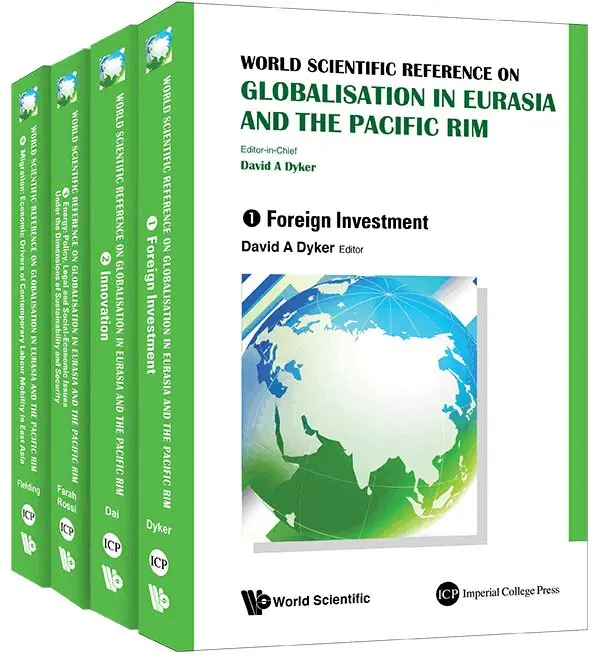
This multi-volume set focuses on a key region of the world which contains four of the biggest emerging economies, a large number of highly dynamic small- and medium-sized emerging economies, and one of the leading advanced industrial countries. It is a region which contains some of the biggest hydrocarbon and mineral deposits in the world, and some of the most energy- and metal-hungry economies in the world. With half the world's population, it is one of the most dynamic regions of the globe in terms of population movement, providing a key focus of foreign investment, both inwards and outwards, with a high degree of technological dynamism. The region plays a central role in the industrial supply networks of the globe.In four volumes, focusing on, respectively, foreign investment, innovation, energy and migration, the set focuses on each of the main elements in the production system in turn — capital, innovation, raw materials and labour. Volume 1 studies patterns of interchange of financial and direct investment within the region, focusing on governance, the development of supply chains, and technology transfer. In Volume 2, the technology theme becomes dominant, with a special focus on digital technology. It includes technical issues like mobile communications standardisation, developmental dimensions, including the role of clusters and science parks, and political economy issues like the rise of techno-nationalism. Volume 3 turns to energy issues — not just issues of supply and demand, but also key problems of climate change, security and sustainability across the Eurasian and Asian landmass. Volume 4 presents the human dimension, looking at people in movement, as workers, citizens, men, women, or colonisers. Among the key issues discussed are the migration from country to town in China, the ‘greying’ of countries like Japan, the effect of war on migration, marriage migration, human trafficking and the depopulation of the Russian Far East.The set is a must-have for anyone keen to understand the region whose manufacturing core can be described, without exaggeration, as the ‘workshop of the world’ of the twenty-first century.
World Scientific Reference On Globalisation In Eurasia And The Pacific Rim - Volume 1: Foreign Investment
Inbunden, Engelska, 2015
3 387 kr
Tillfälligt slut
This multi-volume set focuses on a key region of the world which contains four of the biggest emerging economies, a large number of highly dynamic small- and medium-sized emerging economies, and one of the leading advanced industrial countries. It is a region which contains some of the biggest hydrocarbon and mineral deposits in the world, and some of the most energy- and metal-hungry economies in the world. With half the world's population, it is one of the most dynamic regions of the globe in terms of population movement, providing a key focus of foreign investment, both inwards and outwards, with a high degree of technological dynamism. The region plays a central role in the industrial supply networks of the globe.In four volumes, focusing on, respectively, foreign investment, innovation, energy and migration, the set focuses on each of the main elements in the production system in turn — capital, innovation, raw materials and labour. Volume 1 studies patterns of interchange of financial and direct investment within the region, focusing on governance, the development of supply chains, and technology transfer. In Volume 2, the technology theme becomes dominant, with a special focus on digital technology. It includes technical issues like mobile communications standardisation, developmental dimensions, including the role of clusters and science parks, and political economy issues like the rise of techno-nationalism. Volume 3 turns to energy issues — not just issues of supply and demand, but also key problems of climate change, security and sustainability across the Eurasian and Asian landmass. Volume 4 presents the human dimension, looking at people in movement, as workers, citizens, men, women, or colonisers. Among the key issues discussed are the migration from country to town in China, the ‘greying’ of countries like Japan, the effect of war on migration, marriage migration, human trafficking and the depopulation of the Russian Far East.The set is a must-have for anyone keen to understand the region whose manufacturing core can be described, without exaggeration, as the ‘workshop of the world’ of the twenty-first century.