E. J. Snell – författare
Visar alla böcker från författaren . Handla med fri frakt och snabb leverans.
7 produkter
7 produkter
Häftad, Engelska, 2019
690 kr
Skickas inom 10-15 vardagar
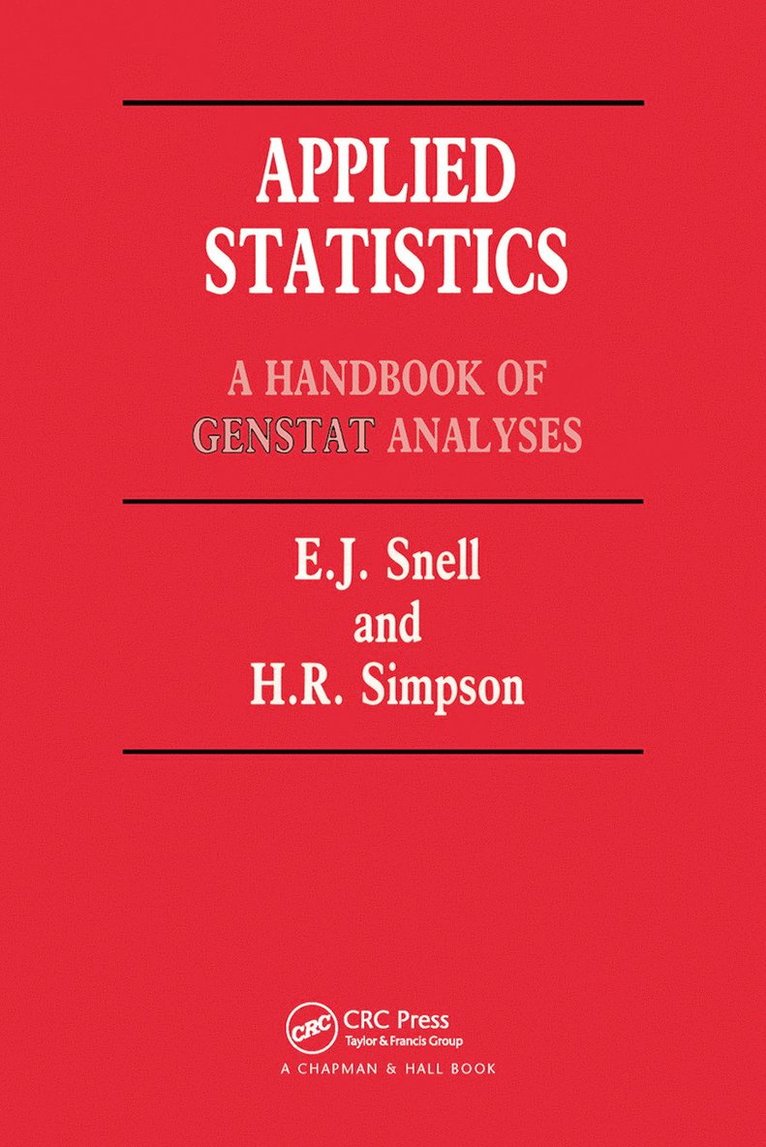
GENSTAT is a general purpose statistical computing system with a flexible command language operating on a variety of data structures. It may be used on a number of computer ranges, either interactively for exploratory data analysis, or in batch mode for standard data analysis.The great flexibility of GENSTAT is demonstrated in this handbook by analysing the wide range of examples discussed in Applied Statistics - Principles and Examples (Cox and Snell, 1981). GENSTAT programs are listed for each of the examples. Most of the data sets are small but often it is these seemingly small problems which involve the most tricky statistical and computational procedures. This handbook is self-contained although for a full description of the analysis and interpretation it should be used in parallel with Applied Statistics - Principles and Examples.
Inbunden, Engelska, 1989
2 934 kr
Skickas inom 10-15 vardagar
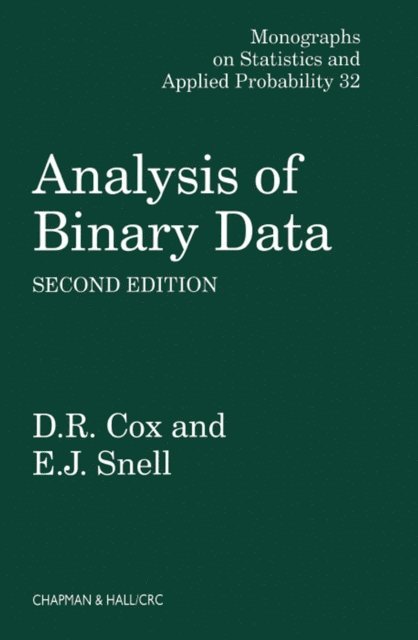
The first edition of this book (1970) set out a systematic basis for the analysis of binary data and in particular for the study of how the probability of 'success' depends on explanatory variables. The first edition has been widely used and the general level and style have been preserved in the second edition, which contains a substantial amount of new material. This amplifies matters dealt with only cryptically in the first edition and includes many more recent developments. In addition the whole material has been reorganized, in particular to put more emphasis on m.aximum likelihood methods.There are nearly 60 further results and exercises. The main points are illustrated by practical examples, many of them not in the first edition, and some general essential background material is set out in new Appendices.
Inbunden, Engelska, 1991
1 456 kr
Skickas inom 10-15 vardagar
GENSTAT is a general purpose statistical computing system with a flexible command language operating on a variety of data structures. It may be used on a number of computer ranges, either interactively for exploratory data analysis, or in batch mode for standard data analysis.The great flexibility of GENSTAT is demonstrated in this handbook by analysing the wide range of examples discussed in Applied Statistics - Principles and Examples (Cox and Snell, 1981). GENSTAT programs are listed for each of the examples. Most of the data sets are small but often it is these seemingly small problems which involve the most tricky statistical and computational procedures. This handbook is self-contained although for a full description of the analysis and interpretation it should be used in parallel with Applied Statistics - Principles and Examples.
E-bok
PDF, Engelska, 2021822 kr
Läs direkt efter köp
GENSTAT is a general purpose statistical computing system with a flexible command language operating on a variety of data structures. It may be used on a number of computer ranges, either interactively for exploratory data analysis, or in batch mode for standard data analysis.The great flexibility of GENSTAT is demonstrated in this handbook by analysing the wide range of examples discussed in Applied Statistics - Principles and Examples (Cox and Snell, 1981). GENSTAT programs are listed for each of the examples. Most of the data sets are small but often it is these seemingly small problems which involve the most tricky statistical and computational procedures. This handbook is self-contained although for a full description of the analysis and interpretation it should be used in parallel with Applied Statistics - Principles and Examples.
E-bok
Engelska, 2021824 kr
Läs direkt efter köp
GENSTAT is a general purpose statistical computing system with a flexible command language operating on a variety of data structures. It may be used on a number of computer ranges, either interactively for exploratory data analysis, or in batch mode for standard data analysis.The great flexibility of GENSTAT is demonstrated in this handbook by analysing the wide range of examples discussed in Applied Statistics - Principles and Examples (Cox and Snell, 1981). GENSTAT programs are listed for each of the examples. Most of the data sets are small but often it is these seemingly small problems which involve the most tricky statistical and computational procedures. This handbook is self-contained although for a full description of the analysis and interpretation it should be used in parallel with Applied Statistics - Principles and Examples.
E-bok
Engelska, 20183 245 kr
Läs direkt efter köp
The first edition of this book (1970) set out a systematic basis for the analysis of binary data and in particular for the study of how the probability of ''success'' depends on explanatory variables. The first edition has been widely used and the general level and style have been preserved in the second edition, which contains a substantial amount of new material. This amplifies matters dealt with only cryptically in the first edition and includes many more recent developments. In addition the whole material has been reorganized, in particular to put more emphasis on m.aximum likelihood methods.There are nearly 60 further results and exercises. The main points are illustrated by practical examples, many of them not in the first edition, and some general essential background material is set out in new Appendices.
E-bok
PDF, Engelska, 20183 236 kr
Läs direkt efter köp
The first edition of this book (1970) set out a systematic basis for the analysis of binary data and in particular for the study of how the probability of ''success'' depends on explanatory variables. The first edition has been widely used and the general level and style have been preserved in the second edition, which contains a substantial amount of new material. This amplifies matters dealt with only cryptically in the first edition and includes many more recent developments. In addition the whole material has been reorganized, in particular to put more emphasis on m.aximum likelihood methods.There are nearly 60 further results and exercises. The main points are illustrated by practical examples, many of them not in the first edition, and some general essential background material is set out in new Appendices.