E. Paul Goldenberg - Böcker
Visar alla böcker från författaren E. Paul Goldenberg. Handla med fri frakt och snabb leverans.
3 produkter
3 produkter
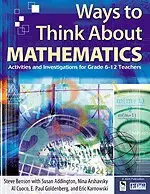
Ways to Think About Mathematics
Activities and Investigations for Grade 6-12 Teachers
Inbunden, Engelska, 2004
1 356 kr
Skickas inom 3-6 vardagar
Engaging in mathematical investigations yourself will help you be a better mathematics teacher! National, state, and local curriculum requirements and recommendations increasingly emphasize active student involvement in exploratory investigations. Teachers now face new demands when they field unexpected student discoveries, determine when some open-ended activity has played out its usefulness or is just on the verge of paying off in a major way, and judge which student-initiated directions are likely to lead to development of important mathematical ideas and which are dead ends. These pedagogical judgments depend heavily on deep mathematical knowledge. Ways to Think About Mathematics uses immersion experiences in algebra, geometry, and statistics to help mathematics teachers improve their knowledge and understanding of mathematical concepts. By experiencing open-ended problems, making and checking conjectures, and evaluating problem solving strategies, every math teacher can become better prepared to deal with day-to-day classroom decisions. Funded by the National Science Foundation and successfully field-tested in a wide variety of professional development and preservice settings, the materials in this book integrate mathematical thinking, effective teaching practices, and explicit connections to exemplary curricula. Because it is aligned with the principles and standards of the National Council of Teachers of Mathematics but is not fixed to any single curriculum, the materials in this book can be aligned with any state or district standards. Emphasizing all components of mathematical investigation, this accessible volume focuses on: Mathematical ways of thinking Discovering connections between mathematical ideas Posing and analyzing problems Making, modifying, testing, and proving conjectures Linking higher level mathematics to the content of grade 6-12 classrooms Ways to Think About Mathematics gives teachers the opportunity to grow as learners and teachers of mathematics by including problems for teachers to explore as well as selected "Problems for the Classroom" for the classes they teach.
Ways to Think About Mathematics
Activities and Investigations for Grade 6-12 Teachers
Häftad, Engelska, 2004
666 kr
Skickas inom 3-6 vardagar
Engaging in mathematical investigations yourself will help you be a better mathematics teacher! National, state, and local curriculum requirements and recommendations increasingly emphasize active student involvement in exploratory investigations. Teachers now face new demands when they field unexpected student discoveries, determine when some open-ended activity has played out its usefulness or is just on the verge of paying off in a major way, and judge which student-initiated directions are likely to lead to development of important mathematical ideas and which are dead ends. These pedagogical judgments depend heavily on deep mathematical knowledge. Ways to Think About Mathematics uses immersion experiences in algebra, geometry, and statistics to help mathematics teachers improve their knowledge and understanding of mathematical concepts. By experiencing open-ended problems, making and checking conjectures, and evaluating problem solving strategies, every math teacher can become better prepared to deal with day-to-day classroom decisions. Funded by the National Science Foundation and successfully field-tested in a wide variety of professional development and preservice settings, the materials in this book integrate mathematical thinking, effective teaching practices, and explicit connections to exemplary curricula. Because it is aligned with the principles and standards of the National Council of Teachers of Mathematics but is not fixed to any single curriculum, the materials in this book can be aligned with any state or district standards. Emphasizing all components of mathematical investigation, this accessible volume focuses on: Mathematical ways of thinking Discovering connections between mathematical ideas Posing and analyzing problems Making, modifying, testing, and proving conjectures Linking higher level mathematics to the content of grade 6-12 classrooms Ways to Think About Mathematics gives teachers the opportunity to grow as learners and teachers of mathematics by including problems for teachers to explore as well as selected "Problems for the Classroom" for the classes they teach.
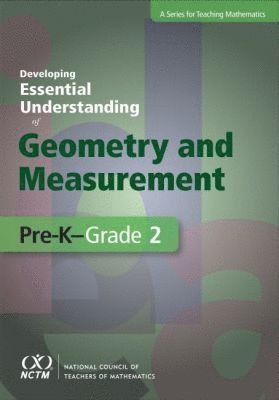
Developing Essential Understanding of Geometry and Measurement for Teaching Mathematics in Pre-K-Grade 2
Häftad, Engelska, 2014
211 kr
Skickas inom 7-10 vardagar
How can you build on young children’s interactions with the world to develop their geometric thinking? What can you say to a student who claims that a diamond isn’t a square because it “stands on a point”? How can knowing what does not change when shapes are transformed help you extend your students’ thinking about the area of geometric figures?How much do you know … and how much do you need to know?Helping your students develop a robust understanding of geometry and measurement requires that you understand this mathematics deeply. But what does that mean?This book focuses on essential knowledge for teachers about geometry and measurement. It is organized around four big ideas, supported by multiple smaller, interconnected ideas—essential understandings.Taking you beyond a simple introduction to geometry and measurement, the book will broaden and deepen your mathematical understanding of one of the most challenging topics for students—and teachers. It will help you engage your students, anticipate their perplexities, avoid pitfalls, and dispel misconceptions. You will also learn to develop appropriate tasks, techniques, and tools for assessing students’ understanding of the topic.About the Series: Focus on the ideas that you need to understand thoroughly to teach confidently. Move beyond the mathematics you expect your students to learn. Students who fail to get a solid grounding in pivotal concepts struggle in subsequent work in mathematics and related disciplines. By bringing a deeper understanding to your teaching, you can help students who don’t get it the first time by presenting the mathematics in multiple ways.The Essential Understanding Series addresses topics in school mathematics that are critical to the mathematical development of students but are often difficult to teach. Each book in the series gives an overview of the topic, highlights the differences between what teachers and students need to know, examines the big ideas and related essential understandings, reconsiders the ideas presented in light of connections with other mathematical ideas, and includes questions for readers’ reflection.