Ed Seidewitz – författare
Visar alla böcker från författaren . Handla med fri frakt och snabb leverans.
2 produkter
2 produkter
Del 11 - SIGS: Advances in Object Technology
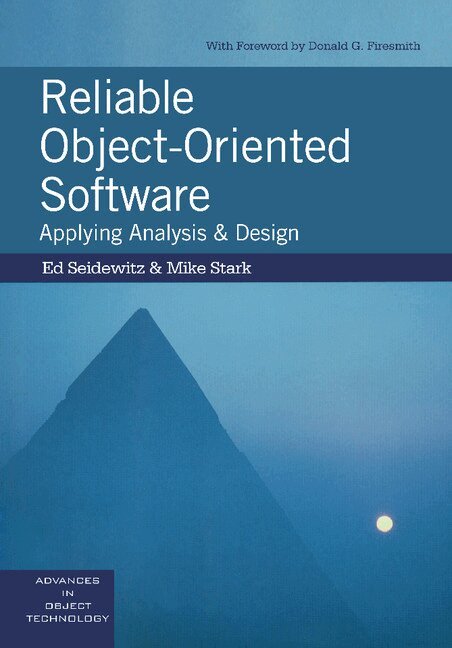
Reliable Object-Oriented Software
Applying Analysis and Design
Häftad, Engelska, 1997
934 kr
Skickas inom 7-10 vardagar
Reliable Object-Oriented Software presents the underlying principles associated with object-orientation and its practical application. More than just another text on methodology, this 1998 book focuses on the fundamental concepts related to the process of software development and architectural design in order to lay the basis necessary for the development of robust, maintainable, and evolvable software. The authors present both formal concepts and practical applications. It includes proven problem-solving techniques designed to develop readers' engineering judgement and to focus their attention on the principles of good software design and its successful application. In addition, an extensive bibliography has been compiled to guide the reader in further studies and to crystallize what is commonly accepted in the field and what is still controversial.
Häftad, Engelska, 2027
1 021 kr
Kommande
Whether you have previous experience modeling with SysML v1 or are new to modeling with SysML, Modeling Systems with SysML v2: The Systems Modeling Language provides the understanding and guidance to help you gain a basic level of competency in SysML v2, prepare for SysML v2 certification, and advance your modeling skills over time. SysML v2 is the next generation systems modeling language that can be used to model complex systems that span a wide range of application domains. It provides the ability to specify requirements, behavior, structure, analysis, and verification of interacting systems and their components while maintaining traceability across the system model. SysML v2 enhances the precision, expressiveness, consistency, usability, extensibility and interoperability of systems modeling. It provides both graphical and textual notations that facilitates stakeholder understanding and enables modern practices with agile workflows. SysML also includes an application programming interface (API) that facilitates interoperability across digital engineering tools and models. The formal semantic and syntactic foundation for SysML v2 enables technologies such as artificial intelligence (AI) with large language models (LLM) to interact with the SysML model. The combination of SysML v2's textual notation and standard API, along with a formal foundation and consistent usage patterns, facilitate automation to support model validation, workflow enhancements, and integration with other models and tools. This book provides a comprehensive and practical guide for modeling systems with SysML v2. With their unique perspective as leading contributors to the language, Friedenthal and Seidewitz provide a full description of the language along with a quick reference guide and practical examples to help you use SysML v2. The book begins with guidance on the most commonly used features to help you get started quickly, explaining the benefits of a model-based approach and providing an overview of the language and how to apply SysML v2 to model systems. The authors include a comprehensive description of SysML v2 that provides a detailed understanding that can serve as a foundation for modeling with SysML v2, and as a reference for practitioners. The book includes methods for applying model-based systems engineering using SysML v2 to specify and design systems, and how these methods can help manage complexity.