Eero Hyvonen – författare
Visar alla böcker från författaren Eero Hyvonen. Handla med fri frakt och snabb leverans.
7 produkter
7 produkter
Häftad, Engelska, 2012
362 kr
Skickas inom 10-15 vardagar
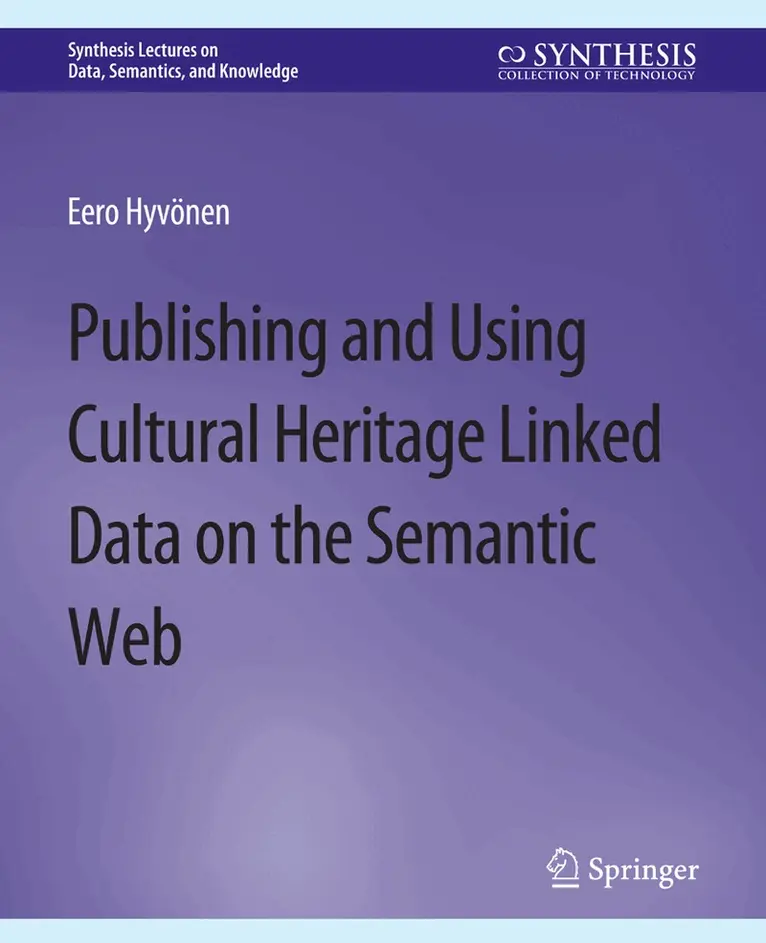
Cultural Heritage (CH) data is syntactically and semantically heterogeneous, multilingual, semantically rich, and highly interlinked. It is produced in a distributed, open fashion by museums, libraries, archives, and media organizations, as well as individual persons. Managing publication of such richness and variety of content on the Web, and at the same time supporting distributed, interoperable content creation processes, poses challenges where traditional publication approaches need to be re-thought. Application of the principles and technologies of Linked Data and the Semantic Web is a new, promising approach to address these problems. This development is leading to the creation of large national and international CH portals, such as Europeana, to large open data repositories, such as the Linked Open Data Cloud, and massive publications of linked library data in the U.S., Europe, and Asia. Cultural Heritage has become one of the most successful application domains of Linked Data and Semantic Web technologies.This book gives an overview on why, when, and how Linked (Open) Data and Semantic Web technologies can be employed in practice in publishing CH collections and other content on the Web. The text first motivates and presents a general semantic portal model and publishing framework as a solution approach to distributed semantic content creation, based on an ontology infrastructure. On the Semantic Web, such an infrastructure includes shared metadata models, ontologies, and logical reasoning, and is supported by shared ontology and other Web services alleviating the use of the new technology and linked data in legacy cataloging systems. The goal of all this is to provide layman users and researchers with new, more intelligent and usable Web applications that can be utilized by other Web applications, too, via well-defined Application Programming Interfaces (API). At the same time, it is possible to provide publishing organizations with more cost-efficient solutions for content creation and publication.This book is targeted to computer scientists, museum curators, librarians, archivists, and other CH professionals interested in Linked Data and CH applications on the Semantic Web. The text is focused on practice and applications, making it suitable to students, researchers, and practitioners developing Web services and applications of CH, as well as to CH managers willing to understand the technical issues and challenges involved in linked data publication.Table of Contents: Cultural Heritage on the Semantic Web / Portal Model for Collaborative CH Publishing / Requirements for Publishing Linked Data / Metadata Schemas / Domain Vocabularies and Ontologies / Logic Rules for Cultural Heritage / Cultural Content Creation / Semantic Services for Human and Machine Users / Conclusions
E-bok
PDF, Engelska, 2022443 kr
Läs direkt efter köp
Cultural Heritage (CH) data is syntactically and semantically heterogeneous, multilingual, semantically rich, and highly interlinked. It is produced in a distributed, open fashion by museums, libraries, archives, and media organizations, as well as individual persons. Managing publication of such richness and variety of content on the Web, and at the same time supporting distributed, interoperable content creation processes, poses challenges where traditional publication approaches need to be re-thought. Application of the principles and technologies of Linked Data and the Semantic Web is a new, promising approach to address these problems. This development is leading to the creation of large national and international CH portals, such as Europeana, to large open data repositories, such as the Linked Open Data Cloud, and massive publications of linked library data in the U.S., Europe, and Asia. Cultural Heritage has become one of the most successful application domains of Linked Data and Semantic Web technologies.This book gives an overview on why, when, and how Linked (Open) Data and Semantic Web technologies can be employed in practice in publishing CH collections and other content on the Web. The text first motivates and presents a general semantic portal model and publishing framework as a solution approach to distributed semantic content creation, based on an ontology infrastructure. On the Semantic Web, such an infrastructure includes shared metadata models, ontologies, and logical reasoning, and is supported by shared ontology and other Web services alleviating the use of the new technology and linked data in legacy cataloging systems. The goal of all this is to provide layman users and researchers with new, more intelligent and usable Web applications that can be utilized by other Web applications, too, via well-defined Application Programming Interfaces (API). At the same time, it is possible to provide publishing organizations with more cost-efficient solutions for content creation and publication.This book is targeted to computer scientists, museum curators, librarians, archivists, and other CH professionals interested in Linked Data and CH applications on the Semantic Web. The text is focused on practice and applications, making it suitable to students, researchers, and practitioners developing Web services and applications of CH, as well as to CH managers willing to understand the technical issues and challenges involved in linked data publication.Table of Contents: Cultural Heritage on the Semantic Web / Portal Model for Collaborative CH Publishing / Requirements for Publishing Linked Data / Metadata Schemas / Domain Vocabularies and Ontologies / Logic Rules for Cultural Heritage / Cultural Content Creation / Semantic Services for Human and Machine Users / Conclusions
E-bok
PDF, Engelska, 2014734 kr
Läs direkt efter köp
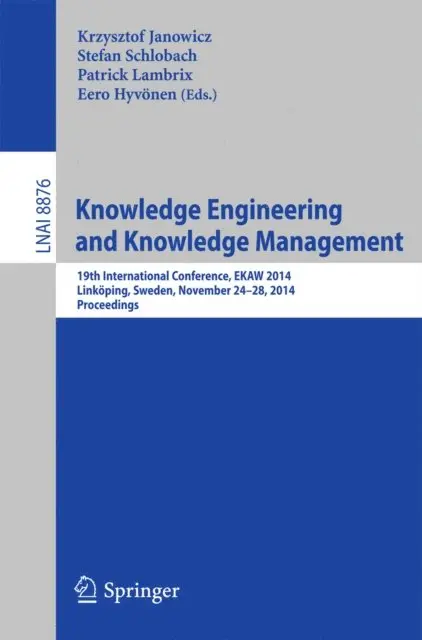
This book constitutes the refereed proceedings of the 19th International Conference on Knowledge Engineering and Knowledge Management, EKAW 2014, held in Linköping, Sweden, in November 2014. The 24 full papers and 21 short papers presented were carefully reviewed and selected from 138 submissions. The papers cover all aspects of eliciting, acquiring, modeling, and managing knowledge, the construction of knowledge-intensive systems and services for the Semantic Web, knowledge management, e-business, natural language processing, intelligent information integration, personal digital assistance systems, and a variety of other related topics.
E-bok
PDF, Engelska, 2015734 kr
Läs direkt efter köp
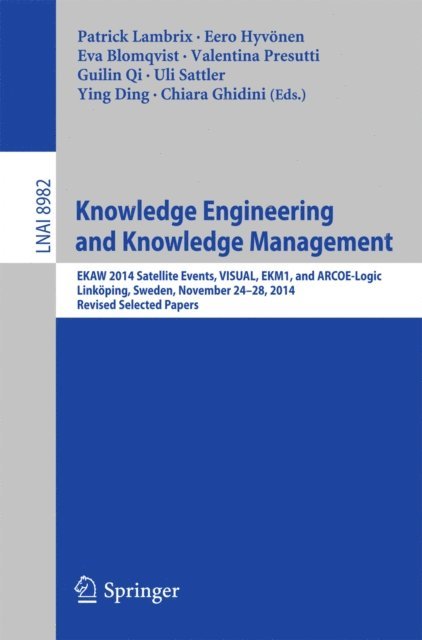
This book constitutes the refereed proceedings of Satellite Events held at the 19th International Conference on Knowledge Engineering and Knowledge Management, EKAW 2014 in November 2014. EKAW 2014 hosted three satellite workshops: VISUAL 2014, International Workshop on Visualizations and User Interfaces for Knowledge Engineering and Linked Data Analytics, EKM1, the First International Workshop on Educational Knowledge Management and ARCOE-Logic 2014, the 6th International Workshop on Acquisition, Representation and Reasoning about Context with Logic. This volume also contains the accepted contributions for the EKAW 2014 tutorials, demo and poster sessions.
E-bok
PDF, Engelska, 20091 459 kr
Läs direkt efter köp
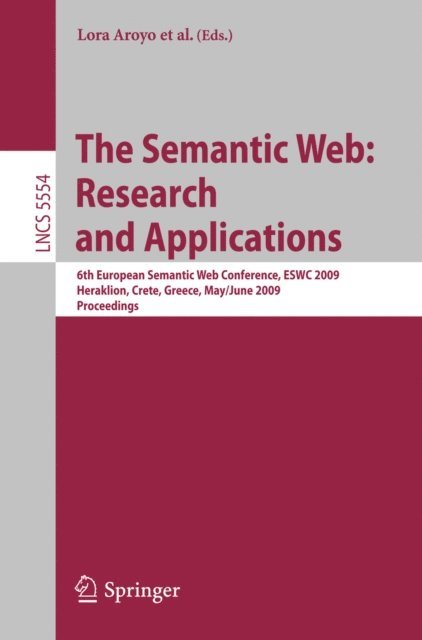
This volume contains papers from the technical program of the 6th European Semantic Web Conference (ESWC 2009), held from May 31 to June 4, 2009, in Heraklion, Greece. ESWC 2009 presented the latest results in research and applications of Semantic Web technologies. In addition to the technical research track, ESWC 2009 featured a tutorial program, a PhD symposium, a system demo track, a poster track, a number of collocated workshops, and for the ?rst time in the series a Semantic Web in-use track exploring the bene?ts of applying Semantic Web technology in real-life applications and contexts. Thetechnical researchpaper trackreceivedover250submissions.The review process was organized using a two-tiered system, where each submission was reviewed by at least three members of the Program Committee. Vice Program CommitteeChairsorganizedadiscussionbetweenreviewers,collectedadditional reviews when necessary and provided a metareview for each submission. During a physical Program Committee meeting, the Vice Program Committee Chairs together with the Program Chairs selected 45 research papers to be presented at the conference.
E-bok
PDF, Engelska, 2010734 kr
Läs direkt efter köp
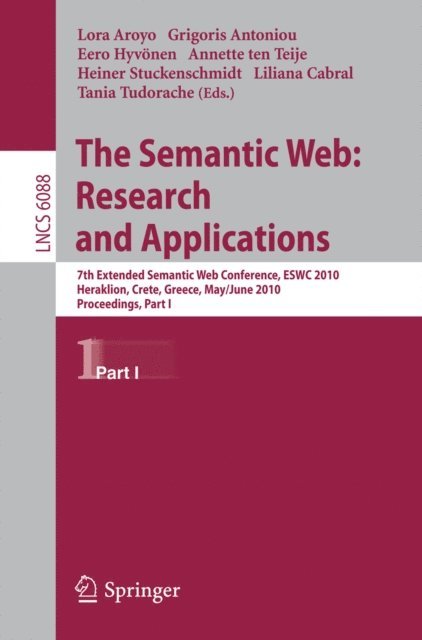
This volume contains papers from the technical program of the 7th Extended Semantic Web Conference (ESWC 2010), held from May 30 to June 3, 2010, in Heraklion, Greece. ESWC 2010 presented the latest results in research and applications of Semantic Web technologies. ESWC 2010 built on the success of the former European Semantic Web Conference series, but sought to extend its focus by engaging with other communities within and outside Information and Communication Technologies, in which semantics can play an important role. At the same time, ESWC has become a truly international conference. Semantics of Web content, enriched with domain theories (ontologies), data about Web usage, natural language processing, etc., will enable a Web that p- vides a qualitatively new level of functionality. It will weave together a large network of human knowledge and make this knowledge machine-processable. Various automated services, based on reasoning with metadata and ontologies, will help the users to achieve their goals by accessing and processing infor- tion in machine-understandable form. This network of knowledge systems will ultimately lead to truly intelligent systems, which will be employed for va- ous complex decision-making tasks. Research about Web semantics can bene?t from ideas and cross-fertilization with many other areas: arti?cial intelligence, natural language processing, database and information systems, information - trieval, multimedia, distributed systems, social networks, Web engineering, and Web science.
E-bok
PDF, Engelska, 20101 459 kr
Läs direkt efter köp
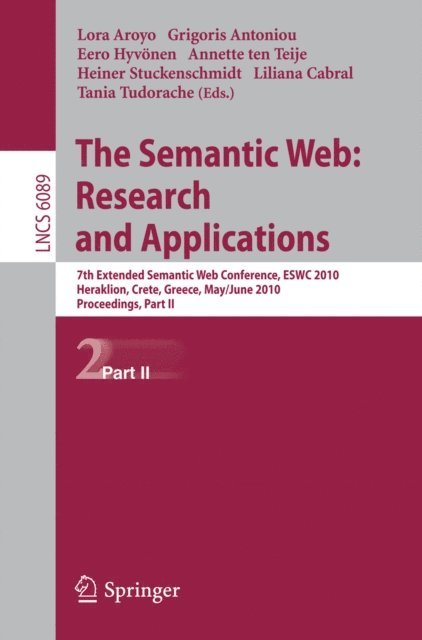
This volume contains papers from the technical program of the 7th Extended Semantic Web Conference (ESWC 2010), held from May 30 to June 3, 2010, in Heraklion, Greece. ESWC 2010 presented the latest results in research and applications of Semantic Web technologies. ESWC 2010 built on the success of the former European Semantic Web Conference series, but sought to extend its focus by engaging with other communities within and outside Information and Communication Technologies, in which semantics can play an important role. At the same time, ESWC has become a truly international conference. Semantics of Web content, enriched with domain theories (ontologies), data about Web usage, natural language processing, etc., will enable a Web that p- vides a qualitatively new level of functionality. It will weave together a large network of human knowledge and make this knowledge machine-processable. Various automated services, based on reasoning with metadata and ontologies, will help the users to achieve their goals by accessing and processing infor- tion in machine-understandable form. This network of knowledge systems will ultimately lead to truly intelligent systems, which will be employed for va- ous complex decision-making tasks. Research about Web semantics can bene?t from ideas and cross-fertilization with many other areas: arti?cial intelligence, natural language processing, database and information systems, information - trieval, multimedia, distributed systems, social networks, Web engineering, and Web science.