Eitan Grossman - Böcker
Visar alla böcker från författaren Eitan Grossman. Handla med fri frakt och snabb leverans.
4 produkter
4 produkter
Scribal Repertoires in Egypt from the New Kingdom to the Early Islamic Period
Inbunden, Engelska, 2017
2 346 kr
Skickas inom 7-10 vardagar
Scribal Repertoires in Egypt from the New Kingdom to the Early Islamic Period deals with the possibility of glimpsing pre-modern and early modern Egyptian scribes, the actual people who produced ancient documents, through the ways in which they organized and wrote those documents. While traditional research has focused on identifying a 'pure' or 'original' text behind the actual manuscripts that have come down to us from pre-modern Egypt, the volume looks instead at variation - different ways of saying the same thing - as a rich source for understanding the complex social and cultural environments in which scribes lived and worked, breaking with the traditional conception of variation in scribal texts as 'free' or indicative of 'corruption'. As such, it presents a novel reconceptualization of scribal variation in pre-modern Egypt from the point of view of contemporary historical sociolinguistics, seeing scribes as agents embedded in particular geographical, temporal, and socio-cultural environments. Introducing to Egyptology concepts such as scribal communities, networks, and repertoires, among others, the authors then apply them to a variety of phenomena, including features of lexicon, grammar, orthography, palaeography, layout, and format. After first presenting this conceptual framework, they demonstrate how it has been applied to better-studied pre-modern societies by drawing upon the well-established domain of scribal variation in pre-modern English, before proceeding to a series of case studies applying these concepts to scribal variation spanning thousands of years, from the languages and writing systems of Pharaonic times, to those of Late Antique and Islamic Egypt.
1 625 kr
Skickas inom 10-15 vardagar
This book offers a comprehensive exploration of recent advances in empirical, theoretical, and experimental research on language change, with a focus on semantic evolution. Bridging the gap between historical linguistics, rooted in philology, and formal semantics, grounded in mathematical logic, it uncovers how insights from one discipline can illuminate the other. Delving into a wide range of linguistic phenomena, and tracking both entailed and presupposed content in historical change, the book examines semantic topics such as causation, concession, negation, reflexivity, numerals, and approximatives, alongside topics related to temporal and aspectual features of language. It also explores pragmatic concepts like topic marking and mirativity. Some papers in the volume focus on morphological and syntactic language change, discussing the rate of morphological change, patterns of subordination, periphrastic structure, and Differential Object Marking. By presenting innovative methodologies, including experimental work, the book reveals key mechanisms behind language change and its interaction with formal and non-formal factors. Designed for researchers and advanced students in linguistics and philology, this volume addresses fundamental questions about the causes, timing, and principles driving linguistic change. It also sheds light on how historical insights can deepen our understanding of synchronic phenomena, offering a fresh perspective on the dynamics of language evolution.
1 833 kr
Skickas inom 7-10 vardagar
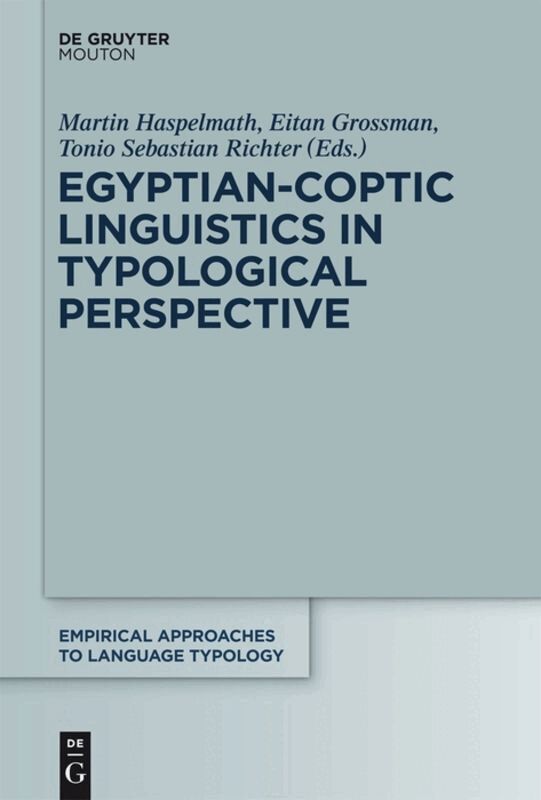
This volume presents the Egyptian-Coptic language in cross-linguistic (‘typological’) perspective. It is aimed at linguists of all stripes, especially typologists, historical linguists, and specialists in Egyptian-Coptic, Afroasiatic languages, or African languages. Uniquely, the contributions are written by both typologists and experts of Egyptian-Coptic and typologists. The former provide case studies dealing with particular aspects of the various phases of the Egyptian-Coptic language (e.g., COLLIER on conditional constructions), while the latter situate Egyptian-Coptic data in cross-linguistic perspective (e.g., those by GUELDEMANN and GENSLER). The volume also includes an introductory section that includes an overview of the Egyptian-Coptic language (HASPELMATH), a sketch of its sociohistorical setting (GROSSMAN & RICHTER), its relationship with language typology (RICHTER), and the way in which Egyptian-Coptic data should be presented to nonspecialists, focusing on transliteration and glossing (GROSSMAN & HASPELMATH).This is the first book to bring together language typology and the Egyptian-Coptic language in an explicit fashion.
373 kr
Skickas inom 3-6 vardagar
This volume presents the Egyptian-Coptic language in cross-linguistic (‘typological’) perspective. It is aimed at linguists of all stripes, especially typologists, historical linguists, and specialists in Egyptian-Coptic, Afroasiatic languages, or African languages. Uniquely, the contributions are written by both typologists and experts of Egyptian-Coptic and typologists. The former provide case studies dealing with particular aspects of the various phases of the Egyptian-Coptic language (e.g., COLLIER on conditional constructions), while the latter situate Egyptian-Coptic data in cross-linguistic perspective (e.g., those by GUELDEMANN and GENSLER). The volume also includes an introductory section that includes an overview of the Egyptian-Coptic language (HASPELMATH), a sketch of its sociohistorical setting (GROSSMAN & RICHTER), its relationship with language typology (RICHTER), and the way in which Egyptian-Coptic data should be presented to nonspecialists, focusing on transliteration and glossing (GROSSMAN & HASPELMATH).This is the first book to bring together language typology and the Egyptian-Coptic language in an explicit fashion.