E.J. Milner-Gulland - Böcker
Visar alla böcker från författaren E.J. Milner-Gulland. Handla med fri frakt och snabb leverans.
4 produkter
4 produkter
904 kr
Skickas inom 5-8 vardagar
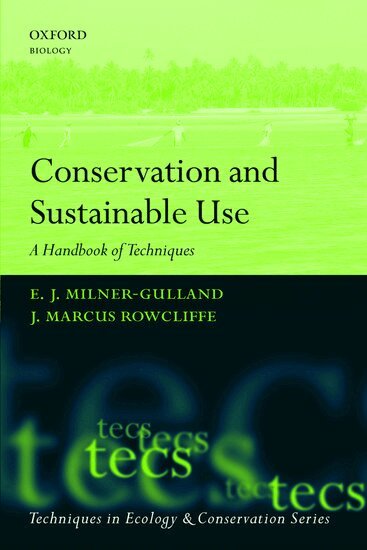
The relentless exploitation and unsustainable use of wildlife, whether for food, medicine or other uses, is a key concern for conservationists worldwide. Indeed, wildlife conservation and sustainable use have recently become centrepieces in conservation and development research. Assessment, interpretation and ultimate action in a scientific study of exploited species must consider numerous factors: from the biology, habitat requirements and population dynamics of the species in question to the relationships that people have with their environment and the species within it. Any long-term management plan must ensure that people and wildlife can coexist - otherwise it is doomed to failure.Conservation and Sustainable Use provides a practical and integrated approach to carrying out research on the conservation of exploited species. It is relevant to both tropical and temperate biomes and is applicable to all exploited species, including mammals, fish and plants. It describes both the practical (field) and theoretical (modelling) techniques for obtaining and interpreting information, integrating biological, social, economic and institutional analyses. It also demonstrates how to translate information into effective action through appropriate interventions, from legislation to changing people's attitudes. This is the first time that all these issues have been covered together in a single, practically-orientated volume.This book will be essential reading for graduate level students and researchers in conservation biology, human ecology, sociology and resource economics. It will also provide an important reference for anyone who is interested in carrying out a scientifically-based conservation programme for an exploited species, including field biologists, wildlife managers and practitioners in the fields of conservation and international development.
1 888 kr
Skickas inom 5-8 vardagar
The relentless exploitation and unsustainable use of wildlife, whether for food, medicine or other uses, is a key concern for conservationists worldwide. Indeed, wildlife conservation and sustainable use have recently become centrepieces in conservation and development research. Assessment, interpretation and ultimate action in a scientific study of exploited species must consider numerous factors: from the biology, habitat requirements and population dynamics of the species in question to the relationships that people have with their environment and the species within it. Any long-term management plan must ensure that people and wildlife can coexist - otherwise it is doomed to failure.Conservation and Sustainable Use provides a practical and integrated approach to carrying out research on the conservation of exploited species. It is relevant to both tropical and temperate biomes and is applicable to all exploited species, including mammals, fish and plants. It describes both the practical (field) and theoretical (modelling) techniques for obtaining and interpreting information, integrating biological, social, economic and institutional analyses. It also demonstrates how to translate information into effective action through appropriate interventions, from legislation to changing people's attitudes. This is the first time that all these issues have been covered together in a single, practically-orientated volume.This book will be essential reading for graduate level students and researchers in conservation biology, human ecology, sociology and resource economics. It will also provide an important reference for anyone who is interested in carrying out a scientifically-based conservation programme for an exploited species, including field biologists, wildlife managers and practitioners in the fields of conservation and international development.
2 369 kr
Skickas inom 7-10 vardagar
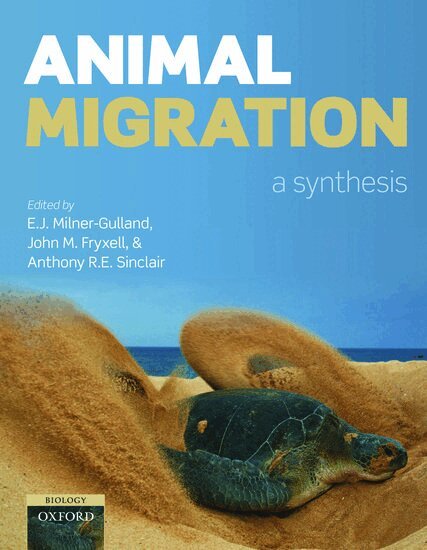
Despite the wealth of natural historical research conducted on migration over decades, there is still a dearth of hypothesis-driven studies that fully integrate theory and empirical analyses to understand the causes and consequences of migration, and a taxonomic bias towards birds in much migration research. This book takes a comparative, integrated view of animal migration, linking evolution with ecology and management, theory with empirical research, and embracing all the major migratory taxa (including human pastoralists). The scope extends beyond the target organism to consider the ecosystem-level dynamics of migration. The emphasis is on exciting new research avenues that are now opening up, whether due to advances in our understanding of migration as a biological phenomenon or through the availability of a range of new technologies. Broad themes that emerge include integrating migration into the broad spectrum of movement behaviour, the need for a comparative and cross-taxonomic approach that considers migration at a range of temporal and spatial scales, and examination of the key roles of resource uncertainty and spatial heterogeneity in driving migratory behaviour. The book identifies the potential for new tools to revolutionise the study of migration, including satellite-tracking technology, genomics, and modelling - all of which are linked to increasing computing power. We are now on the verge of a breakthrough in migration research, which is crucial given the multiple threats that face the conservation of migration as a phenomenon, including climate change.
1 027 kr
Skickas inom 7-10 vardagar
Despite the wealth of natural historical research conducted on migration over decades, there is still a dearth of hypothesis-driven studies that fully integrate theory and empirical analyses to understand the causes and consequences of migration, and a taxonomic bias towards birds in much migration research. This book takes a comparative, integrated view of animal migration, linking evolution with ecology and management, theory with empirical research, and embracing all the major migratory taxa (including human pastoralists). The scope extends beyond the target organism to consider the ecosystem-level dynamics of migration. The emphasis is on exciting new research avenues that are now opening up, whether due to advances in our understanding of migration as a biological phenomenon or through the availability of a range of new technologies. Broad themes that emerge include integrating migration into the broad spectrum of movement behaviour, the need for a comparative and cross-taxonomic approach that considers migration at a range of temporal and spatial scales, and examination of the key roles of resource uncertainty and spatial heterogeneity in driving migratory behaviour. The book identifies the potential for new tools to revolutionise the study of migration, including satellite-tracking technology, genomics, and modelling - all of which are linked to increasing computing power. We are now on the verge of a breakthrough in migration research, which is crucial given the multiple threats that face the conservation of migration as a phenomenon, including climate change.