Eliano Pessa - Böcker
Visar alla böcker från författaren Eliano Pessa. Handla med fri frakt och snabb leverans.
15 produkter
15 produkter
1 625 kr
Skickas inom 10-15 vardagar
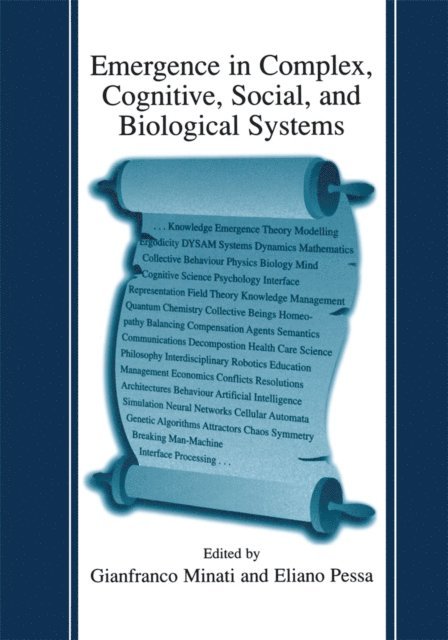
The systems movement is made up of many systems societies as well as of disciplinary researchers and researches, explicitly or implicitly focusing on the subject of systemics, officially introduced in the scientific community fifty years ago. Many researches in different fields have been and continue to be sources of new ideas and challenges for the systems community. To this regard, a very important topic is the one of EMERGENCE. Between the goals for the actual and future systems scientists there is certainly the definition of a general theory of emergence and the building of a general model of it. The goal of this book, is to recall to the systems community an important challenge to be dealt with in the immediate future: the study and characterization of general features of what is commonly qualified as 'emergence', chiefly in complex systems such as biological and cognitive ones. Such a topic was a fundamental one at the very beginning of the systemic movement, and to it the founding fathers, such as Von Bertalanffy, Ashby and Von Foerster, devoted most efforts.In more recent times, however, the interests shifted towards an empirical study of systemic properties characterizing human organizations, and the subject of emergence was partly abandoned. Notwithstanding, the understanding of what is emergence, and of the circumstances which allow for its occurrence within a complex system, is of crucial importance for systemics. Namely all systemic properties -- the ones which allow a system to behave as a whole and not as an aggregate of constituents -- are just emergent properties.
2 101 kr
Skickas inom 10-15 vardagar
Systemics of Emergence: Research and Development is a volume devoted to exploring the core theoretical and disciplinary research problems of emergence processes from which systems are established. It focuses on emergence as the key point of any systemic process. This topic is dealt with within different disciplinary approaches, indicated by the organization in sections: 1) Applications; 2) Biology and human care; 3) Cognitive Science; 4) Emergence; 5) General Systems; 6) Learning; 7) Management; 8) Social Systems; 9) Systemic Approach and Information Science; 10) Theoretical issues in Systemics.The Editors and contributing authors have produced this volume to help, encourage and widen the work in this area of General Systems Research.
1 578 kr
Skickas inom 10-15 vardagar
Microscopic models 226 The intrinsic limitations of the theory of phase transitions 229 5. 3 Quantum Field Theory 230 5. 4 Spontaneous Symmetry Breaking 239 5. 5 Non-ideal models of emergence 249 5. 5. 1 Neural networks 250 5. 5. 2 Cellular Automata 261 5. 5. 3 Artificial Life 265 5. 6 The role of noise 273 5. 7 The relationships between traditional and non-traditional models 279 Chapter 6. The Role of Ergodicity 291 6. 1 Some definitions related to ergodicity 293 6. 1. 1 Ergodic 293 6. 1. 2 Disciplinary definitions 293 6. 2 Ergodicity and stationarity 300 6. 3 Ergodicity in Collective Beings 302 6. 4 Emergence, Collective Beings, and Ergodicity 306 6. 5 Further considerations 309 6. 6 Some remarks and possible lines of research 313 Chapter 7. Applications to Social Systems (1): growth, development, sustainable development and ethics 321 7. 1 Growth, Development and Sustainable Development 323 7. 1. 1 Representing Growth 324 7. 1. 2 Development 326 7. 1. 3 Managing for development 334 7. 2 Ethics 336 7. 2. 1 Ethics and Quality 340 7. 2. 2 Effectiveness and advantages of Ethics 342 7. 2. 3 Ethics for quality and effectiveness 343 7. 2. 4 Ethics and Globalization 346 viii Contents Chapter 8. Applications to Social Systems (2): systems archetypes, virtual systems, knowledge management, organizational learning, industrial districts 353 8. 1 Systems archetypes and collective beings 353 8. 2 Virtual systems 359 8. 2.
2 101 kr
Skickas inom 10-15 vardagar
Systemics of Emergence: Research and Development is a volume devoted to exploring the core theoretical and disciplinary research problems of emergence processes from which systems are established.
1 170 kr
Skickas inom 10-15 vardagar
Microscopic models 226 The intrinsic limitations of the theory of phase transitions 229 5. 3 Quantum Field Theory 230 5. 4 Spontaneous Symmetry Breaking 239 5. 5 Non-ideal models of emergence 249 5. 5. 1 Neural networks 250 5. 5. 2 Cellular Automata 261 5. 5. 3 Artificial Life 265 5. 6 The role of noise 273 5. 7 The relationships between traditional and non-traditional models 279 Chapter 6. The Role of Ergodicity 291 6. 1 Some definitions related to ergodicity 293 6. 1. 1 Ergodic 293 6. 1. 2 Disciplinary definitions 293 6. 2 Ergodicity and stationarity 300 6. 3 Ergodicity in Collective Beings 302 6. 4 Emergence, Collective Beings, and Ergodicity 306 6. 5 Further considerations 309 6. 6 Some remarks and possible lines of research 313 Chapter 7. Applications to Social Systems (1): growth, development, sustainable development and ethics 321 7. 1 Growth, Development and Sustainable Development 323 7. 1. 1 Representing Growth 324 7. 1. 2 Development 326 7. 1. 3 Managing for development 334 7. 2 Ethics 336 7. 2. 1 Ethics and Quality 340 7. 2. 2 Effectiveness and advantages of Ethics 342 7. 2. 3 Ethics for quality and effectiveness 343 7. 2. 4 Ethics and Globalization 346 viii Contents Chapter 8. Applications to Social Systems (2): systems archetypes, virtual systems, knowledge management, organizational learning, industrial districts 353 8. 1 Systems archetypes and collective beings 353 8. 2 Virtual systems 359 8. 2.
1 578 kr
Skickas inom 10-15 vardagar
The systems movement is made up of many systems societies as well as of disciplinary researchers and researches, explicitly or implicitly focusing on the subject of systemics, officially introduced in the scientific community fifty years ago. Many researches in different fields have been and continue to be sources of new ideas and challenges for the systems community. To this regard, a very important topic is the one of EMERGENCE. Between the goals for the actual and future systems scientists there is certainly the definition of a general theory of emergence and the building of a general model of it. The Italian Systems Society, Associazione Italiana per la Ricerca sui Sistemi (AIRS), decided to devote its Second National Conference to this subject. Because AIRS is organized under the form of a network of researchers, institutions, scholars, professionals, and teachers, its research activity has an impact at different levels and in different ways. Thus the topic of emergence was not only the focus of this conference but it is actually the main subject of many AIRS activities.
Relational Methodologies and Epistemology in Economics and Management Sciences
Inbunden, Engelska, 2016
2 493 kr
Skickas inom 5-8 vardagar
1 064 kr
Skickas inom 10-15 vardagar
This book outlines a possible future theoretical perspective for systemics, its conceptual morphology and landscape while the Good-Old-Fashioned-Systemics (GOFS) era is still under way. The change from GOFS to future systemics can be represented, as shown in the book title, by the conceptual change from Collective Beings to Quasi-systems. With the current advancements, problems and approaches occurring in contemporary science, systemics are moving beyond the traditional frameworks used in the past. From Collective Beings to Coherent Quasi-Systems outlines a conceptual morphology and landscape for a new theoretical perspective for systemics introducing the concept of Quasi-systems. Advances in domains such as theoretical physics, philosophy of science, cell biology, neuroscience, experimental economics, network science and many others offer new concepts and technical tools to support the creation of a fully transdisciplinary General Theory of Change. This circumstance requires adeep reformulation of systemics, without forgetting the achievements of established conventions. The book is divided into two parts. Part I, examines classic systemic issues from new theoretical perspectives and approaches. A new general unified framework is introduced to help deal with topics such as dynamic structural coherence and Quasi-systems. This new theoretical framework is compared and contrasted with the traditional approaches. Part II focuses on the process of translation into social culture of the theoretical principles, models and approaches introduced in Part I. This translation is urgent in post-industrial societies where emergent processes and problems are still dealt with by using the classical or non-systemic knowledge of the industrial phase.
1 064 kr
Skickas inom 10-15 vardagar
This book outlines a possible future theoretical perspective for systemics, its conceptual morphology and landscape while the Good-Old-Fashioned-Systemics (GOFS) era is still under way.
1 096 kr
Skickas inom 10-15 vardagar
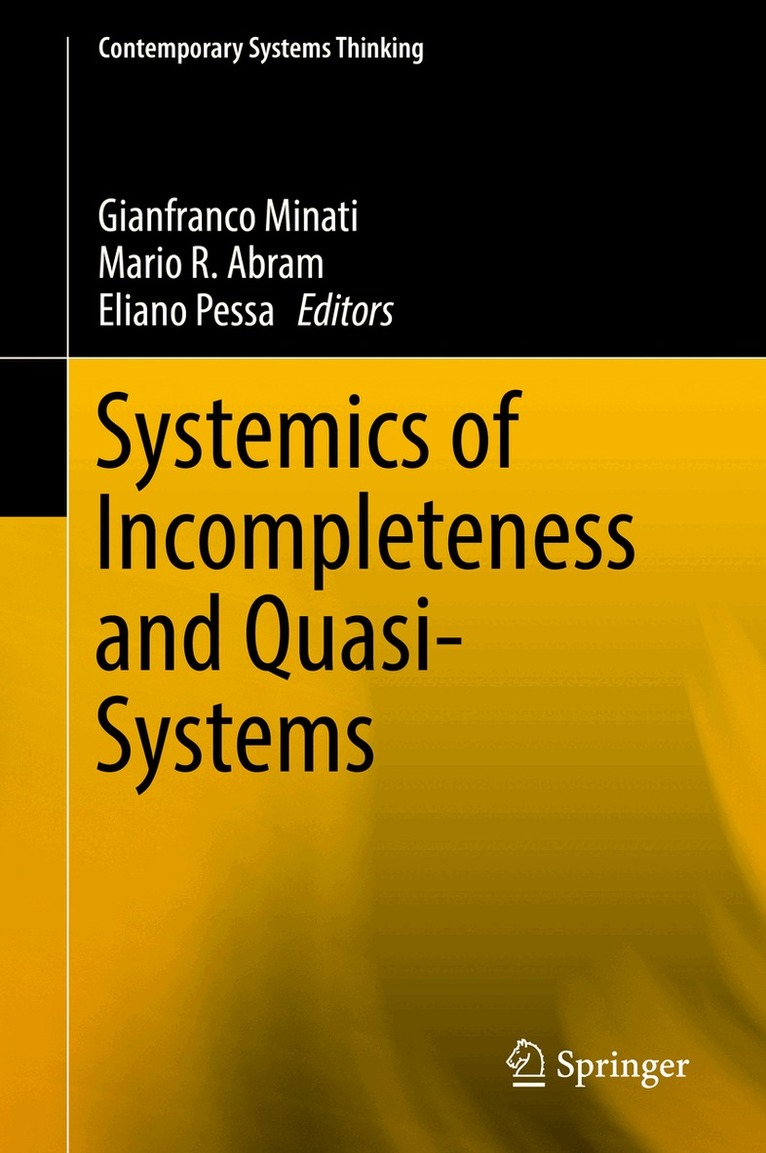
This book contains the proceedings of the Seventh National Conference of the Italian Systems Society. The title, Systemics of Incompleteness and Quasi-Systems, aims to underline the need for Systemics and Systems Science to deal with the concepts of incompleteness and quasiness. Classical models of Systemics are intended to represent comprehensive aspects of phenomena and processes. They consider the phenomena in their temporal and spatial completeness. In these cases, possible incompleteness in the modelling is assumed to have a provisional or practical nature, which is still under study, and because there is no theoretical reason why the modelling cannot be complete. In principle, this is a matter of non-complex phenomena, to be considered using the concepts of the First Systemics. When dealing with emergence, there are phenomena which must be modelled by systems having multiple models, depending on the aspects being taken into consideration. Here, incompleteness in themodelling is intrinsic, theoretically relating changes in properties, structures, and status of system. Rather than consider the same system parametrically changing over time, we consider sequences of systems coherently. We consider contexts and processes for which modelling is incomplete, being related to only some properties, as well as those for which such modelling is theoretically incomplete—as in the case of processes of emergence and for approaches considered by the Second Systemics. In this regard, we consider here the generic concept of quasi explicating such incompleteness. The concept of quasi is used in various disciplines including quasi-crystals, quasi-particles, quasi-electric fields, and quasi-periodicity. In general, the concept of quasiness for systems concerns their continuous structural changes which are always meta-stable, waiting for events to collapse over other configurations and possible forms of stability; whose equivalence depends on the type ofphenomenon under study. Interest in the concept of quasiness is not related to its meaning of rough approximation, but because it indicates an incompleteness which is structurally sufficient to accommodate processes of emergence and sustain coherence or generate new, equivalent or non-equivalent, levels. The conference was devoted to identifying, discussing and understanding possible interrelationships of theoretical disciplinary improvements, recognised as having prospective fundamental roles for a new Quasi-Systemics. The latter should be able to deal with problems related to complexity in more general and realistic ways, when a system is not always a system and not always the same system. In this context, the inter-disciplinarity should consist, for instance, of a constructionist, incomplete, non-ideological, multiple, contradiction-tolerant, Systemics, always in progress, and in its turn, emergent.
1 096 kr
Skickas inom 10-15 vardagar
The latter should be able to deal with problems related to complexity in more general and realistic ways, when a system is not always a system and not always the same system.
1 049 kr
Skickas inom 10-15 vardagar
This book contains the proceedings of the Sixth National Conference of the Italian Systems Society. The title, Towards a post-Bertalanffy Systemics, aims to underline the need for Systemics and Systems Science to generalize theoretically concepts related to complexity (the great enemy of Bertalanffy Systemics). Hopefully this goal should be achieved by working in an inter-disciplinary and trans-disciplinary fashion, using systemic concepts arising from various disciplines and from the original, or Bertalanffy Systemics, as well. The interdisciplinary nature of the original Systemics and its power of generalization were given, overall, by the fact that the problems and solutions of one discipline become problems and solutions for another. Today, the modeling and interpretation of multidisciplinary approaches and representations makes easier to recognize these interconnections. The context, however, has changed dramatically. Of course, the challenge is still to find theoretical generalizations and applications, even where we have a lot of specificities, but we know very little on how to combine them. We cannot, however, simply replace the old with the new, but we must introduce strategies to recognize, represent, model and act on new levels, combining multiple representations, functions and emergence. In many disciplines this has been already done, and inevitably well, since targets and projects are well specified and oriented. The challenge is to do it for Systemics, with the vocations of cultural and theoretical generalization. Examples of new issues introduced by such theoretical disciplinary improvements, dealt with by many disciplines, include the study of mesoscopic or middle-way level, of multiple and dynamic coherence, of equivalence/non-equivalence, of fractality, of networks, of non-causality, of non-invasiveness, of non-prescribability, of non-separability, of quasi properties, of symmetry properties, of topologicaldynamics, as well as of quantum theories and concepts. The conference was devoted to identifying, discussing and understanding possible interrelationships of theoretical disciplinary improvements, recognized as having prospective fundamental roles for a new post-Bertalanffy Systemics. The latter should be able to deal with problems related to complexity in a generalized way. In this context the inter-disciplinarity should consists, for instance, in a disciplinary reformulation of problems, as from algebraic to geometrical, from military to political, from biological to chemical, while the trans-disciplinarity should be related to the study of such reformulations and their properties.The Italian Systems Society (AIRS) was founded in the 1996. The AIRS is a network of academicians, scientists, researchers and professionals involved in Systemics. A partial list of disciplines represented is: ArchitectureBiologyEconomicsEducationEngineeringMathematicsNeurosciencesMedicineMusicPhilosophyPsychologyPhysics. Previous conferences had as open lecturers professors Arecchi, Haken, Klir, and Kauffman. The proceedings have been published as:1. Minati, G., (ed.), (1998), Proceedings of the first Italian Conference on Systemics, Apogeo Scientifica, Milan, Italy. 2. Minati, G., and Pessa, E., (eds.) (2002), Emergence in Complex Cognitive, Social and Biological Systems. Kluwer, New York. 3. Minati, G., Pessa, E., and Abram, M., (eds.), (2006), Systemics of Emergence: Research and Applications. Springer, New York. 4. Minati, G., Abram, M. and Pessa, E., (eds.), (2009), Processes of emergence of systems and systemic properties. Towards a generaltheory of emergence. World Scientific, Singapore. 5. Minati, G., Abram, M. and Pessa, E., (eds.), (2012), Methods, Models, simulations and approaches - towards a general theory of change. World Scientific, Singapore.
1 064 kr
Skickas inom 10-15 vardagar
This book contains the proceedings of the Sixth National Conference of the Italian Systems Society. The title, Towards a post-Bertalanffy Systemics, aims to underline the need for Systemics and Systems Science to generalize theoretically concepts related to complexity (the great enemy of Bertalanffy Systemics).
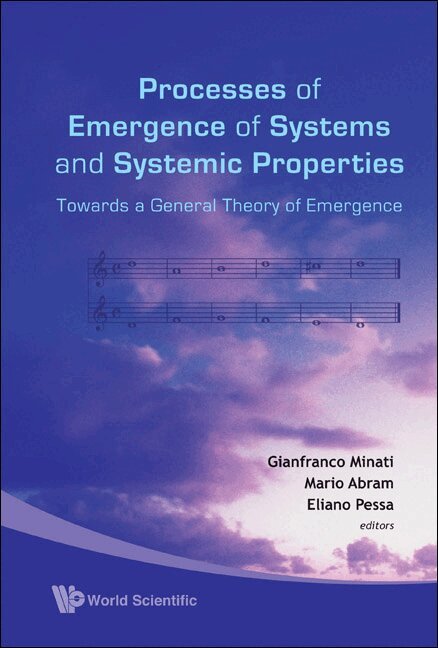
Processes Of Emergence Of Systems And Systemic Properties: Towards A General Theory Of Emergence - Proceedings Of The International Conference
Inbunden, Engelska, 2008
6 163 kr
Skickas inom 5-8 vardagar
This book contains the Proceedings of the 2007 Conference of the Italian Systems Society. Papers deal with the interdisciplinary study of processes of emergence, considering theoretical aspects and applications from physics, cognitive science, biology, artificial intelligence, economics, architecture, philosophy, music and social systems. Such an interdisciplinary study implies the need to model and distinguish, in different disciplinary contexts, the establishment of structures, systems and systemic properties. Systems, as modeled by the observer, not only possess properties, but are also able to make emergent new properties. While current disciplinary models of emergence are based on theories of phase transitions, bifurcations, dissipative structures, multiple systems and organization, the present volume focuses on both generalizing those disciplinary models and identifying correspondences and new more general approaches. The general conceptual framework of the book relates to the attempt to build a general theory of emergence as a general theory of change, corresponding to Von Bertalanffy's project for a general system theory.
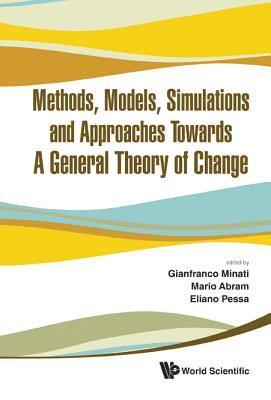
Methods, Models, Simulations And Approaches Towards A General Theory Of Change - Proceedings Of The Fifth National Conference Of The Italian Systems Society
Inbunden, Engelska, 2012
2 974 kr
Tillfälligt slut
The book contains the Proceedings of the 2010 Conference of the Italian Systems Society. Papers deal with the interdisciplinary study of processes of changing related to a wide variety of specific disciplinary aspects. Classical attempts to deal with them, based on generalising approaches used to study the movement of bodies and environmental influence, have included ineffective reductionistic simplifications. Indeed changing also relates, for instance, to processes of acquisition and varying properties such as for software; growing and aging biological systems; learning/cognitive systems; and socio-economic systems growing and developing through innovations. Some approaches to modelling such processes are based on considering changes in structure, e.g., phase-transitions. Other approaches are based on considering (1) periodic changes in structure as for processes of self-organisation; (2) non-periodic but coherent changes in structure, as for processes of emergence; (3) the quantum level of description. Papers in the book study the problem considering its transdisciplinary nature, i.e., systemic properties studied per se and not within specific disciplinary contexts. The aim of these studies is to outline a transdisciplinary theory of change in systemic properties. Such a theory should have simultaneous, corresponding and eventually hierarchical disciplinary aspects as expected for a general theory of emergence. Within this transdisciplinary context, specific disciplinary research activities and results are assumed to be mutually represented as within a philosophical and conceptual framework based on the theoretical centrality of the observer and conceptual non-separability of context and observer, related to logically open systems and Quantum Entanglement. Contributions deal with such issues in interdisciplinary ways considering theoretical aspects and applications from Physics, Cognitive Science, Biology, Artificial Intelligence, Economics, Architecture, Philosophy, Music and Social Systems.