Elisabeth Lefebvre - Böcker
Visar alla böcker från författaren Elisabeth Lefebvre. Handla med fri frakt och snabb leverans.
3 produkter
3 produkter
878 kr
Skickas inom 10-15 vardagar
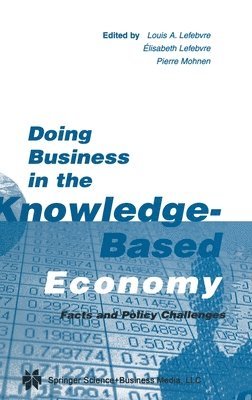
This volume was prepared by a select group of international experts in response to a need expressed by the Canadian government to identify and analyze some of the major challenges facing governments in conducting business in the knowledge-based economy. Special emphasis is placed on identifying the policy issues which governments will need to address in the upcoming years. It presents essays in three primary categories: trends and forces shaping the new reality; re-structuring and re-organizing in a knowledge-based economy, key governance issues in the knowledge-based economy. Part one describes the salient features of the knowledge-based economy: What are its economic underpinnings? What are its technological characteristics? Whereas, in the past, growth was determined primarily by the availability of land, natural resources, labour, and capital, at the end of the 20th century knowledge has become the major factor of economic growth. Part two examines management issues and economic phenomena typical of a knowledge-based economy. What makes new technology adoption and implementation successful? What can government do to make it more successful?Part three is directly focused toward questions of political economy and economic policy considerations, including technical, economic, and societal solutions. The volume concludes with a summary of the new ways in which firms and governments should manage business in a knowledge-based economy.
536 kr
Skickas inom 10-15 vardagar
On September 17 and 18, 1998, a conference took place at Mont Tremblant on the theme "Doing Business in a Knowledge-Based Economy." This conference brought together some hundred participants from government, business and academia, with backgrounds in business administration, engineering, public administration and economics, to provide a multidisciplinary analysis of what has come to be known as the "Knowledge-Based Economy" (KBE). The aim was to come up with suggestions and recommendations about how to do business in a knowledge based economy, both at the firm level and at the government level. All presenters were explicitly asked to conclude with policy recommendations. The conference was sponsored by Industry Canada and organized by the Centre of Interuniversity Research on the Analysis of Organizations (CIRANO). The conference papers offered U.S., Canadian and European perspectives on the management of a knowledge-based economy. This volume is divided into three parts. The papers in part I set the stage by describing the salient features of the KBE. What is so special about it? What are its economic underpinnings? What are its technological characteristics? Knowledge plays a crucial role in a KBE, hence its name. Whereas, in the past, growth was determined primarily by the availability of land, natural resources, labour and capital successively, at the end of the twentieth century, knowledge has become a (if not the) major factor of economic growth.
292 kr
Kommande