Ellen Frank - Böcker
Visar alla böcker från författaren Ellen Frank. Handla med fri frakt och snabb leverans.
7 produkter
7 produkter
535 kr
Skickas inom 7-10 vardagar
Family-focused psychoeducational treatment (FFT) is among a very small number of psychosocial treatments that have been found to be effective in multiple studies to improve the course of bipolar disorder. This indispensable guide describes how to implement FFT with adult and adolescent patients and their family members. Provided are practical procedures for helping families understand the nature of bipolar disorder, strengthen their communication skills, solve day-to-day problems, and reduce the risk and severity of relapse. The book incorporates state-of-the-art knowledge on the illness and its biological and psychosocial management. More than a dozen reproducible handouts are included.
The Raw Deal
How Myths and Misinformation About the Deficit, Inflation, and Wealth Impoverish America
Häftad, Engelska, 2005
272 kr
Skickas inom 5-8 vardagar
1 212 kr
Skickas inom 5-8 vardagar
884 kr
Skickas inom 3-6 vardagar
Based upon and adapted from Aaron T. Beck's cognitive therapy for depressed adults, this long-awaited volume provides general strategies and specific tactics for the use of cognitive therapy with depressed adolescents. Featuring strategies derived from years of clinical work and repeated testing, Cognitive Therapy for Depressed Adolescents provides patient-therapist narratives that convey a clinical feel for how this therapy works, as well as actual case vignettes illustrating effective techniques for diagnosis and treatment. Throughout, the book stresses that the approach be both interactive and educational. The manual opens with a theoretical overview of cognitive therapy applications. Chapters present ten key principles of cognitive therapy with adolescents and techniques for assessing and diagnosing depression. Part II focuses on special issues that arise in the treatment of adolescents--developmental considerations, ways to create and sustain a therapeutic relationship, and how to involve the entire family in the adolescent's treatment. Part III describes the macrostages and microtechniques in cognitive therapy with chapters presenting an in-depth analysis of goal setting, intervention, and termination. Part IV discusses comorbidity and strategies for working with substance-abusing teenagers, survivors of sexual victimization, and suicidal adolescents. Although the emphasis of this manual is on outpatient treatment, brief periods of hospitalization are often part of the management of depressed adolescents, so one chapter in Part V is devoted to the use of cognitive techniques in the inpatient setting, and another describes general management issues and psychopharmacological treatment. Finally, the chapter considers therapeutic failures and obstacles one encounters when working with this population.Providing guidelines and principles of cognitive therapy techniques for the treatment of depressed adolescents, this volume will be of value to psychotherapists, psychiatrists, psychologists, social workers, and counselors. These adapted techniques will also add to the repertoire of cognitive therapists who normally work with depressed adults but also encounter adolescents in their practice. Useful as a teaching text in courses that discuss new applications for cognitive therapy techniques, this book is also ideal supplemental reading in courses on psychology and psychotherapy.
485 kr
Skickas inom 7-10 vardagar
Interpersonal Psychotherapy provides an introduction to the theory, history, research, and practice of this effective, empirically validated approach. Gerald L. Klerman and Myrna M. Weissman initially created interpersonal psychotherapy (IPT) as a brief approach for treating depression, but it has since been adapted for use with a wide variety of client presenting problems and in longer-term situations. This approach focuses on the interaction between interpersonal dysfunction and psychological symptoms. IPT is founded on the idea that humans are social beings, thus client personal relationships lie at the center of presenting problems and psychological states.Although grounded in a medical model, which is used to conceptualize the client's presenting problem, the primary basis for this approach lies in an interpersonal modification of psychodynamic psychotherapy. Therapy is present-focused, but aspects of attachment theory are used to analyze how past relationships affect current relationships. Therapists applying IPT take an active stance, continually and supportively guiding the sessions to maintain focus on one of four interpersonal problem areas: unresolved grief, role transitions, role disputes, or interpersonal deficits.In this book, Frank and Levenson present and explore this versatile and useful approach, its theory, history, therapy process, primary change mechanisms, the empirical basis for its effectiveness, and contemporary developments that have refined the theory and expanded how it may be practiced. This essential primer, amply illustrated with case examples featuring diverse clients, is perfect for graduate students studying theories of therapy and counseling, as well as for seasoned practitioners interested in understanding how this approach has evolved and how it might be used in their practice.
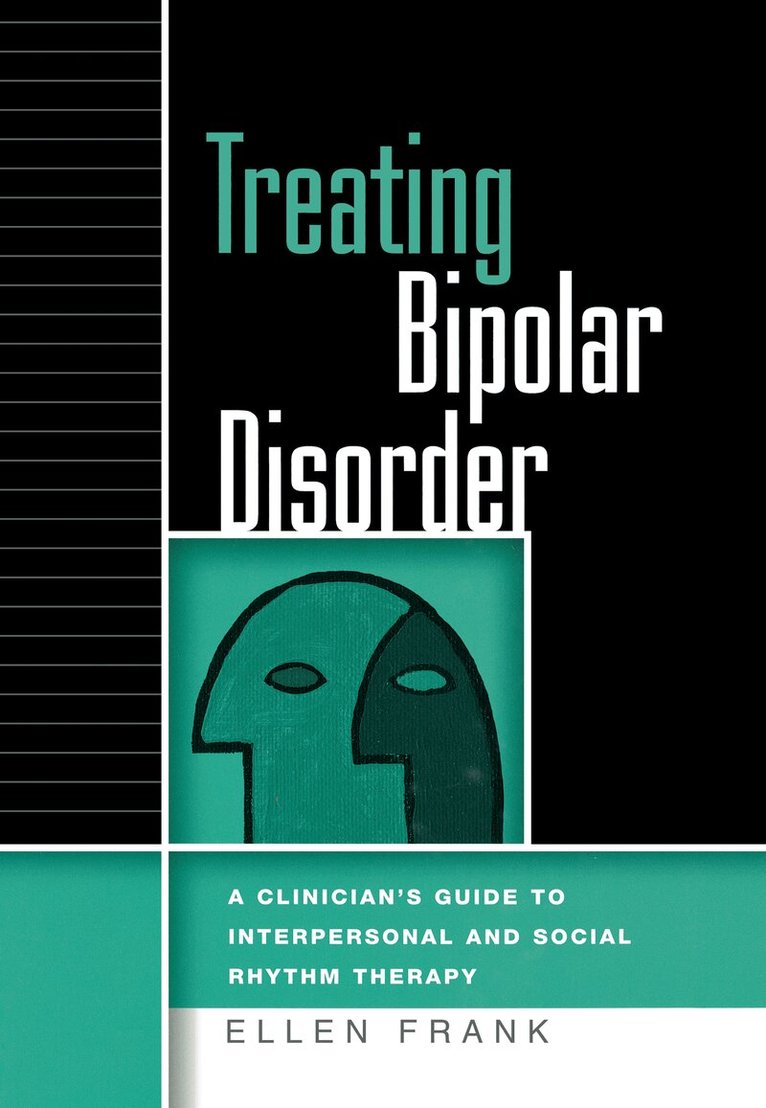
Treating Bipolar Disorder
A Clinician's Guide to Interpersonal and Social Rhythm Therapy
Inbunden, Engelska, 2005
1 067 kr
Skickas inom 3-6 vardagar
This innovative manual presents a powerful approach for helping people manage bipolar illness and protect against the recurrence of manic or depressive episodes. Interpersonal and social rhythm therapy focuses on stabilizing moods by improving medication adherence, building coping skills and relationship satisfaction, and shoring up the regularity of daily rhythms or routines. Each phase of this flexible, evidence-based treatment is vividly detailed, from screening, assessment, and case conceptualization through acute therapy, maintenance treatment, and periodic booster sessions. Among the special features are reproducible assessment tools and a chapter on how to overcome specific treatment challenges.
Treating Bipolar Disorder
A Clinician's Guide to Interpersonal and Social Rhythm Therapy
Häftad, Engelska, 2007
513 kr
Skickas inom 10-15 vardagar
This innovative manual presents a powerful approach for helping people manage bipolar illness and protect against the recurrence of manic or depressive episodes. Interpersonal and social rhythm therapy focuses on stabilizing moods by improving medication adherence, building coping skills and relationship satisfaction, and shoring up the regularity of daily rhythms or routines. Each phase of this flexible, evidence-based treatment is vividly detailed, from screening, assessment, and case conceptualization through acute therapy, maintenance treatment, and periodic booster sessions. Among the special features are reproducible assessment tools and a chapter on how to overcome specific treatment challenges.