Emil-Maria Claassen - Böcker
Visar alla böcker från författaren Emil-Maria Claassen. Handla med fri frakt och snabb leverans.
2 produkter
2 produkter
1 039 kr
Skickas inom 10-15 vardagar
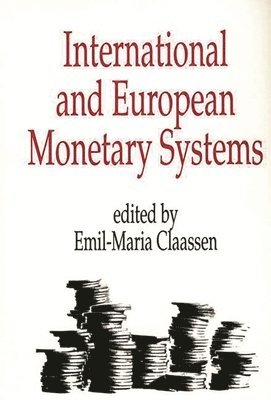
This volume brings together a distinguished group of contributors from European universities and research institutes as well as U.S. finance and economic institutes to examine a broad range of issues related to the current and future roles of international and European monetary systems. Among the topics covered are the relationship of each system to the U.S. dollar and its fluctuations vis-a-vis the Japanese Yen and German Deutschmark; the effect of fiscal policies on monetary systems; the role of the European currency unit; exchange rate management and international coordination; the theory behind, and policy implications of, over- and undervalued currencies; and the prospects for future currency unification and currency competition. Students of international finance and trade, international economics, and monetary theory will find this an important contribution to debates over international monetary policy.Divided into two major sections, which address the international and European systems respectively, the book begins with three chapters that examine the exchange rate system of a managed float with respect to the dollar. The fundamental question addressed by the authors is whether this system, which has predominated in the last decade, has contributed to increasingly unstable real exchange rates. The following two chapters examine the role of the IMF's special drawing right and the appropriate exchange rate regime for developing countries. The remaining chapters focus on the European Monetary System, and explore such issues as the convergence of monetary and fiscal policies within the European Monetary System and the role of the private European Currency Unit. A bibliography is included for those who wish to pursue further research on these topics.
1 839 kr
Skickas inom 7-10 vardagar
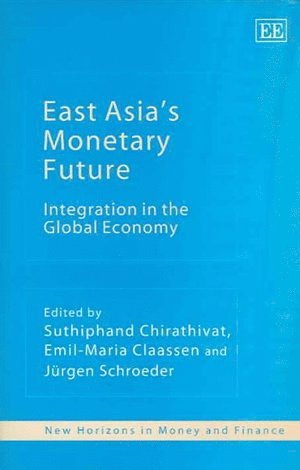
East Asia's Monetary Future is an illuminating and valuable work which uniquely focuses on a long-term monetary view of the region. There are multiple and varied future scenarios which can be applied to this region - an enlarged Singapore-Brunei currency area, a greater China monetary bloc and even a Northeast Asian bloc comprising Japan and Korea.Leading scholars from East Asia, Europe and the US contribute valuable new insights to the key questions facing the organization and future of the monetary system in East Asia. Central questions discussed and analysed in the book include, amongst others: should the region move towards monetary union? Should countries peg their exchange rates to the US dollar? Is complete dollarization an option for East Asia? The authors argue that, having realized price stability over the last twenty years, in contrast to Latin America and Africa, the next logical step would be the gradual formation of various currency blocs within the region. This comprehensive discussion of the fundamental issues at stake will ensure the book's appeal to academics and researchers of Asian studies and financial economics. Financial experts working in this area and policymakers will also find much of interest to them within this book.