Emil M. Claassen - Böcker
Visar alla böcker från författaren Emil M. Claassen. Handla med fri frakt och snabb leverans.
2 produkter
2 produkter
1 039 kr
Skickas inom 10-15 vardagar
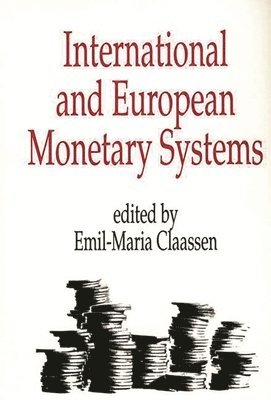
This volume brings together a distinguished group of contributors from European universities and research institutes as well as U.S. finance and economic institutes to examine a broad range of issues related to the current and future roles of international and European monetary systems. Among the topics covered are the relationship of each system to the U.S. dollar and its fluctuations vis-a-vis the Japanese Yen and German Deutschmark; the effect of fiscal policies on monetary systems; the role of the European currency unit; exchange rate management and international coordination; the theory behind, and policy implications of, over- and undervalued currencies; and the prospects for future currency unification and currency competition. Students of international finance and trade, international economics, and monetary theory will find this an important contribution to debates over international monetary policy.Divided into two major sections, which address the international and European systems respectively, the book begins with three chapters that examine the exchange rate system of a managed float with respect to the dollar. The fundamental question addressed by the authors is whether this system, which has predominated in the last decade, has contributed to increasingly unstable real exchange rates. The following two chapters examine the role of the IMF's special drawing right and the appropriate exchange rate regime for developing countries. The remaining chapters focus on the European Monetary System, and explore such issues as the convergence of monetary and fiscal policies within the European Monetary System and the role of the private European Currency Unit. A bibliography is included for those who wish to pursue further research on these topics.
506 kr
Skickas inom 10-15 vardagar
Dies ist die überarbeitete und erweiterte Auflage des im Jahre 1970 erschienenen Buches Probleme der Geldtheorie. Von den ins gesamt 307 Seiten sind 178 überarbeitet und 129 Seiten durch 243 Seiten ersetzt worden. An die Stelle von sieben Kapiteln sind elf Kapitel getreten. Die Geldtheorie, so wie sie in dieser zweiten Auflage konzipiert worden ist, umfaßt die Rolle des Geldes, die Geldnachfrage, das Geldangebot und den Geldmarkt. Die neuen Kapitel befassen sich mit dem Geldangebot und dem Geldmarkt. Im Vergleich zur er sten Auflage ist die Geldtheorie, was den Geldmarkt angeht, so wohl eingeengt als auch erweitert worden. Die Einengung bezieht sich auf eine neue (bzw. klassische) Abgrenzung zwischen der ma kroökonomischen Theorie und der Geldtheorie; als makroökono mische Geldtheorie haben wir jene makroökonomische Theorie definiert, die sich mit der langfristigen Bestimmung des Preis niveaus und der Inflation befaßt. Die Erweiterung behandelt die ebenfalls schwierige Abgrenzung zwischen monetärer Außenwirt schaftstheorie und Geldtheorie; als die außenwirtschaftliche Kom ponente der Geldtheorie haben wir jene Geldmarkttheorie ge wählt, die die Bestimmung der Zahlungsbilanz und des Wechsel kurses zum Gegenstand hat. Da wir versucht haben, in diesem Buch ein geschlossenes Bild der Geldtheorie zu entwerfen, haben wir es Grundlagen der Geld theorie genannt. Dieser für manchen Leser prätentiös erscheinende Titel ist jedoch - so glauben wir - angesichts der Erweiterungen im Vergleich zur ersten Auflage gerechtfertigt.