Emmanuel Dalle Mulle - Böcker
Visar alla böcker från författaren Emmanuel Dalle Mulle. Handla med fri frakt och snabb leverans.
4 produkter
4 produkter
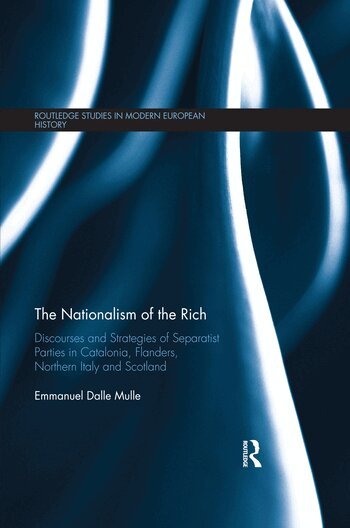
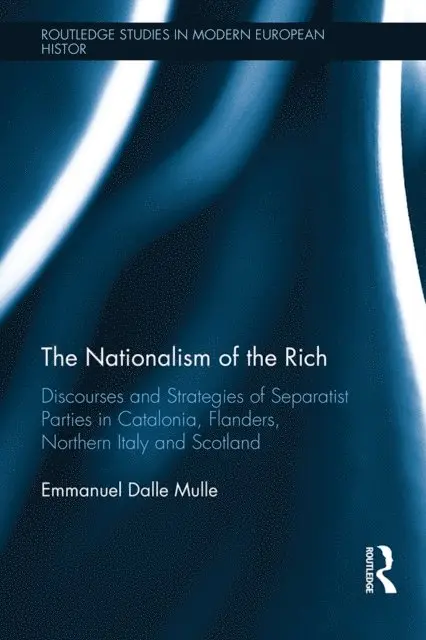
Nationalism of the Rich
Discourses and Strategies of Separatist Parties in Catalonia, Flanders, Northern Italy and Scotland
Häftad, Engelska, 2019
820 kr
Skickas inom 10-15 vardagar
Based on rigorous analysis of the propaganda of five Western European separatist parties, this book provides in-depth examination of the ‘nationalism of the rich’, defined as a type of nationalist discourse that seeks to end the economic ‘exploitation’ suffered by a group of people represented as a wealthy nation and supposedly carried out by the populations of poorer regions and/or by inefficient state administrations. It shows that the nationalism of the rich represents a new phenomenon peculiar to societies that have set in place complex systems of wealth redistribution and adopted economic growth as the main principle of government legitimacy. The book argues that the nationalism of the rich can be seen as a rhetorical strategy portraying independent statehood as a solution to the dilemma between solidarity and efficiency arisen in Western Europe since the end of the Glorious Thirties. It further suggests that its formation can be best explained by the following combination of factors: (1) the creation, from the end of the Second World War, of extensive forms of automatic redistribution to a scale previously unprecedented; (2) the beginning, from the mid-1970s, of an era of ‘permanent austerity’ exacerbated, in specific contexts, by situations of serious public policy failure; (3) the existence of national/cultural cleavages roughly squaring with uneven development and sharp income differentials among territorial areas of a given state.
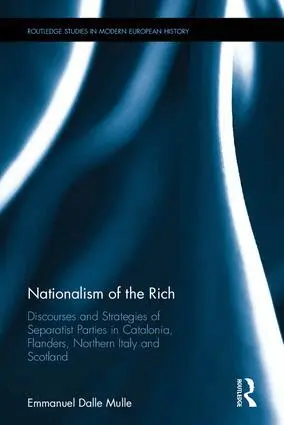
Nationalism of the Rich
Discourses and Strategies of Separatist Parties in Catalonia, Flanders, Northern Italy and Scotland
Inbunden, Engelska, 2017
2 088 kr
Skickas inom 10-15 vardagar
Based on rigorous analysis of the propaganda of five Western European separatist parties, this book provides in-depth examination of the ‘nationalism of the rich’, defined as a type of nationalist discourse that seeks to end the economic ‘exploitation’ suffered by a group of people represented as a wealthy nation and supposedly carried out by the populations of poorer regions and/or by inefficient state administrations. It shows that the nationalism of the rich represents a new phenomenon peculiar to societies that have set in place complex systems of wealth redistribution and adopted economic growth as the main principle of government legitimacy. The book argues that the nationalism of the rich can be seen as a rhetorical strategy portraying independent statehood as a solution to the dilemma between solidarity and efficiency arisen in Western Europe since the end of the Glorious Thirties. It further suggests that its formation can be best explained by the following combination of factors: (1) the creation, from the end of the Second World War, of extensive forms of automatic redistribution to a scale previously unprecedented; (2) the beginning, from the mid-1970s, of an era of ‘permanent austerity’ exacerbated, in specific contexts, by situations of serious public policy failure; (3) the existence of national/cultural cleavages roughly squaring with uneven development and sharp income differentials among territorial areas of a given state.
406 kr
Skickas inom 10-15 vardagar
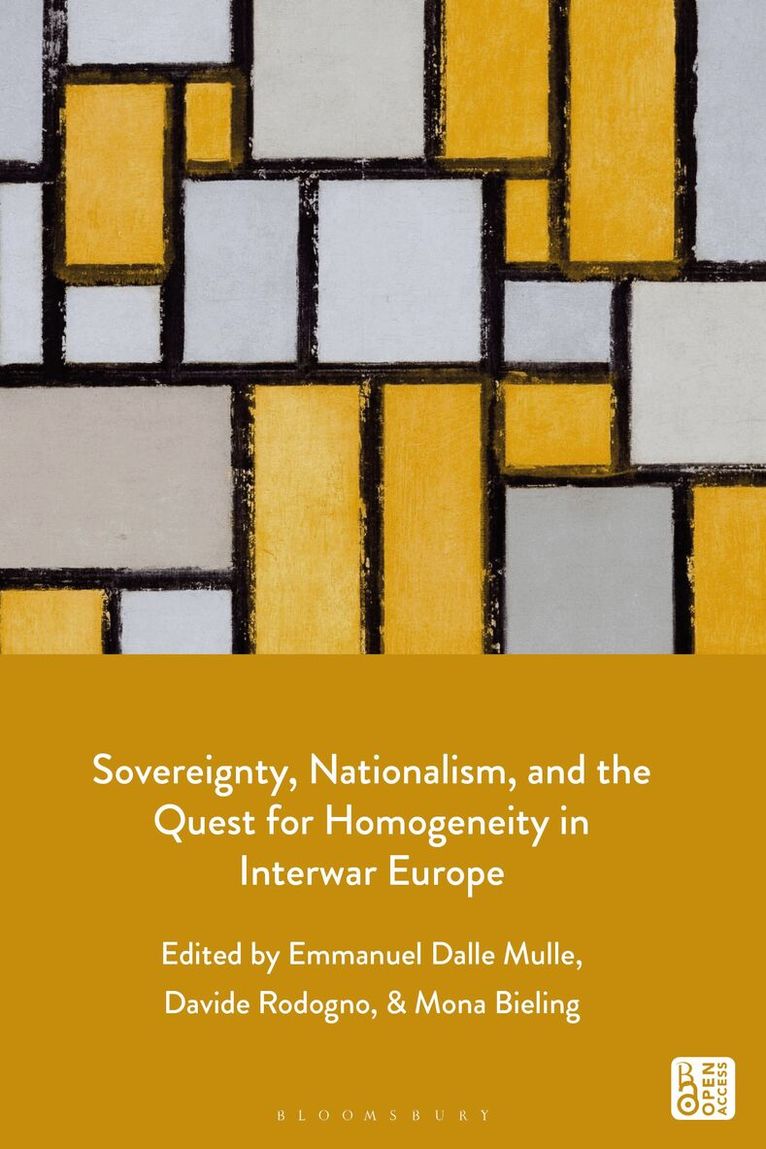
Interwar European minority questions have been predominantly discussed in the context of Eastern Europe until now. This open access book challenges that geographical emphasis by examining both Eastern and Western European experiences. It thus lays the foundation for a new comparative international history of the relations between national majorities and minorities in Europe after the Great War. Building on the assumption that nationalist conflicts are based on dynamic interactions between multiple actors, this book brings together different perspectives and methodological approaches (political, social and transnational) to provide a comprehensive account of minority questions between the two World Wars.With contributions from leading academics and emerging scholars based in Austria, Ireland, Poland, Spain, Switzerland, the UK and the USA among others, Sovereignty, Nationalism, and the Quest for Homogeneity in Interwar Europe is a wide-ranging study which is firmly anchored in the history of the transition from empires to nation-states as well as in the history of human rights and the nation-state.The ebook editions of this book are available open access under a CC BY-NC-ND 4.0 licence on bloomsburycollections.com. Open access was funded by the Swiss National Science Foundation (SNSF).
1 245 kr
Skickas inom 10-15 vardagar
Interwar European minority questions have been predominantly discussed in the context of Eastern Europe until now. This open access book challenges that geographical emphasis by examining both Eastern and Western European experiences. It thus lays the foundation for a new comparative international history of the relations between national majorities and minorities in Europe after the Great War. Building on the assumption that nationalist conflicts are based on dynamic interactions between multiple actors, this book brings together different perspectives and methodological approaches (political, social and transnational) to provide a comprehensive account of minority questions between the two World Wars.With contributions from leading academics and emerging scholars based in Austria, Ireland, Poland, Spain, Switzerland, the UK and the USA among others, Sovereignty, Nationalism, and the Quest for Homogeneity in Interwar Europe is a wide-ranging study which is firmly anchored in the history of the transition from empires to nation-states as well as in the history of human rights and the nation-state.The ebook editions of this book are available open access under a CC BY-NC-ND 4.0 licence on bloomsburycollections.com. Open access was funded by the Swiss National Science Foundation (SNSF).