Erchin Serpedin – författare
1 524 kr
Skickas inom 11-20 vardagar
1 313 kr
Läs direkt efter köp
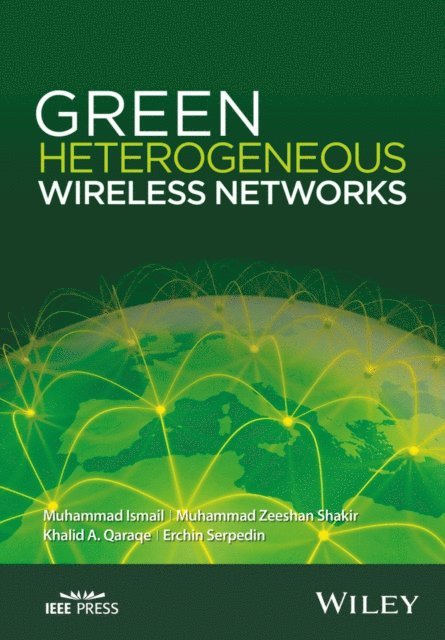
This book focuses on the emerging research topic "green (energy efficient) wireless networks" which has drawn huge attention recently from both academia and industry. This topic is highly motivated due to important environmental, financial, and quality-of-experience (QoE) considerations. Specifically, the high energy consumption of the wireless networks manifests in approximately 2% of all CO2 emissions worldwide. This book presents the authors’ visions and solutions for deployment of energy efficient (green) heterogeneous wireless communication networks. The book consists of three major parts. The first part provides an introduction to the "green networks" concept, the second part targets the green multi-homing resource allocation problem, and the third chapter presents a novel deployment of device-to-device (D2D) communications and its successful integration in Heterogeneous Networks (HetNets).
The book is novel in that it specifically targets green networking in a heterogeneous wireless medium, which represents the current and future wireless communication medium faced by the existing and next generation communication networks. The book focuses on multi-homing resource allocation, exploiting network cooperation, and integrating different and new network technologies (radio frequency and VLC), expanding the network coverage and integrating new device centric communication paradigms such as D2D Communications. Whilst the book discusses a significant research topic supported with advanced mathematical analysis, the resulting algorithms and solutions are explained and summarized in a way that is easy to follow and grasp. This book is suitable for networking and telecommunications engineers, researchers in industry and academia, as well as students and instructors.
1 313 kr
Läs direkt efter köp
This book focuses on the emerging research topic "green (energy efficient) wireless networks" which has drawn huge attention recently from both academia and industry. This topic is highly motivated due to important environmental, financial, and quality-of-experience (QoE) considerations. Specifically, the high energy consumption of the wireless networks manifests in approximately 2% of all CO2 emissions worldwide. This book presents the authors’ visions and solutions for deployment of energy efficient (green) heterogeneous wireless communication networks. The book consists of three major parts. The first part provides an introduction to the "green networks" concept, the second part targets the green multi-homing resource allocation problem, and the third chapter presents a novel deployment of device-to-device (D2D) communications and its successful integration in Heterogeneous Networks (HetNets).
The book is novel in that it specifically targets green networking in a heterogeneous wireless medium, which represents the current and future wireless communication medium faced by the existing and next generation communication networks. The book focuses on multi-homing resource allocation, exploiting network cooperation, and integrating different and new network technologies (radio frequency and VLC), expanding the network coverage and integrating new device centric communication paradigms such as D2D Communications. Whilst the book discusses a significant research topic supported with advanced mathematical analysis, the resulting algorithms and solutions are explained and summarized in a way that is easy to follow and grasp. This book is suitable for networking and telecommunications engineers, researchers in industry and academia, as well as students and instructors.
1 129 kr
Skickas inom 11-20 vardagar
1 252 kr
Skickas inom 10-15 vardagar
3 355 kr
Skickas inom 10-15 vardagar
1 473 kr
Läs direkt efter köp
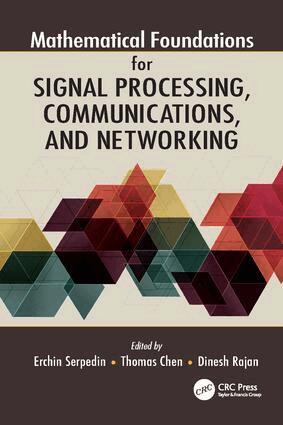
Mathematical Foundations for Signal Processing, Communications, and Networking describes mathematical concepts and results important in the design, analysis, and optimization of signal processing algorithms, modern communication systems, and networks. Helping readers master key techniques and comprehend the current research literature, the book offers a comprehensive overview of methods and applications from linear algebra, numerical analysis, statistics, probability, stochastic processes, and optimization.
From basic transforms to Monte Carlo simulation to linear programming, the text covers a broad range of mathematical techniques essential to understanding the concepts and results in signal processing, telecommunications, and networking. Along with discussing mathematical theory, each self-contained chapter presents examples that illustrate the use of various mathematical concepts to solve different applications. Each chapter also includes a set of homework exercises and readings for additional study.
This text helps readers understand fundamental and advanced results as well as recent research trends in the interrelated fields of signal processing, telecommunications, and networking. It provides all the necessary mathematical background to prepare students for more advanced courses and train specialists working in these areas.
1 460 kr
Läs direkt efter köp
Mathematical Foundations for Signal Processing, Communications, and Networking describes mathematical concepts and results important in the design, analysis, and optimization of signal processing algorithms, modern communication systems, and networks. Helping readers master key techniques and comprehend the current research literature, the book offers a comprehensive overview of methods and applications from linear algebra, numerical analysis, statistics, probability, stochastic processes, and optimization.
From basic transforms to Monte Carlo simulation to linear programming, the text covers a broad range of mathematical techniques essential to understanding the concepts and results in signal processing, telecommunications, and networking. Along with discussing mathematical theory, each self-contained chapter presents examples that illustrate the use of various mathematical concepts to solve different applications. Each chapter also includes a set of homework exercises and readings for additional study.
This text helps readers understand fundamental and advanced results as well as recent research trends in the interrelated fields of signal processing, telecommunications, and networking. It provides all the necessary mathematical background to prepare students for more advanced courses and train specialists working in these areas.
540 kr
Skickas inom 10-15 vardagar
687 kr
Läs direkt efter köp
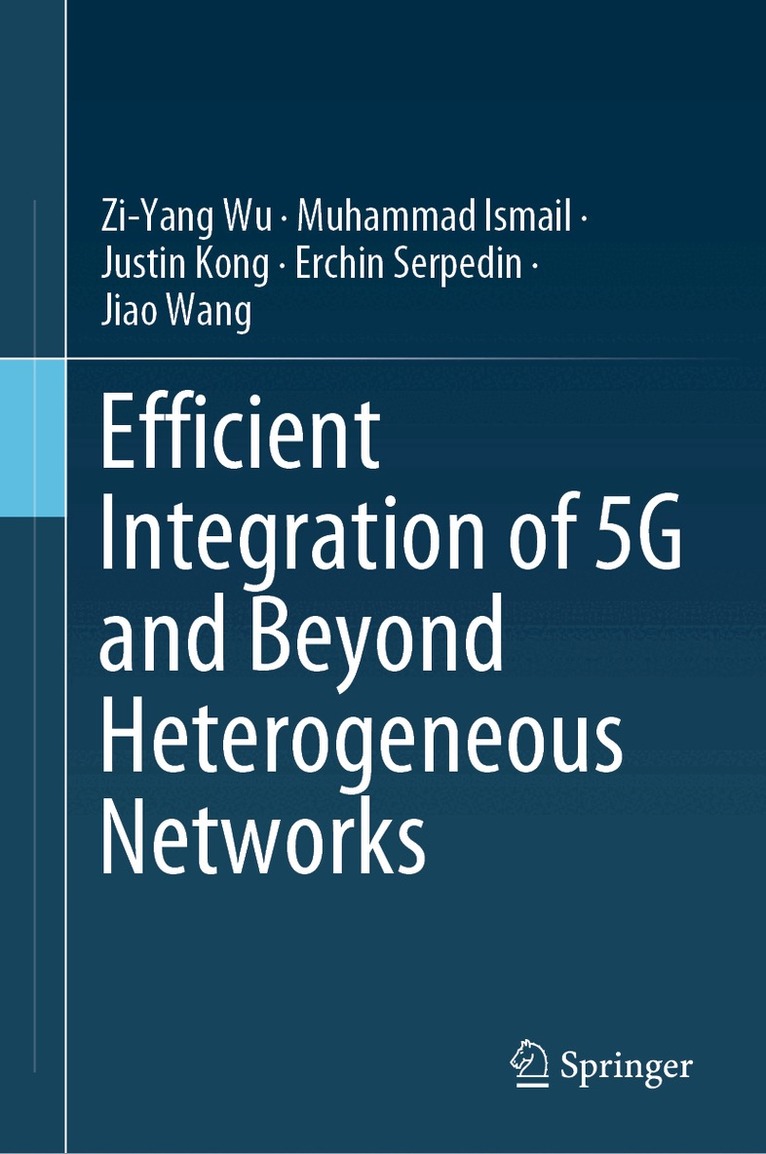
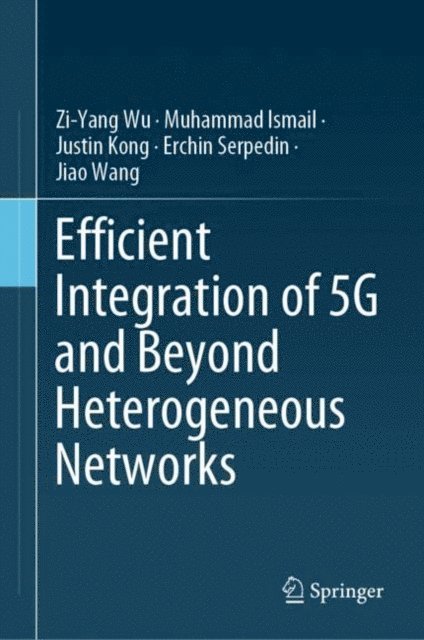
This book discusses the smooth integration of optical and RF networks in 5G and beyond (5G+) heterogeneous networks (HetNets), covering both planning and operational aspects. The integration of high-frequency air interfaces into 5G+ wireless networks can relieve the congested radio frequency (RF) bands. Visible light communication (VLC) is now emerging as a promising candidate for future generations of HetNets. Heterogeneous RF-optical networks combine the high throughput of visible light and the high reliability of RF. However, when implementing these HetNets in mobile scenarios, several challenges arise from both planning and operational perspectives. Since the mmWave, terahertz, and visible light bands share similar wave propagation characteristics, the concepts presented here can be broadly applied in all such bands.
To facilitate the planning of RF-optical HetNets, the authors present an algorithm that specifies the joint optimal densities of the base stations by drawing on stochastic geometry in order to satisfy the users’ quality-of-service (QoS) demands with minimum network power consumption. From an operational perspective, the book explores vertical handovers and multi-homing using a cooperative framework. For vertical handovers, it employs a data-driven approach based on deep neural networks to predict abrupt optical outages; and, on the basis of this prediction, proposes a reinforcement learning strategy that ensures minimal network latency during handovers. In terms of multi-homing support, the authors examine the aggregation of the resources from both optical and RF networks, adopting a two-timescale multi-agent reinforcement learning strategy for optimal power allocation.
Presenting comprehensive planning and operational strategies, the book allows readers to gain an in-depth grasp of how to integrate future coexisting networks at high-frequency bands in a cooperative manner, yielding reliable and high-speed 5G+ HetNets.
540 kr
Skickas inom 10-15 vardagar