Erik K. Antonsson - Böcker
Visar alla böcker från författaren Erik K. Antonsson. Handla med fri frakt och snabb leverans.
4 produkter
4 produkter
758 kr
Skickas inom 7-10 vardagar
The development of a new design is often thought of as a fundamentally human, creative act. However, emerging research has demonstrated that aspects of design synthesis can be formalized. First steps in this direction were taken in the early 1960s when systematic techniques were introduced to guide engineers in producing high-quality designs. By the mid-1980s these methods had evolved from their informal (guideline-like) origins to more formal (computable) methods. In recent years, highly automated design synthesis techniques have emerged. This intriguing book reviews formal design synthesis methods. It also provides an in-depth exploration of several representative projects in formal design synthesis and examines future directions in computational design synthesis research. Written by internationally renowned experts in engineering and architectural design, it covers essential topics in engineering design, and will appeal to designers, researchers and engineering graduate students.
2 127 kr
Skickas inom 7-10 vardagar
The development of a new design is often thought of as a fundamentally human, creative act. However, emerging research has demonstrated that aspects of design synthesis can be formalized. First steps in this direction were taken in the early 1960s when systematic techniques were introduced to guide engineers in producing high-quality designs. By the mid-1980s these methods had evolved from their informal (guideline-like) origins to more formal (computable) methods. In recent years, highly automated design synthesis techniques have emerged. This intriguing book reviews formal design synthesis methods. It also provides an in-depth exploration of several representative projects in formal design synthesis and examines future directions in computational design synthesis research. Written by internationally renowned experts in engineering and architectural design, it covers essential topics in engineering design, and will appeal to designers, researchers and engineering graduate students.
1 064 kr
Skickas inom 10-15 vardagar
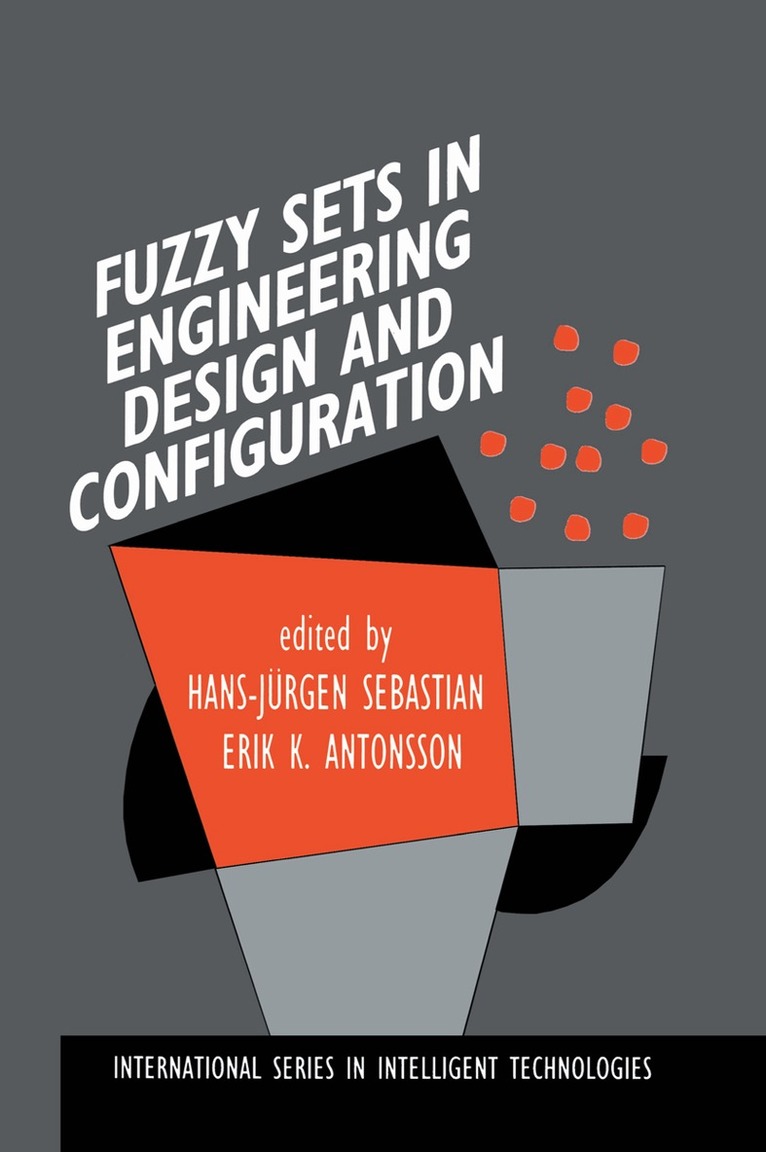
This work presents some of the most recent research results that apply fuzzy sets to engineering design and configuration problems. These chapters cover the representation and manipulation of imprecise information during the synthesis of new designs and selection of configurations. The authors utilize the mathematics of fuzzy sets to represent information that has not yet been reduced to precise descriptions. In most cases, the mathematics of probability is also used to represent more traditional stochastic uncertainties such as uncontrolled manufacturing variations, etc. Presentations on fuzzy optimization and AHP methods are also included. These (fuzzy) set-based methods have particular application to concurrent engineering techniques.
Del 9 - International Series in Intelligent Technologies
Fuzzy Sets in Engineering Design and Configuration
Häftad, Engelska, 2011
1 064 kr
Skickas inom 10-15 vardagar
As understanding of the engineering design and configuration processes grows, the recognition that these processes intrinsically involve imprecise information is also growing. This book collects some of the most recent work in the area of representation and manipulation of imprecise information during the syn thesis of new designs and selection of configurations. These authors all utilize the mathematics of fuzzy sets to represent information that has not-yet been reduced to precise descriptions, and in most cases also use the mathematics of probability to represent more traditional stochastic uncertainties such as un controlled manufacturing variations, etc. These advances form the nucleus of new formal methods to solve design, configuration, and concurrent engineering problems. Hans-Jurgen Sebastian Aachen, Germany Erik K. Antonsson Pasadena, California ACKNOWLEDGMENTS We wish to thank H.-J. Zimmermann for inviting us to write this book. We are also grateful to him for many discussions about this new field Fuzzy Engineering Design which have been very stimulating. We wish to thank our collaborators in particular: B. Funke, M. Tharigen, K. Miiller, S. Jarvinen, T. Goudarzi-Pour, and T. Kriese in Aachen who worked in the PROKON project and who elaborated some of the results presented in the book. We also wish to thank Michael J. Scott for providing invaluable editorial assis tance. Finally, the book would not have been possible without the many contributions and suggestions of Alex Greene of Kluwer Academic Publishers. 1 MODELING IMPRECISION IN ENGINEERING DESIGN Erik K. Antonsson, Ph.D., P.E.