Erik Palmgren - Böcker
Visar alla böcker från författaren Erik Palmgren. Handla med fri frakt och snabb leverans.
4 produkter
4 produkter
2 939 kr
Skickas inom 10-15 vardagar
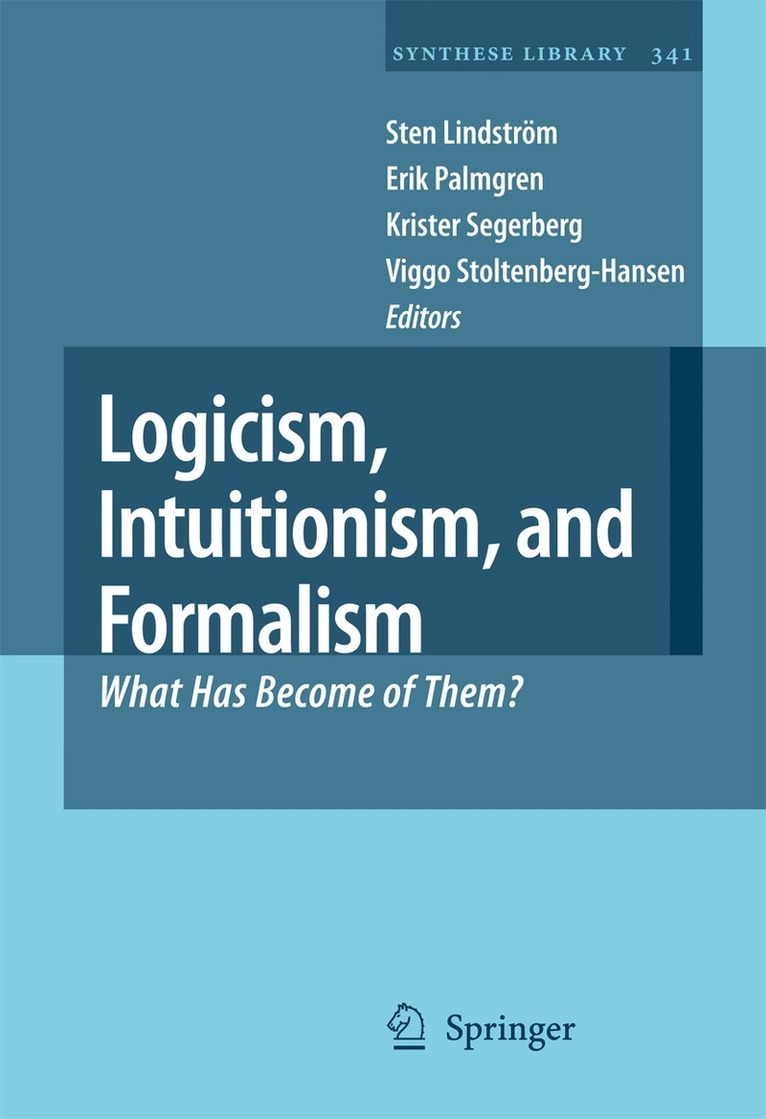
The present anthology has its origin in two international conferences that were arranged at Uppsala University in August 2004: "Logicism, Intuitionism and F- malism: What has become of them?" followed by "Symposium on Constructive Mathematics". The rst conference concerned the three major programmes in the foundations of mathematics during the classical period from Frege's Begrif- schrift in 1879 to the publication of Godel' .. s two incompleteness theorems in 1931: The logicism of Frege, Russell and Whitehead, the intuitionism of Brouwer, and Hilbert's formalist and proof-theoretic programme. The main purpose of the conf- ence was to assess the relevance of these foundational programmes to contemporary philosophy of mathematics. The second conference was announced as a satellite event to the rst, and was speci cally concerned with constructive mathematics-an activebranchofmathematicswheremathematicalstatements-existencestatements in particular-are interpreted in terms of what can be effectively constructed. C- structive mathematics may also be characterized as mathematics based on intuiti- isticlogicand,thus,beviewedasadirectdescendant ofBrouwer'sintuitionism.The two conferences were successful in bringing together a number of internationally renowned mathematicians and philosophers around common concerns. Once again it was con rmed that philosophers and mathematicians can work together and that real progress in the philosophy and foundations of mathematics is possible only if they do. Most of the papers in this collection originate from the two conferences, but a few additional papers of relevance to the issues discussed at the Uppsala c- ferences have been solicited especially for this volume.
Del 341 - Synthese Library
Logicism, Intuitionism, and Formalism
What Has Become of Them?
Häftad, Engelska, 2010
2 939 kr
Skickas inom 10-15 vardagar
The present anthology has its origin in two international conferences that were arranged at Uppsala University in August 2004: "Logicism, Intuitionism and F- malism: What has become of them?" followed by "Symposium on Constructive Mathematics". The rst conference concerned the three major programmes in the foundations of mathematics during the classical period from Frege's Begrif- schrift in 1879 to the publication of Godel' .. s two incompleteness theorems in 1931: The logicism of Frege, Russell and Whitehead, the intuitionism of Brouwer, and Hilbert's formalist and proof-theoretic programme. The main purpose of the conf- ence was to assess the relevance of these foundational programmes to contemporary philosophy of mathematics. The second conference was announced as a satellite event to the rst, and was speci cally concerned with constructive mathematics-an activebranchofmathematicswheremathematicalstatements-existencestatements in particular-are interpreted in terms of what can be effectively constructed. C- structive mathematics may also be characterized as mathematics based on intuiti- isticlogicand,thus,beviewedasadirectdescendant ofBrouwer'sintuitionism.The two conferences were successful in bringing together a number of internationally renowned mathematicians and philosophers around common concerns. Once again it was con rmed that philosophers and mathematicians can work together and that real progress in the philosophy and foundations of mathematics is possible only if they do. Most of the papers in this collection originate from the two conferences, but a few additional papers of relevance to the issues discussed at the Uppsala c- ferences have been solicited especially for this volume.
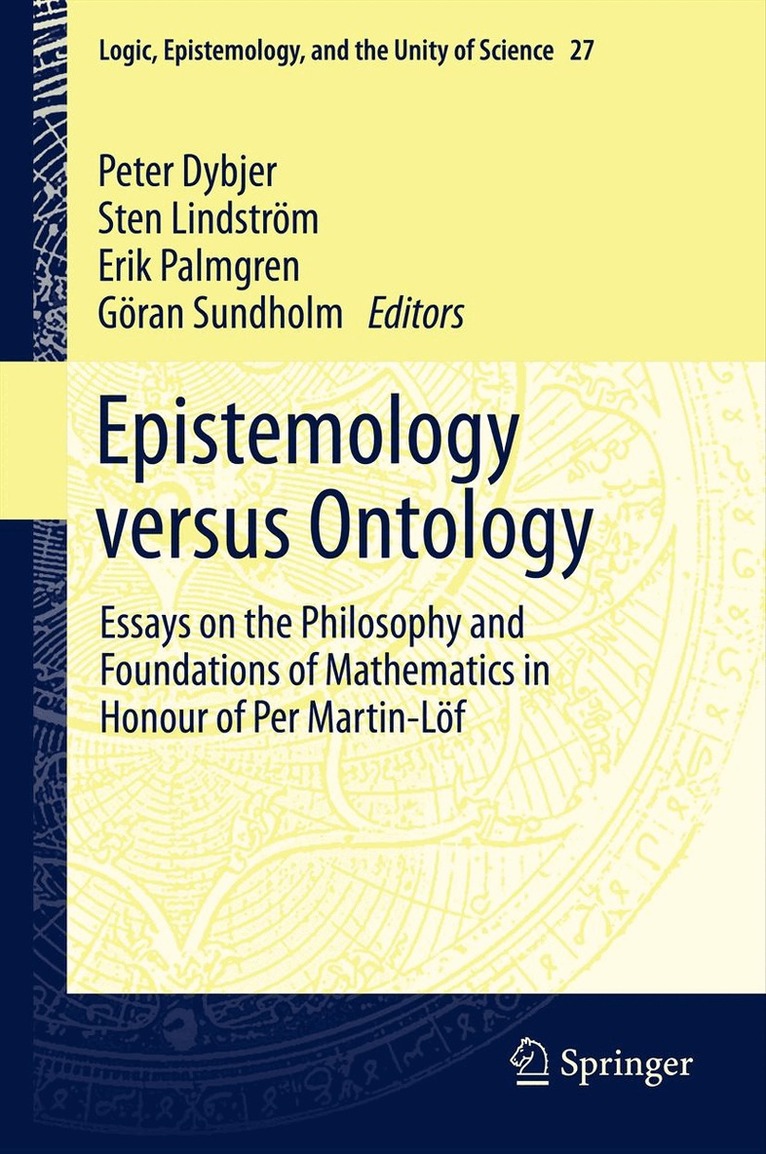
Epistemology versus Ontology
Essays on the Philosophy and Foundations of Mathematics in Honour of Per Martin-Löf
Inbunden, Engelska, 2012
2 101 kr
Skickas inom 10-15 vardagar
This book brings together philosophers, mathematicians and logicians to penetrate important problems in the philosophy and foundations of mathematics. In philosophy, one has been concerned with the opposition between constructivism and classical mathematics and the different ontological and epistemological views that are reflected in this opposition. The dominant foundational framework for current mathematics is classical logic and set theory with the axiom of choice (ZFC). This framework is, however, laden with philosophical difficulties. One important alternative foundational programme that is actively pursued today is predicativistic constructivism based on Martin-Löf type theory. Associated philosophical foundations are meaning theories in the tradition of Wittgenstein, Dummett, Prawitz and Martin-Löf. What is the relation between proof-theoretical semantics in the tradition of Gentzen, Prawitz, and Martin-Löf and Wittgensteinian or other accounts of meaning-as-use? What can proof-theoretical analyses tell us about the scope and limits of constructive and predicative mathematics?
Epistemology versus Ontology
Essays on the Philosophy and Foundations of Mathematics in Honour of Per Martin-Löf
Häftad, Engelska, 2014
2 101 kr
Skickas inom 10-15 vardagar
This book brings together philosophers, mathematicians and logicians to penetrate important problems in the philosophy and foundations of mathematics. In philosophy, one has been concerned with the opposition between constructivism and classical mathematics and the different ontological and epistemological views that are reflected in this opposition. The dominant foundational framework for current mathematics is classical logic and set theory with the axiom of choice (ZFC). This framework is, however, laden with philosophical difficulties. One important alternative foundational programme that is actively pursued today is predicativistic constructivism based on Martin-Löf type theory. Associated philosophical foundations are meaning theories in the tradition of Wittgenstein, Dummett, Prawitz and Martin-Löf. What is the relation between proof-theoretical semantics in the tradition of Gentzen, Prawitz, and Martin-Löf and Wittgensteinian or other accounts of meaning-as-use? What can proof-theoretical analyses tell us about the scope and limits of constructive and predicative mathematics?