Krister Segerberg – författare
Visar alla böcker från författaren Krister Segerberg. Handla med fri frakt och snabb leverans.
5 produkter
5 produkter
Inbunden, Engelska, 1990
1 619 kr
Skickas inom 10-15 vardagar
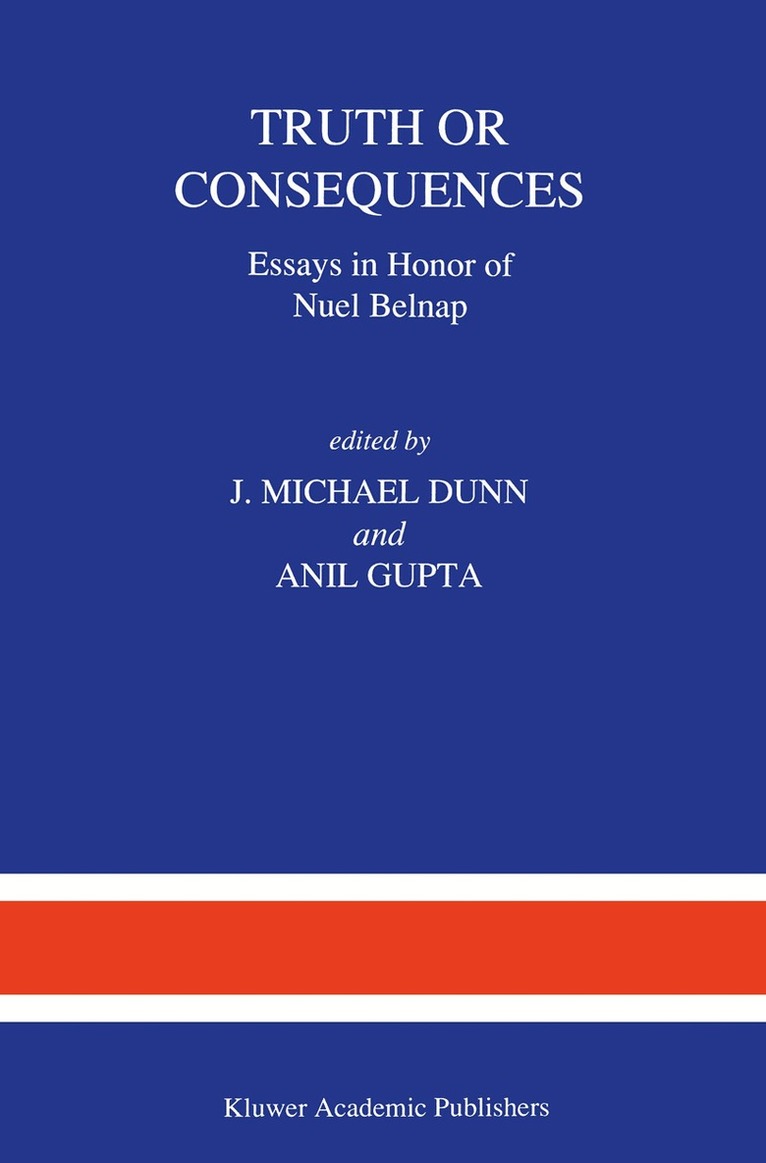
The essays in this collection are written by students, colleagues, and friends of Nuel Belnap to honor him on his sixtieth birthday. Our original plan was to include pieces from fonner students only, but we have deviated from this ever so slightly for a variety of personal and practical reasons. Belnap's research accomplishments are numerous and well known: He has founded (together with Alan Ross Anderson) a whole branch of logic known as "relevance logic." He has made contributions of fundamental importance to the logic of questions. His work in modal logic, fonnal pragmatics, and the theory of truth has been highly influential. And the list goes on. Belnap's accomplishments as a teacher are also distinguished and well known but, by virtue of the essential privacy of the teaching relationship, not so well understood. We would like to reflect a little on what makes him such an outstanding teacher.
Inbunden, Engelska, 2008
3 016 kr
Skickas inom 10-15 vardagar
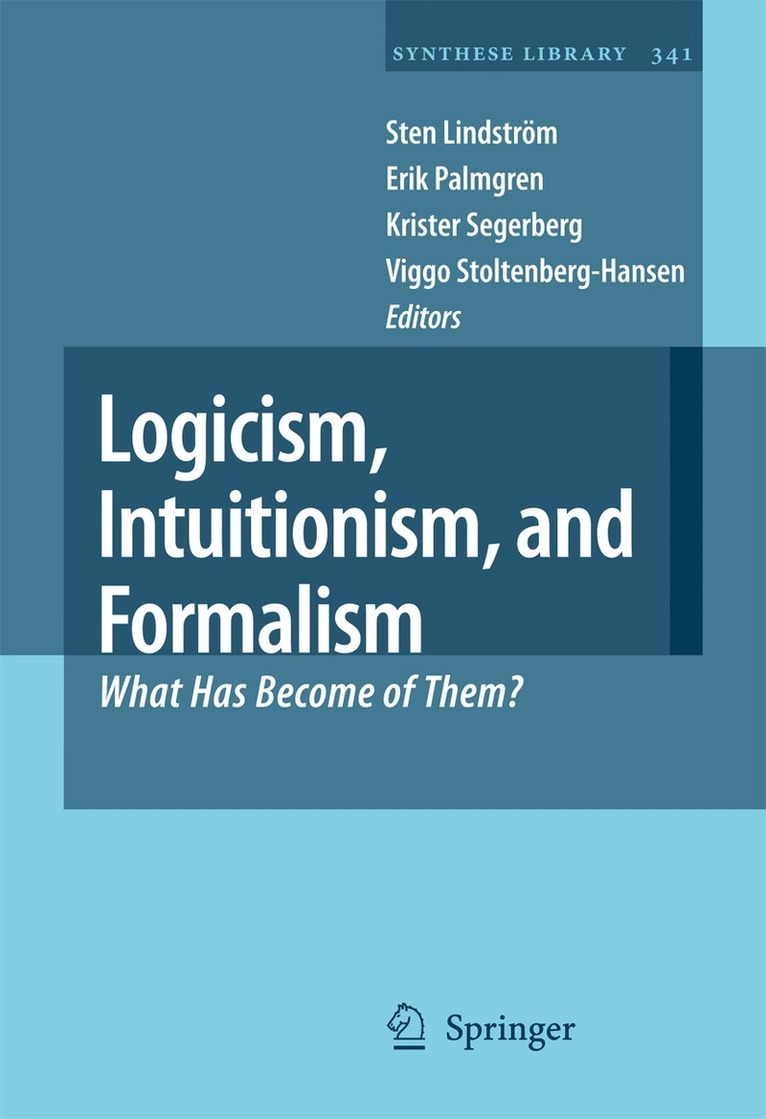
The present anthology has its origin in two international conferences that were arranged at Uppsala University in August 2004: "Logicism, Intuitionism and F- malism: What has become of them?" followed by "Symposium on Constructive Mathematics". The rst conference concerned the three major programmes in the foundations of mathematics during the classical period from Frege's Begrif- schrift in 1879 to the publication of Godel' .. s two incompleteness theorems in 1931: The logicism of Frege, Russell and Whitehead, the intuitionism of Brouwer, and Hilbert's formalist and proof-theoretic programme. The main purpose of the conf- ence was to assess the relevance of these foundational programmes to contemporary philosophy of mathematics. The second conference was announced as a satellite event to the rst, and was speci cally concerned with constructive mathematics-an activebranchofmathematicswheremathematicalstatements-existencestatements in particular-are interpreted in terms of what can be effectively constructed. C- structive mathematics may also be characterized as mathematics based on intuiti- isticlogicand,thus,beviewedasadirectdescendant ofBrouwer'sintuitionism.The two conferences were successful in bringing together a number of internationally renowned mathematicians and philosophers around common concerns. Once again it was con rmed that philosophers and mathematicians can work together and that real progress in the philosophy and foundations of mathematics is possible only if they do. Most of the papers in this collection originate from the two conferences, but a few additional papers of relevance to the issues discussed at the Uppsala c- ferences have been solicited especially for this volume.
Häftad, Engelska, 2001
379 kr
Skickas
Modal logic originated in philosophy as the logic of necessity and possibility. Now it has reached a high level of mathematical sophistication and has many applications in a variety of disciplines, ranging from artificial intelligence, computer science and mathematics via natural language syntax and semantics to philosophy. It is the main source of formal languages aimed at analyzing complex notions such as common knowlwdge and formal provability. This volume presents a broad, contemporary view of the field, with contributions covering the foundations of modal logic as well as its many application areas.
Del 341 - Synthese Library
Logicism, Intuitionism, and Formalism
What Has Become of Them?
Häftad, Engelska, 2010
2 991 kr
Skickas inom 10-15 vardagar
The present anthology has its origin in two international conferences that were arranged at Uppsala University in August 2004: "Logicism, Intuitionism and F- malism: What has become of them?" followed by "Symposium on Constructive Mathematics". The rst conference concerned the three major programmes in the foundations of mathematics during the classical period from Frege's Begrif- schrift in 1879 to the publication of Godel' .. s two incompleteness theorems in 1931: The logicism of Frege, Russell and Whitehead, the intuitionism of Brouwer, and Hilbert's formalist and proof-theoretic programme. The main purpose of the conf- ence was to assess the relevance of these foundational programmes to contemporary philosophy of mathematics. The second conference was announced as a satellite event to the rst, and was speci cally concerned with constructive mathematics-an activebranchofmathematicswheremathematicalstatements-existencestatements in particular-are interpreted in terms of what can be effectively constructed. C- structive mathematics may also be characterized as mathematics based on intuiti- isticlogicand,thus,beviewedasadirectdescendant ofBrouwer'sintuitionism.The two conferences were successful in bringing together a number of internationally renowned mathematicians and philosophers around common concerns. Once again it was con rmed that philosophers and mathematicians can work together and that real progress in the philosophy and foundations of mathematics is possible only if they do. Most of the papers in this collection originate from the two conferences, but a few additional papers of relevance to the issues discussed at the Uppsala c- ferences have been solicited especially for this volume.
Häftad, Engelska, 2011
1 605 kr
Skickas inom 10-15 vardagar
The essays in this collection are written by students, colleagues, and friends of Nuel Belnap to honor him on his sixtieth birthday. Our original plan was to include pieces from fonner students only, but we have deviated from this ever so slightly for a variety of personal and practical reasons. Belnap's research accomplishments are numerous and well known: He has founded (together with Alan Ross Anderson) a whole branch of logic known as "relevance logic." He has made contributions of fundamental importance to the logic of questions. His work in modal logic, fonnal pragmatics, and the theory of truth has been highly influential. And the list goes on. Belnap's accomplishments as a teacher are also distinguished and well known but, by virtue of the essential privacy of the teaching relationship, not so well understood. We would like to reflect a little on what makes him such an outstanding teacher.