The Foundations of Meta-Technics is a rigorous phenomenological analysis of the transcendence of anthropomorphic, anthropocentric, and geocentric technology in terms of the new meta-technical forms of space and time. The book draws out the epistemological and ontological implications of an emerging meta-technical supernature in which space and time are perceived by trans-human means and from trans-terrestrial perspectives. This book is especially valuable to philosophers in either the phenomenological or continental tradition.
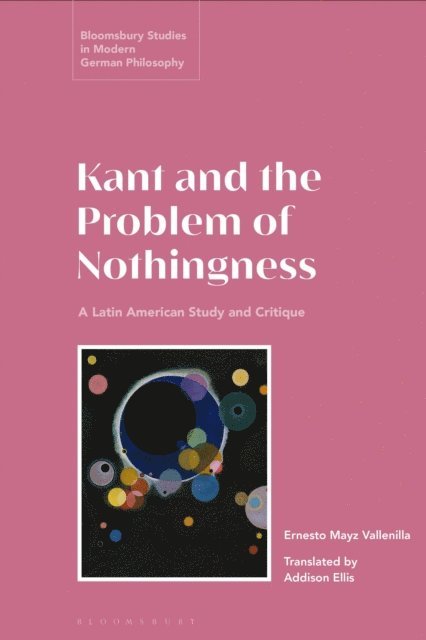
The Latin American philosopher Ernesto Mayz Vallenilla published the first study of Kant’s concept of nothingness in 1965. This translation of Mayz Vallenilla’s ground-breaking work makes it available in English for the first time.Mayz Vallenilla’s interpretation is deeply informed by Heidegger's reading of Kant, against the background of the early 20th century neo-Kantian tradition. He offers a detailed interpretation and critique of “nothing” as it appears in the Amphiboly chapter of the Critique of Pure Reason and presents an analysis of Kant’s Table of Nothing which understands temporality as the horizon of all possible cognition[AE1] , including cognition of real nothings.Accompanied by translator’s notes and a glossary, Addison Ellis' translation includes extensive commentary and an introduction providing historical context and references to the original sources in German. He preserves key terminology and phrasing from the original text and allows an often-neglected connection to be made between the Kantian tradition in Latin America and the tradition in the Anglophone world.
The Latin American philosopher Ernesto Mayz Vallenilla published the first study of Kant''s concept of nothingness in 1965. This translation of Mayz Vallenilla''s ground-breaking work makes it available in English for the first time. Mayz Vallenilla''s interpretation is deeply informed by Heidegger''s reading of Kant, against the background of the early 20th century neo-Kantian tradition. He offers a detailed interpretation and critique of “nothing” as it appears in the Amphiboly chapter of the Critique of Pure Reason and presents an analysis of Kant''s Table of Nothing which understands temporality as the horizon of all possible cognition[AE1] , including cognition of real nothings. Accompanied by translator''s notes and a glossary, Addison Ellis'' translation includes extensive commentary and an introduction providing historical context and references to the original sources in German. He preserves key terminology and phrasing from the original text and allows an often-neglected connection to be made between the Kantian tradition in Latin America and the tradition in the Anglophone world.
The Latin American philosopher Ernesto Mayz Vallenilla published the first study of Kant’s concept of nothingness in 1965. This translation of Mayz Vallenilla’s ground-breaking work makes it available in English for the first time.Mayz Vallenilla’s interpretation is deeply informed by Heidegger's reading of Kant, against the background of the early 20th century neo-Kantian tradition. He offers a detailed interpretation and critique of “nothing” as it appears in the Amphiboly chapter of the Critique of Pure Reason and presents an analysis of Kant’s Table of Nothing which understands temporality as the horizon of all possible cognition[AE1] , including cognition of real nothings.Accompanied by translator’s notes and a glossary, Addison Ellis' translation includes extensive commentary and an introduction providing historical context and references to the original sources in German. He preserves key terminology and phrasing from the original text and allows an often-neglected connection to be made between the Kantian tradition in Latin America and the tradition in the Anglophone world.
The Latin American philosopher Ernesto Mayz Vallenilla published the first study of Kant''s concept of nothingness in 1965. This translation of Mayz Vallenilla''s ground-breaking work makes it available in English for the first time. Mayz Vallenilla''s interpretation is deeply informed by Heidegger''s reading of Kant, against the background of the early 20th century neo-Kantian tradition. He offers a detailed interpretation and critique of “nothing” as it appears in the Amphiboly chapter of the Critique of Pure Reason and presents an analysis of Kant''s Table of Nothing which understands temporality as the horizon of all possible cognition[AE1] , including cognition of real nothings. Accompanied by translator''s notes and a glossary, Addison Ellis'' translation includes extensive commentary and an introduction providing historical context and references to the original sources in German. He preserves key terminology and phrasing from the original text and allows an often-neglected connection to be made between the Kantian tradition in Latin America and the tradition in the Anglophone world.
Der Autor will mit diesem Buch die Last einer überkommenen Tradition abschütteln und neue, faszinierende Horizonte einer im Entstehen begriffenen Welt eröffnen. Die Begründung der Meta-Technik stützt sich auf die Kernthese, dass die historische Entfaltung der ratio technica an einen Scheidepunkt gelangt ist, dessen Merkmale die Gegenwart und Zukunft der Menschheit in gleicher Weise beeinflussen werden. Dem Menschen stellt sich die titanische Aufgabe, eine von der ausschliesslich menschlichen radikal geschiedene Ratio zu schaffen, welche über deren Fundamente hinauswächst und ihre Grenzen sprengt. Seine zentralen Erkenntnisse gelten den daraus erwachsenden Folgen und der Verheissung eines neuen, phantastischen Universums.