Ernst B. Haas - Böcker
Visar alla böcker från författaren Ernst B. Haas. Handla med fri frakt och snabb leverans.
12 produkter
12 produkter
1 106 kr
Skickas inom 10-15 vardagar
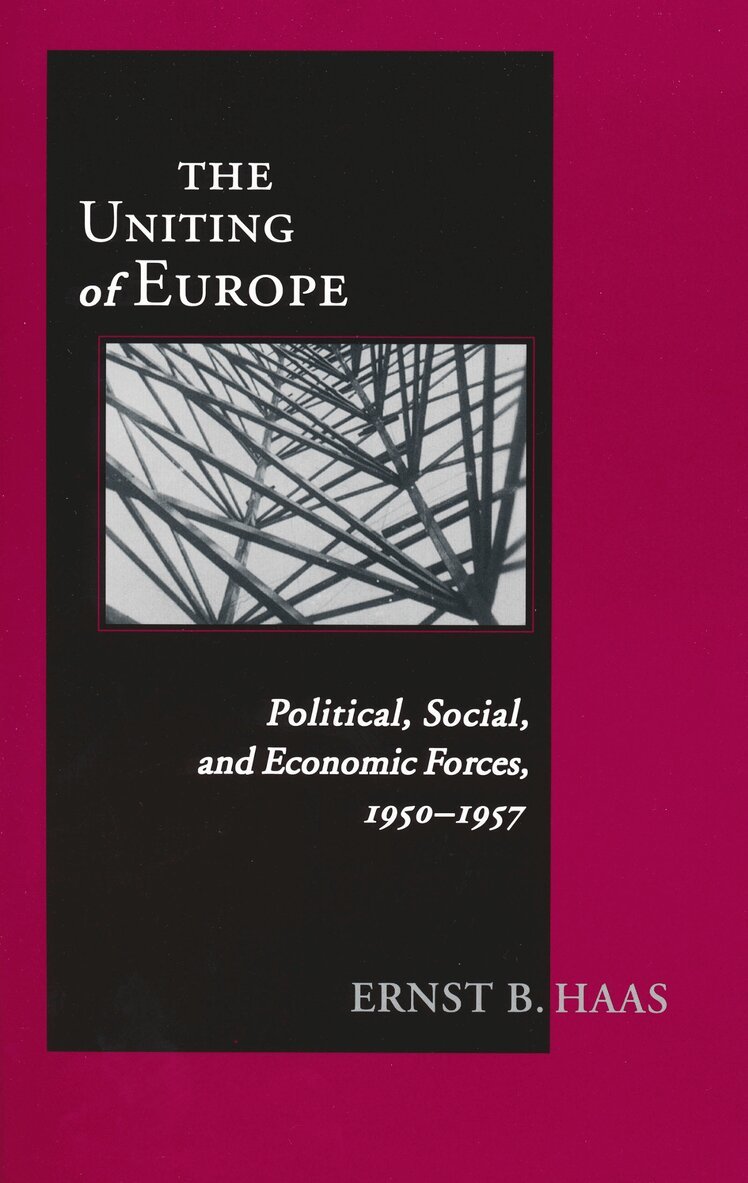
The University of Notre Dame Press is pleased to bring Ernst Haas's classic work on European integration, The Uniting of Europe, back into print. First published in 1958 and last printed in 1968, this seminal volume is the starting point for anyone interested in the pre-history of the European Union. Haas uses the European Coal and Steel Community (ECSC) as a case study of the community formation processes that occur across traditional national and state boundaries. Haas points to the ECSC as an example of an organization with the "power to redirect the loyalties and expectations of political actors."In this pathbreaking book Haas contends that, based on his observations of the actual integration process, the idea of a "united Europe" took root in the years immediately following World War II. His careful and rigorous analysis tracks the development of the ECSC, including, in his 1968 preface, a discussion of the eventual loss of the individual identity of the ECSC through its absorption into the new European Community. Featuring a new introduction by Haas analyzing the impact of his book over time, as well as an updated bibliography, The Uniting of Europe is a must-have for political scientists and historians of modern and contemporary Europe. This book is the inaugural volume of Notre Dame's new Contemporary European Politics and Society Series.
323 kr
Skickas inom 10-15 vardagar
The University of Notre Dame Press is pleased to bring Ernst Haas's classic work on European integration, The Uniting of Europe, back into print. First published in 1958 and last printed in 1968, this seminal volume is the starting point for anyone interested in the pre-history of the European Union. Haas uses the European Coal and Steel Community (ECSC) as a case study of the community formation processes that occur across traditional national and state boundaries. Haas points to the ECSC as an example of an organization with the "power to redirect the loyalties and expectations of political actors."In this pathbreaking book Haas contends that, based on his observations of the actual integration process, the idea of a "united Europe" took root in the years immediately following World War II. His careful and rigorous analysis tracks the development of the ECSC, including, in his 1968 preface, a discussion of the eventual loss of the individual identity of the ECSC through its absorption into the new European Community. Featuring a new introduction by Haas analyzing the impact of his book over time, as well as an updated bibliography, The Uniting of Europe is a must-have for political scientists and historians of modern and contemporary Europe. This book is the inaugural volume of Notre Dame's new Contemporary European Politics and Society Series.
Del 22 - Studies in International Political Economy
When Knowledge Is Power
Three Models of Change in International Organizations
Häftad, Engelska, 2018
665 kr
Skickas inom 3-6 vardagar
Do governments seeking to collaborate in such international organizations as the United Nations and the World Bank ever learn to improve the performance of those organizations? Can international organizations be improved by a deliberate institutional design that reflects lessons learned in peacekeeping, the protection of human rights, and environmentally sound economic development? In this incisive work, Ernst Haas examines these and other issues to delineate the conditions under which organizations change their methods for defining problems.Haas contends that international organizations change most effectively when they are able to redefine the causes underlying the problems to be addressed. He shows that such self-reflection is possible when the expert-generated knowledge about the problems can be made to mesh with the interests of hegemonic coalitions of member governments. But usually efforts to change organizations begin as adaptive practices that owe little to a systematic questioning of past behavior. Often organizations adapt and survive without fully satisfying most of their members, as has been the case with the United Nations since 1970.When Knowledge Is Power is a wide-ranging work that will elicit interest from political scientists, organization theorists, bureaucrats, and students of management and international administration.This title is part of UC Press's Voices Revived program, which commemorates University of California Press’s mission to seek out and cultivate the brightest minds and give them voice, reach, and impact. Drawing on a backlist dating to 1893, Voices Revived makes high-quality, peer-reviewed scholarship accessible once again using print-on-demand technology. This title was originally published in 1990.
Scientists and World Order
The Uses of Technical Knowledge in International Organizations
Häftad, Engelska, 2022
811 kr
Skickas inom 3-6 vardagar
Scientists and World Order: The Uses of Technical Knowledge in International Organizations by Ernst B. Haas, Mary Pat Williams, and Don Babai is a pioneering study of the intersection between scientific expertise and global governance. Drawing on interviews with over two hundred scientists and officials across institutions such as the United Nations, UNESCO, WHO, and the European Communities, the book investigates how internationally active scientists conceive of their responsibilities and how their knowledge shapes policy. The authors examine rationalist, pragmatic, and skeptical “world order models,” showing how different cognitive assumptions about knowledge and action inform institutional programs in areas ranging from environmental management to economic development.By tracing the evolution of nine major international science programs between the 1960s and 1970s, the authors reveal how technical expertise becomes institutionalized, contested, and refracted through political negotiation. At stake is whether science can serve as a transnational language for solving pressing problems—poverty, disease, energy, pollution—or whether political constraints and clashing goals limit its impact. Combining political science, sociology of science, and international relations, Scientists and World Order maps the cognitive terrain on which science, technology, and policy meet, offering a critical framework for understanding the promises and limits of scientific expertise in shaping world order.This title is part of UC Press's Voices Revived program, which commemorates University of California Press’s mission to seek out and cultivate the brightest minds and give them voice, reach, and impact. Drawing on a backlist dating to 1893, Voices Revived makes high-quality, peer-reviewed scholarship accessible once again using print-on-demand technology. This title was originally published in 1977.
Scientists and World Order
The Uses of Technical Knowledge in International Organizations
Inbunden, Engelska, 2022
1 469 kr
Skickas inom 3-6 vardagar
Scientists and World Order: The Uses of Technical Knowledge in International Organizations by Ernst B. Haas, Mary Pat Williams, and Don Babai is a pioneering study of the intersection between scientific expertise and global governance. Drawing on interviews with over two hundred scientists and officials across institutions such as the United Nations, UNESCO, WHO, and the European Communities, the book investigates how internationally active scientists conceive of their responsibilities and how their knowledge shapes policy. The authors examine rationalist, pragmatic, and skeptical “world order models,” showing how different cognitive assumptions about knowledge and action inform institutional programs in areas ranging from environmental management to economic development.By tracing the evolution of nine major international science programs between the 1960s and 1970s, the authors reveal how technical expertise becomes institutionalized, contested, and refracted through political negotiation. At stake is whether science can serve as a transnational language for solving pressing problems—poverty, disease, energy, pollution—or whether political constraints and clashing goals limit its impact. Combining political science, sociology of science, and international relations, Scientists and World Order maps the cognitive terrain on which science, technology, and policy meet, offering a critical framework for understanding the promises and limits of scientific expertise in shaping world order.This title is part of UC Press's Voices Revived program, which commemorates University of California Press’s mission to seek out and cultivate the brightest minds and give them voice, reach, and impact. Drawing on a backlist dating to 1893, Voices Revived makes high-quality, peer-reviewed scholarship accessible once again using print-on-demand technology. This title was originally published in 1977.
Del 22 - Studies in International Political Economy
When Knowledge Is Power
Three Models of Change in International Organizations
Inbunden, Engelska, 2024
1 469 kr
Skickas inom 3-6 vardagar
Do governments seeking to collaborate in such international organizations as the United Nations and the World Bank ever learn to improve the performance of those organizations? Can international organizations be improved by a deliberate institutional design that reflects lessons learned in peacekeeping, the protection of human rights, and environmentally sound economic development? In this incisive work, Ernst Haas examines these and other issues to delineate the conditions under which organizations change their methods for defining problems.Haas contends that international organizations change most effectively when they are able to redefine the causes underlying the problems to be addressed. He shows that such self-reflection is possible when the expert-generated knowledge about the problems can be made to mesh with the interests of hegemonic coalitions of member governments. But usually efforts to change organizations begin as adaptive practices that owe little to a systematic questioning of past behavior. Often organizations adapt and survive without fully satisfying most of their members, as has been the case with the United Nations since 1970.When Knowledge Is Power is a wide-ranging work that will elicit interest from political scientists, organization theorists, bureaucrats, and students of management and international administration.This title is part of UC Press's Voices Revived program, which commemorates University of California Press’s mission to seek out and cultivate the brightest minds and give them voice, reach, and impact. Drawing on a backlist dating to 1893, Voices Revived makes high-quality, peer-reviewed scholarship accessible once again using print-on-demand technology. This title was originally published in 1990.
981 kr
Skickas inom 10-15 vardagar
Has global liberalism made the nation-state obsolete? Or, on the contrary, are primordial nationalist hatreds overwhelming cosmopolitanism? To assert either theme without serious qualification, according to Ernst B. Haas, is historically simplistic and morally misleading. Haas describes nationalism as a key component of modernity and a crucial instrument for making sense of impersonal, rapidly changing, and heterogeneous societies. He characterizes nationalism as a feeling of collective identity, a mutual understanding experienced among people who may never meet but who are persuaded that they belong to a community of kindred spirits. Without nationalism, there could be no large integrated state.Nationalism comes in many varieties, some revolutionary in rejecting the past and some syncretist in seeking to retain religious traditions. Haas asks whether liberal nationalism is particularly successful as a rationalizing agent, noting that liberalism is usually associated with collective learning and that liberal-secular nationalism delivers substantial material benefits to mass populations. He also asks whether liberal nationalism can lead to its own transcendence. He explores nationalism in five societies that had achieved the status of nation-states by about 1880: the United States, Britain, France, Germany, and Japan.Several of these nation-states became exemplars for later nationalists. A second, forthcoming volume will consider ten societies that modernized more recently, many of them aroused to nationalism by the imperialism of these "old" nation-states.
981 kr
Skickas inom 10-15 vardagar
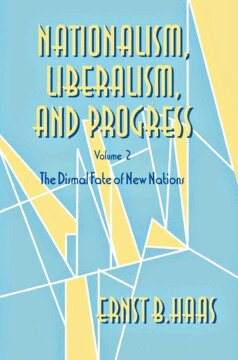
Far from being an inevitably aggressive and destructive force, nationalism is, for Ernst B. Haas, the primary means of bringing coherence to modernizing societies. In the second volume of his magisterial exploration of this topic, Haas emphasizes the benefits of liberal nationalism, which he deems more progressive than other nation-building formulas because it relies on reason to improve citizens' lives.The Dismal Fate of New Nations considers several societies that modernized relatively recently, many of them aroused to nationalism by the imperialism of the "old" nation-states. The book probes the different patterns of development in emerging countries—Iran, Egypt, India, Brazil, Mexico, China, Russia, and Ukraine—for insights into the possibilities and limitations of all nationalisms, especially liberal nationalism.Employing a systematic comparative perspective, Haas organizes the book around the notion of change and its management by political elites in Asia, Eastern Europe, Latin America, and the Middle East. Haas particularly wants to understand how nationalism plays out in the politics of modernization within non-Western cultures, especially those where religions other than Christianity predominate. Where the hold of religion remains formidable, he argues, the mixture of traditional and secular-modernist institutions and beliefs will challenge the victory of liberal nationalism and the very success of nation-state formation.
1 009 kr
Skickas inom 10-15 vardagar
461 kr
Skickas inom 5-8 vardagar
353 kr
Skickas inom 5-8 vardagar
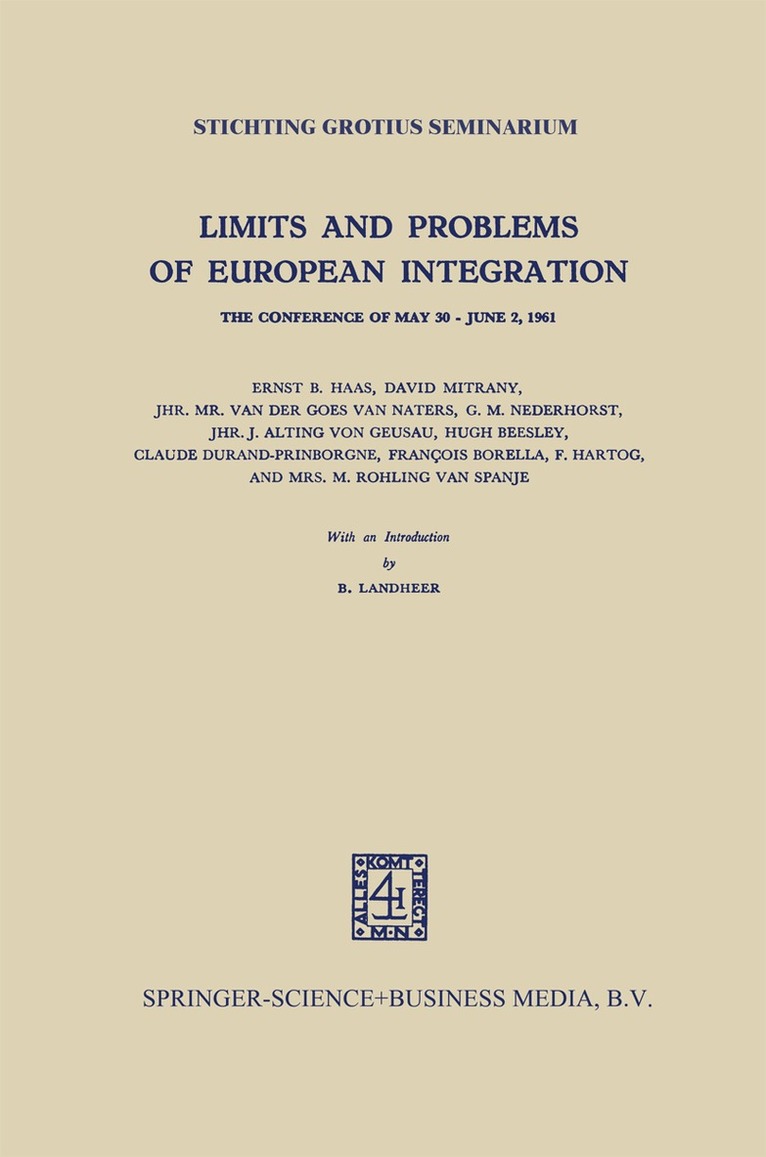
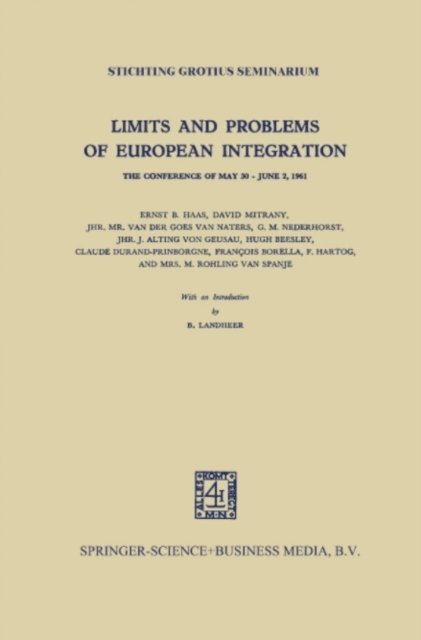
Limits and Problems of European Integration
The Conference of May 30 - June 2, 1961
Häftad, Engelska, 1963
551 kr
Skickas inom 10-15 vardagar
by B. LANDHEER The Grotius Seminarium has as its purpose the study of international problems under the aspect of "living and cooperating in one world." Its Conference of May 30-June 2, I96I on "Limits and Problems of European integration" attempted to view European integration within the framework of this general goal as is somewhat implied in its title. "The limits of European integration" lie in the necessity of fitting it in the wider framework of international cooperation, while its problems lie in the various interpretations and concretizations of its own goals, ab out which there are a number of different viewpoints. It could be stated that the European is faced with three sets of problems: the creation of a more unified world as a global problem; the regional integration of Europe; and, thirdly, the continuation of more strictly national interests. It is not justified to assume that these three circles of interest are automatically complementary: they are often antagonistic, and a "philosophy of integration" would have to arrive at a structural presentation of those various values and of tbeir interrelatedness. While it is obviously not possible for a small Conference to give those problems their full weight, it is nevertheless hoped that the essays combined in this volume raise a number of relevant questions and contribute to the elaboration of some more concrete problems.