Ernst Ulrich von Weizsacker – författare
Visar alla böcker från författaren Ernst Ulrich von Weizsacker. Handla med fri frakt och snabb leverans.
18 produkter
Factor Five
Transforming the Global Economy through 80% Improvements in Resource Productivity
Av Ernst Ulrich von Weizsacker, Charlie Hargroves m. fl.
Häftad, 2014
892 kr
Lägg i varukorg
When first published in 1997, Factor Four: Doubling Wealth, Halving Resource Use by renowned economic and engineering experts Ernst von Weizsäcker, Amory Lovins and L. Hunter Lovins, transformed how economists, policy makers, engineers, entrepreneurs and business leaders thought about innovation …
Factor Five
Transforming the Global Economy through 80% Improvements in Resource Productivity
Av Peter Stasinopoulos, Cheryl Desha m. fl.
E-bok, 2009
1056 kr
Lägg i varukorg
When first published in 1997, Factor Four: Doubling Wealth, Halving Resource Use by renowned economic and engineering experts Ernst von Weizsäcker, Amory Lovins and L. Hunter Lovins, transformed how economists, policy makers, engineers, entrepreneurs and business leaders thought about innovation …
Factor Five
Transforming the Global Economy through 80% Improvements in Resource Productivity
Av Peter Stasinopoulos, Cheryl Desha m. fl.
E-bok, 2009
1056 kr
Lägg i varukorg
When first published in 1997, Factor Four: Doubling Wealth, Halving Resource Use by renowned economic and engineering experts Ernst von Weizsäcker, Amory Lovins and L. Hunter Lovins, transformed how economists, policy makers, engineers, entrepreneurs and business leaders thought about innovation …
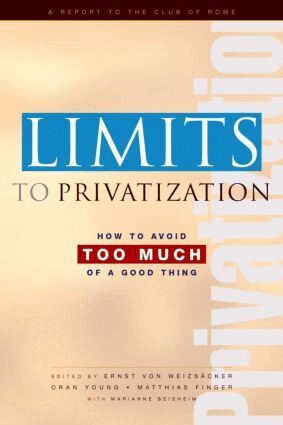
Limits to Privatization
How to Avoid Too Much of a Good Thing - A Report to the Club of Rome
Av Marianne Beisheim, Matthias Finger m. fl.
E-bok, 2012
901 kr
Lägg i varukorg
Limits to Privatization is the first thorough audit of privatizations from around the world. It outlines the historical emergence of globalization and liberalization, and from analyses of over 50 case studies of best- and worst-case experiences of privatization, it provides guidance for policy and …
Limits to Privatization
How to Avoid Too Much of a Good Thing - A Report to the Club of Rome
Av Marianne Beisheim, Matthias Finger m. fl.
E-bok, 2012
901 kr
Lägg i varukorg
Limits to Privatization is the first thorough audit of privatizations from around the world. It outlines the historical emergence of globalization and liberalization, and from analyses of over 50 case studies of best- and worst-case experiences of privatization, it provides guidance for policy and …
Governance and Sustainability
New Challenges for States, Companies and Civil Society
Av Ernst Ulrich von Weizsacker, James Rosenau m. fl.
E-bok, 2017
1195 kr
Lägg i varukorg
Sustainability cannot be achieved without good governance. The Johannesburg World Summit on Sustainable Development in 2002 stated that governance and sustainable development are intimately tied together and the future role and architecture of institutions, from local to international levels, will …
Governance and Sustainability
New Challenges for States, Companies and Civil Society
Av Ernst Ulrich von Weizsacker, James Rosenau m. fl.
E-bok, 2017
1169 kr
Lägg i varukorg
Sustainability cannot be achieved without good governance. The Johannesburg World Summit on Sustainable Development in 2002 stated that governance and sustainable development are intimately tied together and the future role and architecture of institutions, from local to international levels, will …
Eco-efficiency and Beyond
Towards the Sustainable Enterprise
Av Ernst Ulrich von Weizsacker, Christa Liedtke m. fl.
E-bok, 2017
856 kr
Lägg i varukorg
Business-as-usual, it is widely accepted, will exceed the Earth''s carrying capacity in an alarmingly short space of time. In simple terms, we need to learn to use the world''s rapidly depleting resources in a significantly more efficient manner. Practical and readily adopted solutions are needed …
Eco-efficiency and Beyond
Towards the Sustainable Enterprise
Av Ernst Ulrich von Weizsacker, Christa Liedtke m. fl.
E-bok, 2017
856 kr
Lägg i varukorg
Business-as-usual, it is widely accepted, will exceed the Earth''s carrying capacity in an alarmingly short space of time. In simple terms, we need to learn to use the world''s rapidly depleting resources in a significantly more efficient manner. Practical and readily adopted solutions are needed …
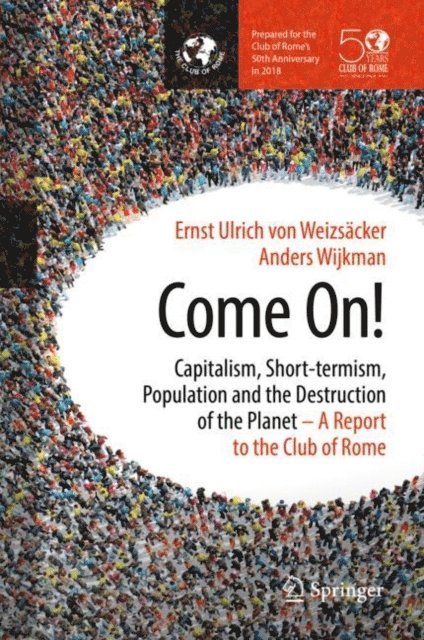
Come On!
Capitalism, Short-termism, Population and the Destruction of the Planet
Av Anders Wijkman, Ernst Ulrich von Weizsacker
E-bok, 2017
408 kr
Lägg i varukorg
Current worldwide trends are not sustainable. The Club of Rome’s warnings published in the book Limits to Growth are still valid. Remedies that are acceptable for the great majority tend to make things worse. We seem to be in a philosophical crisis. Pope Francis says it clearly: our common home is …
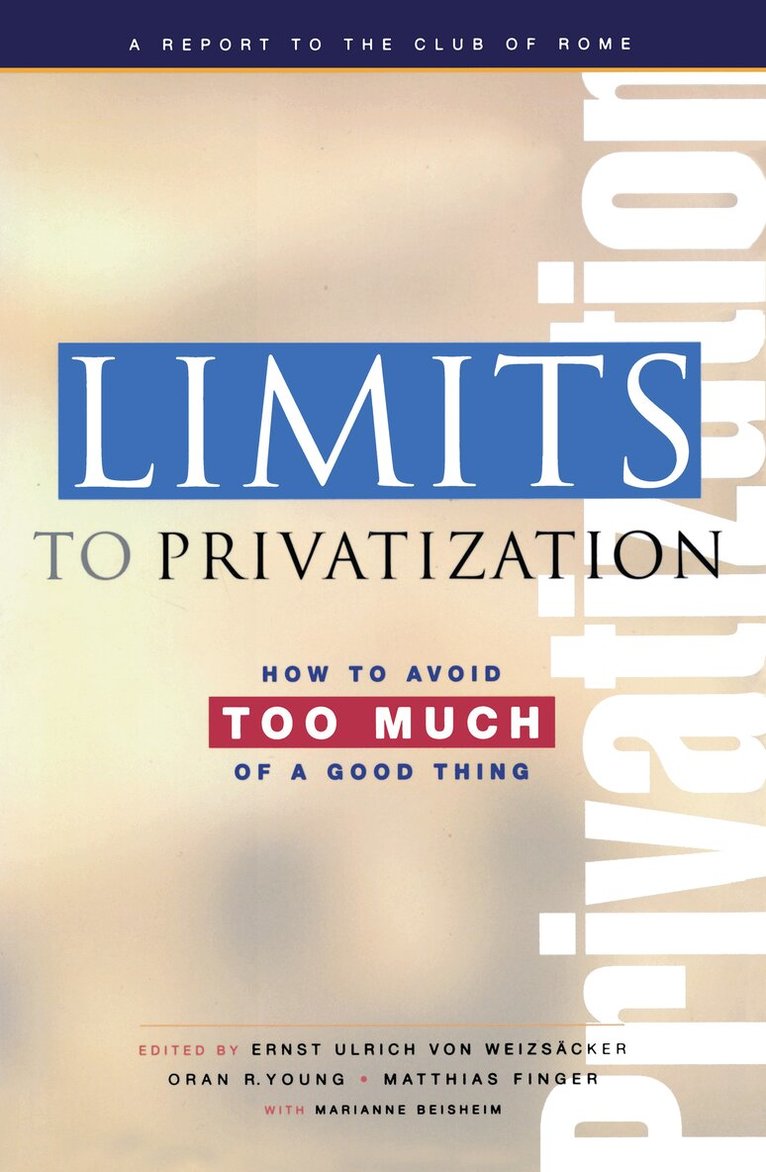
Limits to Privatization
How to Avoid Too Much of a Good Thing - A Report to the Club of Rome
Av Ernst Ulrich von Weizsacker, Matthias Finger m. fl.
Inbunden, 2005
2190 kr
Lägg i varukorg
Limits to Privatization is the first thorough audit of privatizations from around the world. It outlines the historical emergence of globalization and liberalization, and from analyses of over 50 case studies of best- and worst-case experiences of privatization, it provides guidance for policy and …
Limits to Privatization
How to Avoid Too Much of a Good Thing - A Report to the Club of Rome
Av Ernst Ulrich von Weizsacker, Matthias Finger m. fl.
Häftad, 2006
785 kr
Lägg i varukorg
Limits to Privatization is the first thorough audit of privatizations from around the world. It outlines the historical emergence of globalization and liberalization, and from analyses of over 50 case studies of best- and worst-case experiences of privatization, it provides guidance for policy and …
Factor Five
Transforming the Global Economy through 80% Improvements in Resource Productivity
Av Ernst Ulrich von Weizsacker, Charlie Hargroves m. fl.
Inbunden, 2009
2504 kr
Lägg i varukorg
When first published in 1997, Factor Four transformed how economists, policy makers, engineers, entrepreneurs and business leaders thought about innovation and wealth creation. Through examples from a wide range of industrial sectors, the authors demonstrated how technical innovation could cut …
Connaître notre valeur
Conversations sur l'énergie et le développement durable
Av Daisaku Ikeda, Ernst Ulrich Von Weizsacker
Häftad, 2020
227 kr
Lägg i varukorg
Ökoeffizienz
Management der Zukunft
Av Jan-Dirk Seiler-Hausmann, Ernst Ulrich von Weizsacker
E-bok, 2013
462 kr
Lägg i varukorg
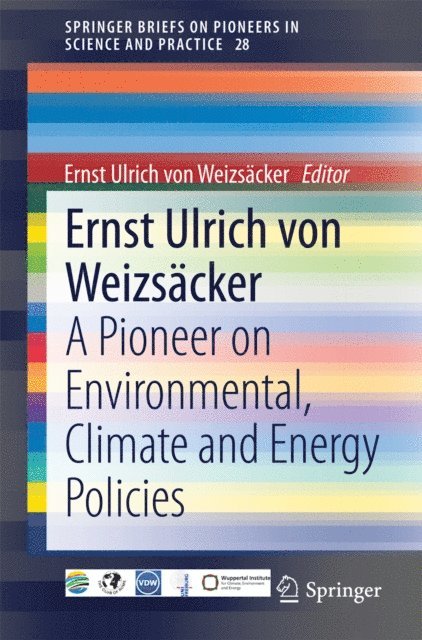
Ernst Ulrich von Weizsacker
A Pioneer on Environmental, Climate and Energy Policies
Av Ernst Ulrich von Weizsacker
E-bok, 2014
877 kr
Lägg i varukorg
On the occasion of the 75th birthday of Ernst Ulrich von Weizsäcker this unique anthology presents thought-provoking texts from 1970 to 2013, spanning several disciplines and combining science and practice. Among them are three Reports to the Club of Rome that Weizsäcker lead-authored, a new …
Faktor Fünf
Die Formel für nachhaltiges Wachstum
Av Michael Smith, Karlson Hargroves m. fl.
E-bok, 2012
57 kr
Lägg i varukorg
Eine Revolution des Wirtschaftens kündigt sich anDie Welt wird sich im 21. Jahrhundert grundlegend verändern. Entweder lernt die Menschheit, nachhaltig mit der Erde umzugehen, oder die Natur wird zurückschlagen.Mit Faktor Fünf stellen Ernst Ulrich von Weizsäcker und seine Koautoren das Konzept …
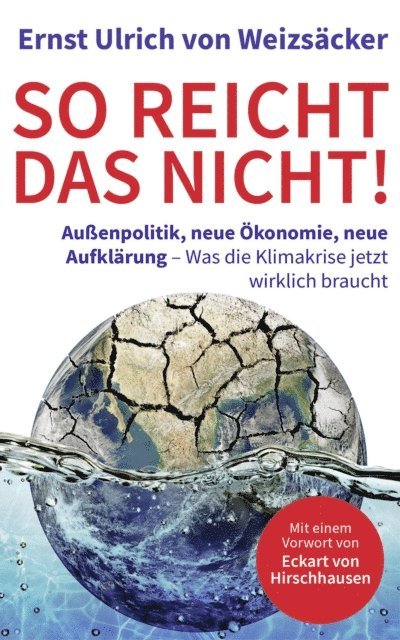
So reicht das nicht!
Außenpolitik, neue Ökonomie, neue Aufklärung - Was die Klimakrise jetzt wirklich braucht
Av Ernst Ulrich von Weizsacker
E-bok, 2022
179 kr
Lägg i varukorg
»Wir dürfen keine Zeit mehr verlieren. Vor allem müssen wir Klima-Außenpolitik lernen.« Ernst Ulrich von WeizsäckerSeit dem berühmten Club-of-Rome-Bericht von 1972 "Die Grenzen des Wachstums" sollte die Welt wissen, dass das schiere Wirtschaftswachstum zu viel Schaden anrichtet. Besonders beim …