Eugene B. Rumer - Böcker
Visar alla böcker från författaren Eugene B. Rumer. Handla med fri frakt och snabb leverans.
6 produkter
6 produkter
260 kr
Skickas inom 3-6 vardagar
414 kr
Skickas inom 10-15 vardagar
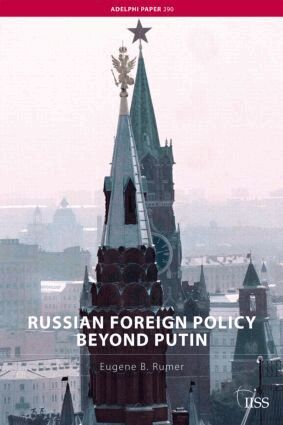
Russia’s resurgence as an assertive actor in the global diplomatic arena after a long period of introspection and preoccupation with domestic troubles, and the economic revival that underpins it, are among the most striking developments in international relations of recent years. But what drives Russian foreign policy at the end of the Putin era? To what extent is it shaped by Russia’s role as a major energy supplier, and how long can the country remain an ‘energy superpower’, if indeed it is one? How might Russian foreign policy change in the years ahead? Which way will Russia, faced with the might of growing powers around it, and struggling with the fragility of its economic success and stability at home, choose to face in international relations? This Adelphi Paper examines the domestic context of contemporary Russian foreign policy and its key political, economic, military and security drivers, as well as looking at the contrasting outlook that preceded it, and at how Russia’s international posture may adjust again in the coming years. It concludes with recommendations for Western policy makers on how to respond to Russia’s return.
Central Asia: Views from Washington, Moscow, and Beijing
Views from Washington, Moscow, and Beijing
Inbunden, Engelska, 2007
2 558 kr
Skickas inom 10-15 vardagar
The disintegration of the Soviet Union in 1991 rapidly and irrevocably transformed Central Asia's political landscape. This region of five sovereign states with a population of some fifty million people quickly became a major focus of interest and influence for competing poles of power. The eminent contributors to this volume offer a four-part analysis of the region's new importance in world affairs. Rajan Menon examines the place of Central Asia in a global perspective. Eugene Rumer considers the perspective of the post-9/11 United States. Dimitri Trenin looks at the region from the standpoint of traditional hegemon Russia. Huasheng Zhao provides the view from economic superpower-in-the-making China.
Central Asia: Views from Washington, Moscow, and Beijing
Views from Washington, Moscow, and Beijing
Häftad, Engelska, 2007
725 kr
Skickas inom 10-15 vardagar
The disintegration of the Soviet Union in 1991 rapidly and irrevocably transformed Central Asia's political landscape. This region of five sovereign states with a population of some fifty million people quickly became a major focus of interest and influence for competing poles of power. The eminent contributors to this volume offer a four-part analysis of the region's new importance in world affairs. Rajan Menon examines the place of Central Asia in a global perspective. Eugene Rumer considers the perspective of the post-9/11 United States. Dimitri Trenin looks at the region from the standpoint of traditional hegemon Russia. Huasheng Zhao provides the view from economic superpower-in-the-making China.
255 kr
Skickas inom 5-8 vardagar
2 424 kr
Skickas inom 10-15 vardagar
Russia‘s resurgence as an assertive actor in the global diplomatic arena after a long period of introspection and preoccupation with domestic troubles, and the economic revival that underpins it, are among the most striking developments in international relations of recent years. But what drives Russian foreign policy at the end of the Putin era? To what extent is it shaped by Russia‘s role as a major energy supplier, and how long can the country remain anenergy superpower if indeed it is one? How might Russian foreign policy change in the years ahead? Which way will Russia, faced with the might of growing powers around it, and struggling with the fragility of its economic success and stability at home, choose to face in international relations? This Adelphi Paper examines the domestic context of contemporary Russian foreign policy and its key political, economic, military and security drivers, as well as looking at the contrasting outlook that preceded it, and at how Russia‘s international posture may adjust again in the coming years. It concludes with recommendations for Western policy makers on how to respond to Russia‘s return.