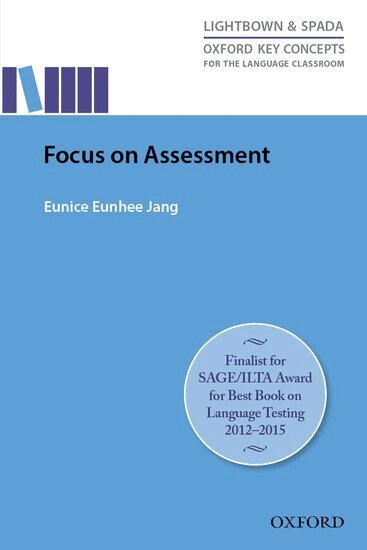
helps teachers to understand research evidence in language assessment for students aged 6-16, and to develop an ability to design, implement, and critically evaluate language assessment, with reference to language frameworks and standards for assessment in school education. The book includes:This book is part of the Oxford Key Concepts for the Language Classroom series, focusing on key topics for teaching English as a second or foreign language. These research-led instructional guides link the theories of secondlanguage acquisition andpedagogy with classroom practice, helping you to reflect on what needs to happen in the language classroom. Eunice Eunhee Jang is Associate Professor in the Department of Applied Psychology and Human Development at the Ontario Institute for Studies in Education, University of Toronto.
The concept of communicative competence has been rendered as context-abstracted code-bound knowledge for language teaching and assessment. This Element offers a different perspective on 'communication' and 'competence'. Section 1 offers the rationale for this re-orientation. Section 2 examines the conceptual and pedagogic affordances and delimitations of the prevailing approach to communicative competence; Section 3 describes a conceptual re-framing of language use as ecological languaging in terms of embodied, situation-sensitive action through which people coordinate with others, artefacts, and environments; Section 4 explores assessment approaches built on Bayesian principles for tracking learner development and progress by taking account of prior accomplishment, expert opinion, and emerging performance to create probabilistic trajectories; Section 5 focusses on professional developments related to conceptual refinement, curriculum design, teaching materials, and teacher education. Section 6 considers some key future challenges. This Element is also available as Open Access on Cambridge Core.
helps teachers to understand research evidence in language assessment for students aged 6-16, and to develop an ability to design, implement, and critically evaluate language assessment, with reference to language frameworks and standards for assessment in school education. The book includes:This book is part of the Oxford Key Concepts for the Language Classroom series, focusing on key topics for teaching English as a second or foreign language. These research-led instructional guides link the theories of secondlanguage acquisition andpedagogy with classroom practice, helping you to reflect on what needs to happen in the language classroom. Eunice Eunhee Jang is Associate Professor in the Department of Applied Psychology and Human Development at the Ontario Institute for Studies in Education, University of Toronto.
The concept of communicative competence has been rendered as context-abstracted code-bound knowledge for language teaching and assessment. This Element offers a different perspective on 'communication' and 'competence'. Section 1 offers the rationale for this re-orientation. Section 2 examines the conceptual and pedagogic affordances and delimitations of the prevailing approach to communicative competence; Section 3 describes a conceptual re-framing of language use as ecological languaging in terms of embodied, situation-sensitive action through which people coordinate with others, artefacts, and environments; Section 4 explores assessment approaches built on Bayesian principles for tracking learner development and progress by taking account of prior accomplishment, expert opinion, and emerging performance to create probabilistic trajectories; Section 5 focusses on professional developments related to conceptual refinement, curriculum design, teaching materials, and teacher education. Section 6 considers some key future challenges. This Element is also available as Open Access on Cambridge Core.