Ewing Michael C. Ewing – författare
Visar alla böcker från författaren Ewing Michael C. Ewing. Handla med fri frakt och snabb leverans.
2 produkter
2 produkter
E-bok
Engelska, 20241 447 kr
Läs direkt efter köp
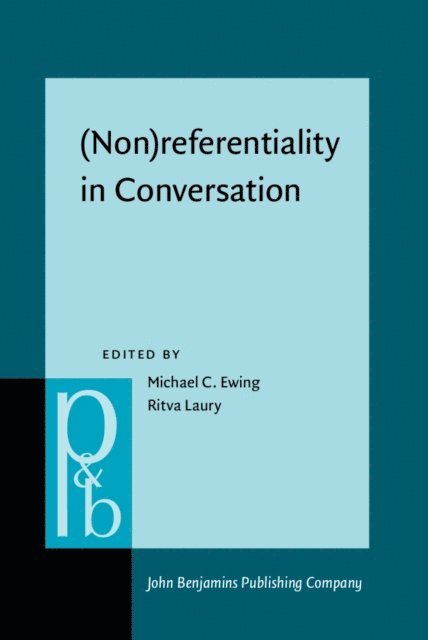
Although there is a large literature on referentiality, going back to at least the nineteenth and early twentieth century, much of this early work is based on constructed data and most of it is on English. The chapters in this volume contribute to a growing body of work that examines referentiality through naturalistic data in context. Taking an interactional approach to (non)referentiality, contributors to this volume ask how participants talk in real time about persons and things as individuals or as categories, and what distinguishes ‘referential’ from ‘nonreferential’, ‘specific’ from ‘nonspecific’, and ‘generic’ from ‘nongeneric’. Crucially, we ask whether these distinctions even matter to participants in conversation, and if they do, what the evidence for that would be. Contributors investigate these issues using data from conversational interaction in a variety of social contexts – including between close friends and family to more casual acquaintances, in service encounters, and between adults and children – and in a range of languages: English, Finnish, French, Indonesian, Japanese and Mandarin. Collectively, the chapters develop insights showing that reference is often fluid, dynamic, and indeterminate, that referential indeterminacy is typically unproblematic for participants, that shifts in referentiality tend to be tied to specific social goals, and that reference and referentiality emerge dialogically and interactionally.
E-bok
PDF, Engelska, 20051 651 kr
Läs direkt efter köp
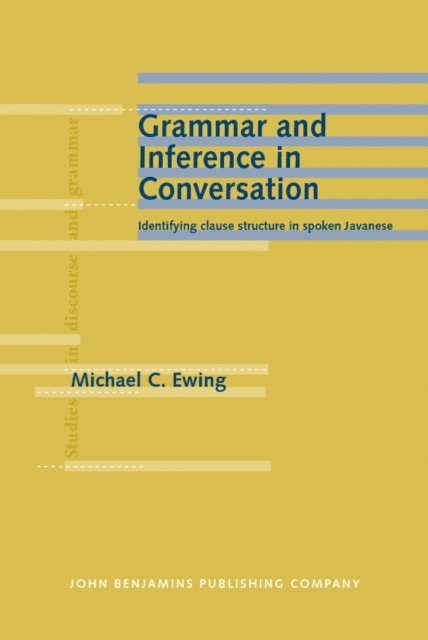
This study analyzes how morphosyntactic structures and information flow characteristics are used by interlocutors in producing and understanding clauses in conversational Javanese, focusing on the Cirebon variety of the language. While some clauses display grammatical mechanisms used to code their structure explicitly and redundantly, many other clauses include few if any of these grammatical resources. These extremes mark a cline between the morphosyntactic and paratactic expression of clauses. The situation is thrown into relief by the frequency of unexpressed referents and conversationalists' heavy reliance on shared experience and cultural knowledge. In all cases, pragmatic inference grounded in the interactional context is essential for establishing not only the discourse functions, but indeed also the very structure of clauses in conversational Javanese. This study contributes to our understanding of transitivity, emergent constituency, prosodic organization and the co-construction of meaning and structure by conversational interlocutors.