Laury Ritva Laury – författare
Visar alla böcker från författaren Laury Ritva Laury. Handla med fri frakt och snabb leverans.
7 produkter
7 produkter
E-bok
Engelska, 20241 447 kr
Läs direkt efter köp
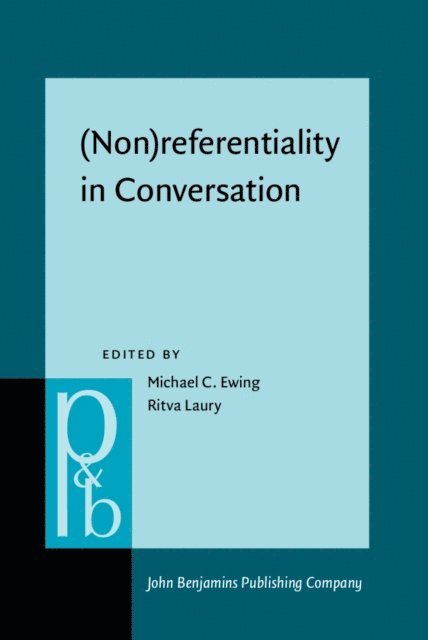
Although there is a large literature on referentiality, going back to at least the nineteenth and early twentieth century, much of this early work is based on constructed data and most of it is on English. The chapters in this volume contribute to a growing body of work that examines referentiality through naturalistic data in context. Taking an interactional approach to (non)referentiality, contributors to this volume ask how participants talk in real time about persons and things as individuals or as categories, and what distinguishes ‘referential’ from ‘nonreferential’, ‘specific’ from ‘nonspecific’, and ‘generic’ from ‘nongeneric’. Crucially, we ask whether these distinctions even matter to participants in conversation, and if they do, what the evidence for that would be. Contributors investigate these issues using data from conversational interaction in a variety of social contexts – including between close friends and family to more casual acquaintances, in service encounters, and between adults and children – and in a range of languages: English, Finnish, French, Indonesian, Japanese and Mandarin. Collectively, the chapters develop insights showing that reference is often fluid, dynamic, and indeterminate, that referential indeterminacy is typically unproblematic for participants, that shifts in referentiality tend to be tied to specific social goals, and that reference and referentiality emerge dialogically and interactionally.
E-bok
Engelska, 20211 305 kr
Läs direkt efter köp
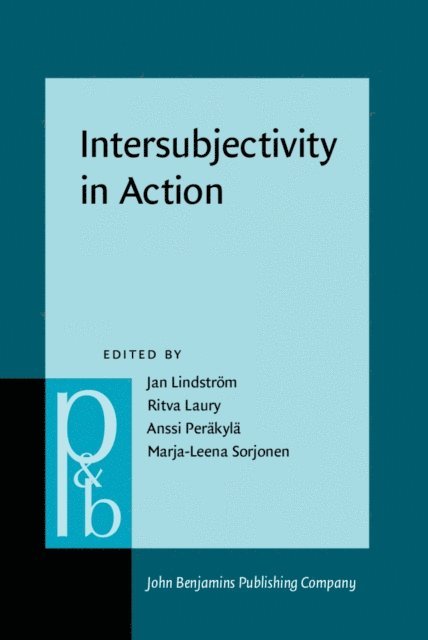
Intersubjectivity is a precondition for human life - for social organization as well as for individual development and well-being. Through empirical examination of social interactions in everyday and institutional settings, the authors in this volume explore the achievement and maintenance of intersubjectivity. The contributions show how language codes and creates intersubjectivity, how interactants move towards shared understanding in interaction, how intersubjectivity is central to phenomena and experiences often considered merely individual, and how intersubjectivity evolves through learning. While the core methodology of the studies is Conversation Analysis, the volume highlights the advantages of using several methods to tackle intersubjectivity.
E-bok
Engelska, 20211 195 kr
Läs direkt efter köp
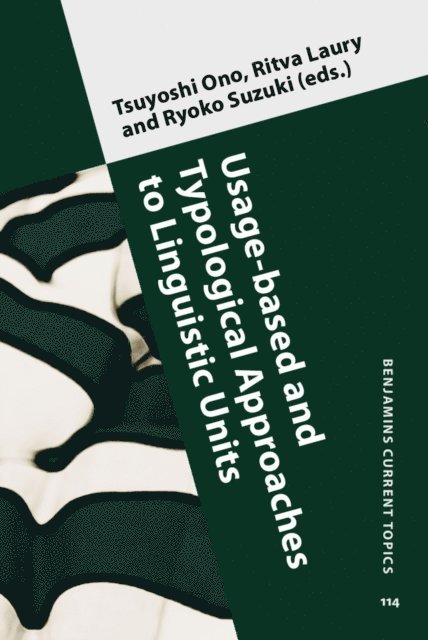
The chapters in this volume focus on how we might understand the concept of 'unit' in human languages. It is an analytical notion that has been widely adopted by linguists of various theoretical and applied orientations but has recently been critically examined by both typologically oriented and interactional linguistics. This volume contributes to and extends this discussion by examining the nature of units in actual usage in a range of genetically and typologically unrelated languages, English, Finnish, Indonesian, Japanese, and Mandarin, engaging with fundamental theoretical issues. The chapters show that categories originally created for the description of Indo-European languages have limited usefulness if our goal is to understand the nature of human language in general. The authors thus question the status of traditionally accepted linguistic units, especially their static understanding as a priori entities, and suggest instead that an emergent and interactional view of both structure and function offers a better fit with the data from the languages examined. Originally published as special issue 43:2 (2019) of Studies in Language.
E-bok
Engelska, 20201 258 kr
Läs direkt efter köp
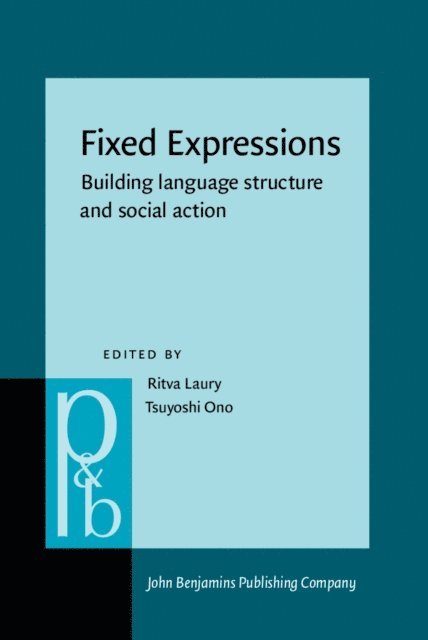
This volume concerns the structure and use of fixed expressions in a range of typologically, genetically and areally distinct languages. The chapters consider the use contexts of fixed expressions, at the same time taking seriously the need to account for their structural aspects. Formulaicity is taken here as a central feature of everyday language use, and fixed expressions as a basic utterance building resource for interaction. Our crosslinguistic investigation suggests that humans have the propensity to automatize ways to handle various discourse-level needs for specific sequential contexts by creating (semi-)fixed expressions based on frequent patterns. The chapters examine topics such as the degrees and types of fixedness, the emergence of fixed expressions, their connection to social action, the new understanding of traditional linguistic categories in light of fixedness, crosslinguistic variation in types of fixed expressions, as well as their non-verbal aspects. The volume situates the notion of 'units' of language at the intersection of interaction and formal structure as part of a larger effort to replace rule-based conceptions of language with a more dynamic, realistic and pragmatically based model of language. The articles are based on naturally occurring data, mostly everyday conversation, in English, Estonian, Finnish, Japanese, and Mandarin, with some crosslinguistic comparison.
E-bok
PDF, Engelska, 19971 525 kr
Läs direkt efter köp
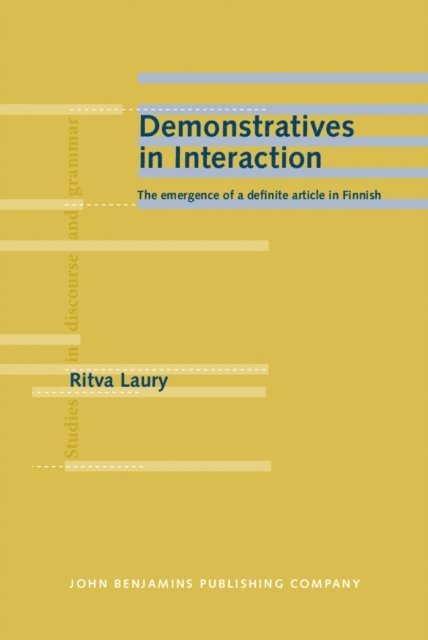
This book concerns one of the paradigm examples of grammaticalization, the development of a definite article from a demonstrative determiner. Although standard written Finnish has no articles, the demonstrative se is currently emerging as a definite article in spoken Finnish. This book describes and explains the developing use of se based on a database consisting of spoken narratives from three different periods spanning the last one hundred years.The author proposes that the development from demonstrative to article has its roots in the way that speakers ordinarily use demonstratives in conversation, and provides an analysis of the use of se and the two other Finnish demonstratives, tämä and tuo in a corpus of multi-party conversations, showing that speakers of Finnish use demonstratives to focus attention on important referents and to express and negotiate access to them in the interactive context of ongoing talk, and not primarily to talk about how near or far referents are. The development of se into a general marker of identifiability is shown to be connected with both the focusing function of demonstratives as well as its use for referents which the speaker considers accessible to the addressee.
E-bok
PDF, Engelska, 20111 258 kr
Läs direkt efter köp
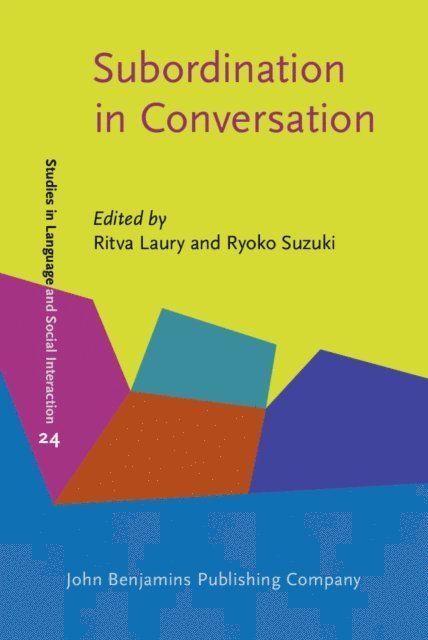
The articles in this volume examine the notion of clausal subordination based on English, Estonian, Finnish, French, German and Japanese conversational data. Some of the articles approach ‘subordination’ in terms of social action, taking into account what participants are doing with their talk, considering topics such as the use of clauses as projector phrases and as devices for organizing the participant structure of the conversation. Other articles focus on the emergence of clause combinations diachronically and synchronically, taking on topics such as the grammaticalization of clauses and conjunctions into discourse markers, and the continuum nature of syntactic subordination. In all of the articles, linguistic forms are considered to be emergent from recurrent practices engaged in by participants in conversation. The contributions critically examine central syntactic notions in interclausal relations and their relevance to the description of clause combining in conversational language, to the structure of conversation, and to the interactional functions of language.
E-bok
PDF, Engelska, 20081 384 kr
Läs direkt efter köp
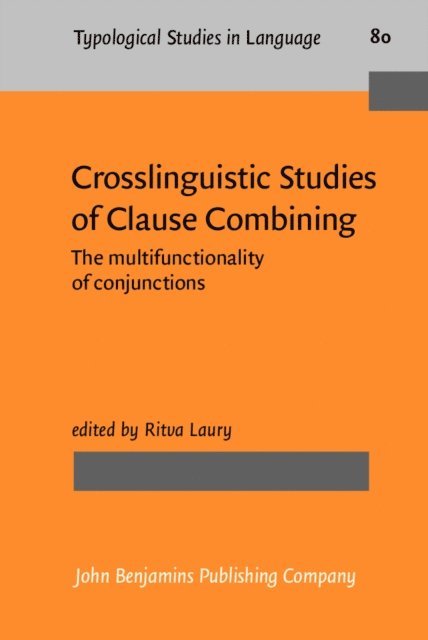
The study of clause combining has been advanced lately by increasing interest in the study of actual language use in a typologically diverse set of languages. A number of received understandings have been challenged, among these the idea of clause combinations as being divisible into subordination and coordination in a binary fashion. Connected to this idea is the nature of conjunctions, a topic treated in several articles here. Couched within the larger issue of the nature of categoriality in language, several of the papers show that conjunctions are highly polyfunctional items, and that clause combining is only one of the uses to which speakers put them. Other topics treated in the volume are the historical development of conjunctions and the use of formulaic main clause constructions as projective units in conversation. The articles manifest both typological and theoretical breadth. They are based on data from Bulgarian, English, Estonian, Finnish, Indonesian, Japanese, and Spanish. The theoretical approaches include discourse-functional, interactional, historical and generative linguistics.