Ono Tsuyoshi Ono – författare
Visar alla böcker från författaren Ono Tsuyoshi Ono. Handla med fri frakt och snabb leverans.
4 produkter
4 produkter
E-bok
Engelska, 20211 195 kr
Läs direkt efter köp
The chapters in this volume focus on how we might understand the concept of 'unit' in human languages. It is an analytical notion that has been widely adopted by linguists of various theoretical and applied orientations but has recently been critically examined by both typologically oriented and interactional linguistics. This volume contributes to and extends this discussion by examining the nature of units in actual usage in a range of genetically and typologically unrelated languages, English, Finnish, Indonesian, Japanese, and Mandarin, engaging with fundamental theoretical issues. The chapters show that categories originally created for the description of Indo-European languages have limited usefulness if our goal is to understand the nature of human language in general. The authors thus question the status of traditionally accepted linguistic units, especially their static understanding as a priori entities, and suggest instead that an emergent and interactional view of both structure and function offers a better fit with the data from the languages examined. Originally published as special issue 43:2 (2019) of Studies in Language.
E-bok
Engelska, 20201 258 kr
Läs direkt efter köp
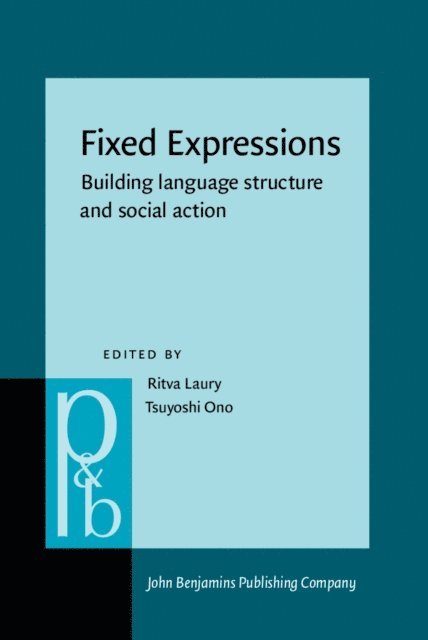
This volume concerns the structure and use of fixed expressions in a range of typologically, genetically and areally distinct languages. The chapters consider the use contexts of fixed expressions, at the same time taking seriously the need to account for their structural aspects. Formulaicity is taken here as a central feature of everyday language use, and fixed expressions as a basic utterance building resource for interaction. Our crosslinguistic investigation suggests that humans have the propensity to automatize ways to handle various discourse-level needs for specific sequential contexts by creating (semi-)fixed expressions based on frequent patterns. The chapters examine topics such as the degrees and types of fixedness, the emergence of fixed expressions, their connection to social action, the new understanding of traditional linguistic categories in light of fixedness, crosslinguistic variation in types of fixed expressions, as well as their non-verbal aspects. The volume situates the notion of 'units' of language at the intersection of interaction and formal structure as part of a larger effort to replace rule-based conceptions of language with a more dynamic, realistic and pragmatically based model of language. The articles are based on naturally occurring data, mostly everyday conversation, in English, Estonian, Finnish, Japanese, and Mandarin, with some crosslinguistic comparison.
E-bok
Engelska, 20201 384 kr
Läs direkt efter köp
The 'NP' is one of the least controversial grammatical units that linguists work with. The NP is often assumed to be universal, and appears to be robust cross-linguistically (compared to 'VP' or even 'clause') in that it can be manipulated in argument positions in constructed examples. Furthermore, for any given language, its internal structure (order and type of modifiers) tends to be relatively fixed. Surprisingly, however, the empirical basis for 'NP' has never been established. The chapters in this volume examine the NP in everyday interactions from diverse languages, including little-studied languages as well as better-researched ones, in a variety of interactional settings. Together, these chapters show that cross-linguistically, the category NP is not as robust as has been assumed: in the context of temporally unfolding human interaction, its structural status is constantly negotiated in terms of participants' evolving social agendas.
E-bok
PDF, Engelska, 20141 305 kr
Läs direkt efter köp
This volume brings together papers that take usage-based approaches to study the nature of human language, with a focus on the grammar of Japanese. The 12 chapters provide a rich array of data and methodologies, with topics ranging from phonology, modality, and grammatical morphemes, to sentential construction and discourse-level phenomena such as turn-taking, speech register, and language change. As a whole, they demonstrate that usage-based linguistics illuminates various phenomena in the language that could not have been well accounted for by resorting solely to a formal theory such as the Universal-Grammar-based approach. Reflecting theoretical, methodological, and technological advancements made in and outside the field of cognitive-functional linguistics in recent years, the papers contained in this volume, both individually and collectively, have significant implications towards linguistics in general and Japanese linguistics in particular, as we as Japanese language teaching.