Fabian Kraemer – författare
Visar alla böcker från författaren . Handla med fri frakt och snabb leverans.
2 produkter
2 produkter
Inbunden, Engelska, 2023
872 kr
Skickas inom 5-8 vardagar
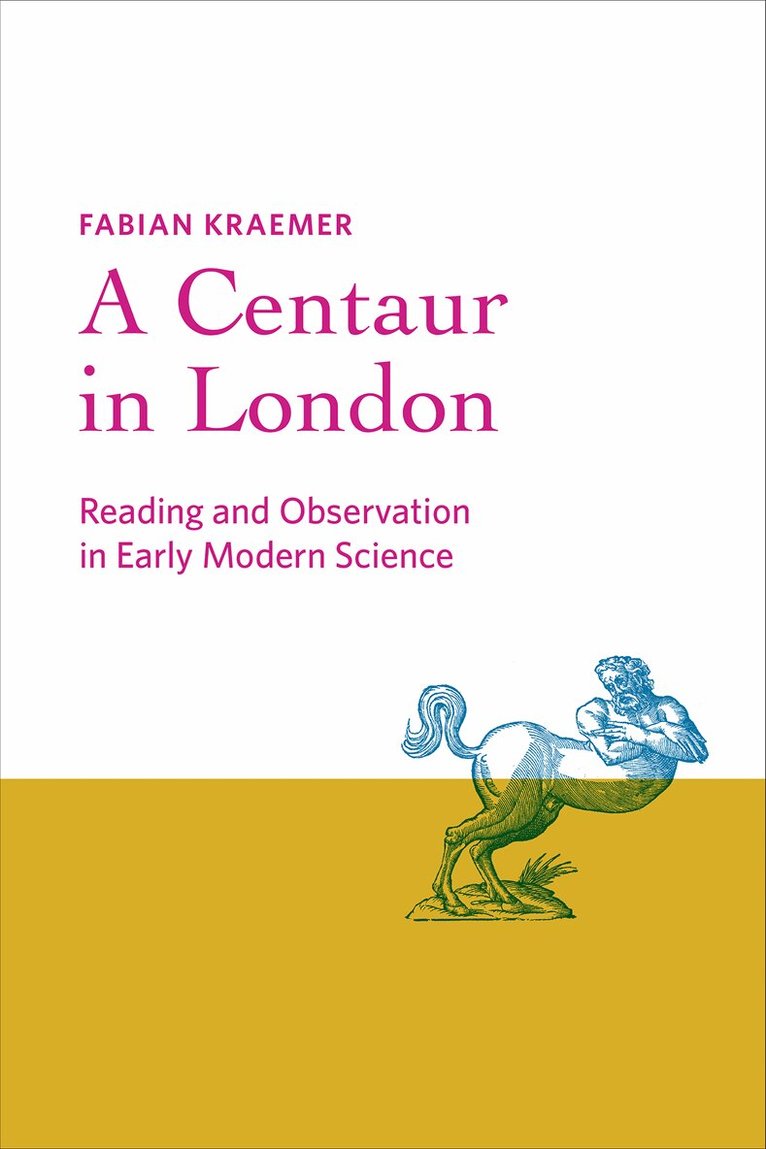
A nuanced reframing of the dual importance of reading and observation for early modern naturalists.Historians traditionally argue that the sciences were born in early modern Europe during the so-called Scientific Revolution. At the heart of this narrative lies a supposed shift from the knowledge of books to the knowledge of things. The attitude of the new-style intellectual broke with the text-based practices of erudition and instead cultivated an emerging empiricism of observation and experiment. Rather than blindly trusting the authority of ancient sources such as Pliny and Aristotle, practitioners of this experimental philosophy insisted upon experiential proof. In A Centaur in London, Fabian Kraemer calls a key tenet of this master narrative into question—that the rise of empiricism entailed a decrease in the importance of reading practices. Kraemer shows instead that the early practices of textual erudition and observational empiricism were by no means so remote from one another as the traditional narrative would suggest. He argues that reading books and reading the book of nature had a great deal in common—indeed, that reading texts was its own kind of observation. Especially in the case of rare and unusual phenomena like monsters, naturalists were dependent on the written reports of others who had experienced the good luck to be at the right place at the right time. The connections between compiling examples from texts and from observation were especially close in such cases. A Centaur in London combines the history of scholarly reading with the history of scientific observation to argue for the sustained importance of both throughout the Renaissance and provides a nuanced, textured portrait of early modern naturalists at work.
Inbunden, Engelska, 2026
2 634 kr
Kommande
We are living in an era of unprecedented “information overload”. This is one of the most common clichés defining the early 21st century, both in academic circles and in general public imagery. And, as clichés often do, this one encapsulates some elements of truth. The "unprecedented" nature of our contemporary overload may be less clear than we tend to think. Some periods in the past were confronted with a similar cultural situation, considering both the objective growth in available information and the subjective impression of living in an era of unprecedented epistemological saturation. An emblematic moment of this kind was the sixteenth and seventeenth century in Europe, the two centuries that led up to, and witnessed, the now often contested "Scientific Revolution", a period characterized also by geographical expansion and aesthetic subversion. The essays brought together in this volume constitute the first systematic survey of the visual strategies devised by early modern naturalists, authors and artists in dealing with copia.Epistemological Excess in Early Modern Europe will appeal to students and scholars, early modern art historians, and early modern historians of science.