Fabio Antonialli - Böcker
Visar alla böcker från författaren Fabio Antonialli. Handla med fri frakt och snabb leverans.
3 produkter
3 produkter
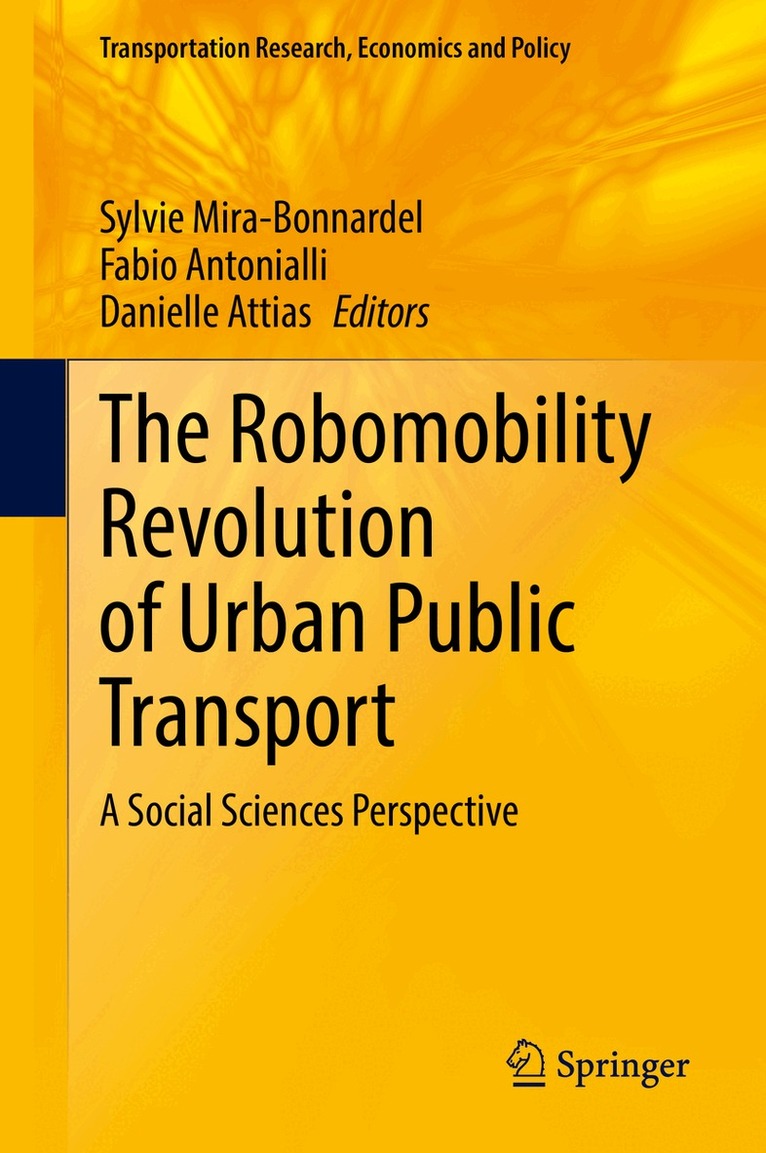
Robomobility Revolution of Urban Public Transport
A Social Sciences Perspective
Inbunden, Engelska, 2021
1 473 kr
Skickas inom 10-15 vardagar
Over the past two decades, society has been witnessing how technological, political, and societal changes have been transforming individual and collective urban mobility. Driven both by newcomers and traditional players, by disruptive as well as incremental innovations, the main objective now is to enhance mobility and accessibility while, reducing vehicle ownership, congestion, road accidents, and pollution in cities.This transformation has been mainly enabled by the widespread adoption of internet-connected devices (e.g.: smartphones and tablets) and by the innovative business models, technologies, and use-cases that arose from this rapid digitalization, such as peer-to-peer, and two-sided markets providing several mobility schemes: car-sharing, car-pooling, bike sharing, free-floating (cars, bikes, electric scooter), ridesharing and ride hailing either for long distances as well as for urban and micro-mobility.The book presents – in a holistic perspective – howthis revolution is happening and what are the major cornerstones for the implementation of robomobility. It aims at answering several substantial issues, such as: What is robomobility and what does it imply for the different stakeholders of the public transport ecosystem? How do policy makers integrate this innovation and how ready the regulations are? How do citizens take part in this transformation? What is the level of user acceptance for this new type of mobility? What are its environmental impacts? What is the economic impact of deploying these shuttles in a local ecosystem?
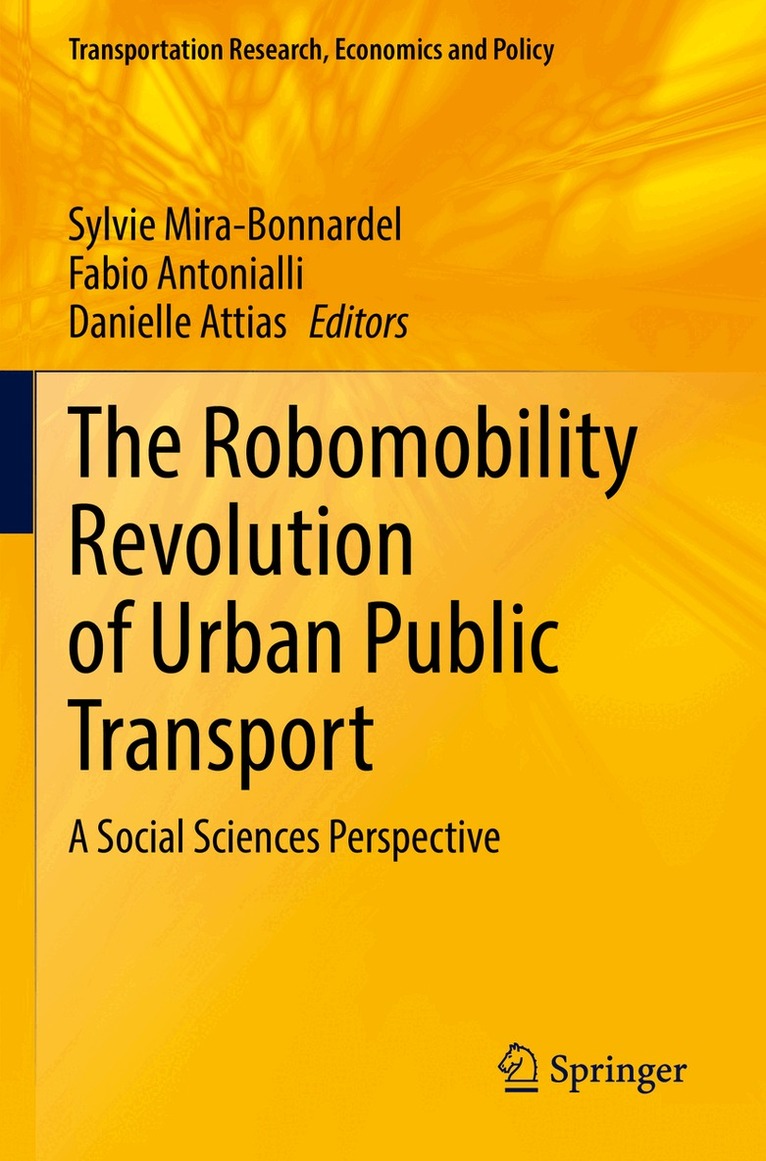
Robomobility Revolution of Urban Public Transport
A Social Sciences Perspective
Häftad, Engelska, 2022
1 473 kr
Skickas inom 10-15 vardagar
Over the past two decades, society has been witnessing how technological, political, and societal changes have been transforming individual and collective urban mobility. Driven both by newcomers and traditional players, by disruptive as well as incremental innovations, the main objective now is to enhance mobility and accessibility while, reducing vehicle ownership, congestion, road accidents, and pollution in cities.This transformation has been mainly enabled by the widespread adoption of internet-connected devices (e.g.: smartphones and tablets) and by the innovative business models, technologies, and use-cases that arose from this rapid digitalization, such as peer-to-peer, and two-sided markets providing several mobility schemes: car-sharing, car-pooling, bike sharing, free-floating (cars, bikes, electric scooter), ridesharing and ride hailing either for long distances as well as for urban and micro-mobility.The book presents – in a holistic perspective – howthis revolution is happening and what are the major cornerstones for the implementation of robomobility. It aims at answering several substantial issues, such as: What is robomobility and what does it imply for the different stakeholders of the public transport ecosystem? How do policy makers integrate this innovation and how ready the regulations are? How do citizens take part in this transformation? What is the level of user acceptance for this new type of mobility? What are its environmental impacts? What is the economic impact of deploying these shuttles in a local ecosystem?
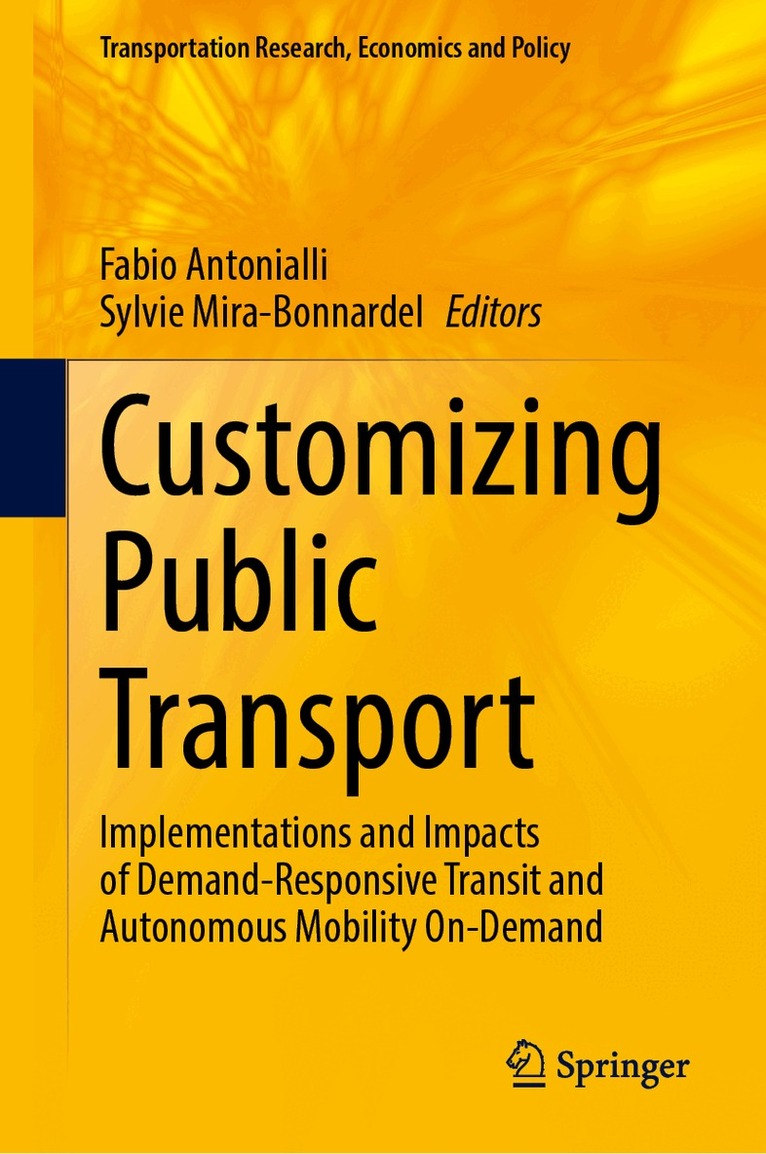
Customizing Public Transport
Implementations and Impacts of Demand-Responsive Transit and Autonomous Mobility On-Demand
Inbunden, Engelska, 2026
2 317 kr
Kommande
This edited volume critically examines the paradigm shift occurring in public transport through the rise of flexible, user-centric mobility solutions. Grounded in the empirical and methodological work of the EU-funded ArtMED project, this book proposal brings together scholars and practitioners to explore the theoretical foundations, operational tools, and real-world implementations of Demand-Responsive Transit (DRT) and Autonomous Mobility on Demand (AMOD) systems. Structured into two main parts, the volume offers a comprehensive perspective that bridges academic insights with policy and operational realities. Chapters in Part I focus on the evolution of DRT and AMOD concepts, the European policy landscape, cybersecurity concerns, and the introduction of the .MOBI decision-support tool developed under ArtMED for evaluating and planning these services. Chapters in Part II present diverse real-world examples from cities and regions across Europe, South America, and China. These case studies address implementation challenges and lessons learned in urban and peri-urban areas, highlight inclusivity for people with reduced mobility, and examine mobility transitions in developing economies and innovation ecosystems.By combining robust conceptual analysis with grounded implementation insights, this volume will inform future research agendas and the development of adaptive, context-sensitive public transport strategies. As such, the volume will be of use to academics and students of transportation economics, urban economics and policy, and public policy, as well as transport planners, policymakers, and technology developers.