Fabrice DeClerck – författare
Visar alla böcker från författaren Fabrice DeClerck. Handla med fri frakt och snabb leverans.
6 produkter
6 produkter
679 kr
Skickas inom 10-15 vardagar
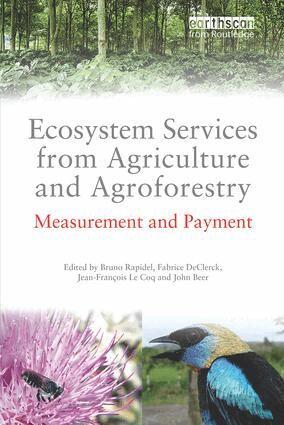
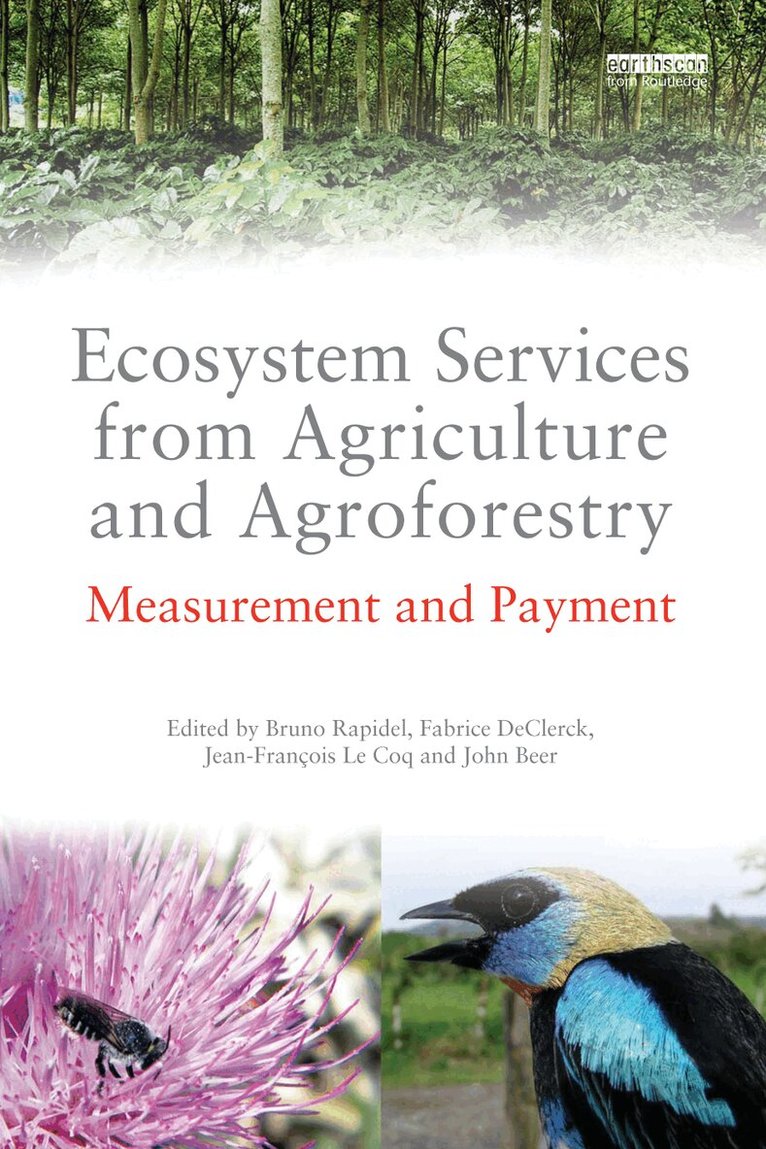
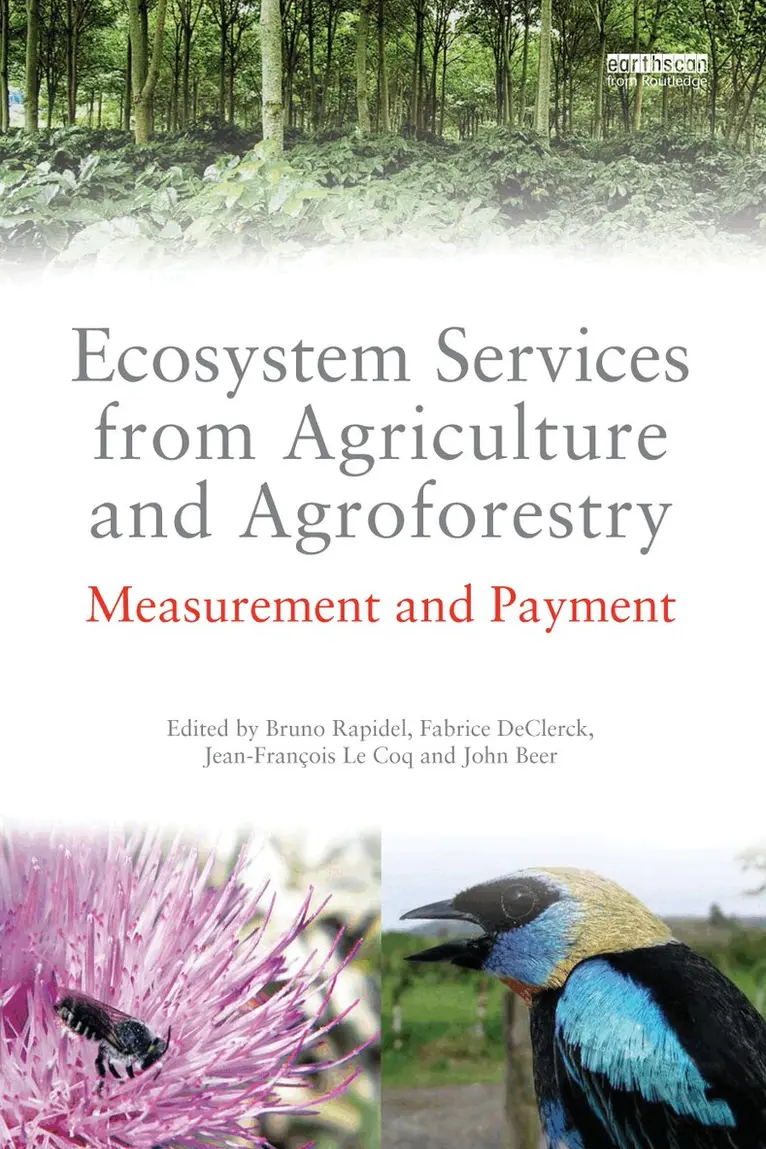
Agricultural systems are no longer evaluated solely on the basis of the food they provide, but also on their capacity to limit impacts on the environment, such as soil conservation, water quality and biodiversity conservation, as well as their contribution to mitigating and adapting to climate change. In order to cope with these multiple service functions, they must internalize the costs and benefits of their environmental impact. Payments for ecosystem services are hoped to encourage and promote sustainable practices via financial incentives. The authors show that while the principle is straightforward, the practice is much more complicated. Whereas scenic beauty and protection of water sources provide benefits to the local population, carbon sequestration and biodiversity conservation can be considered international public goods, rendering potential payment schemes more complex. Few examples exist where national or international bodies have been able to set up viable mechanisms that compensate agricultural systems for the environmental services they provide. However this book provides several examples of successful programs, and aims to transfer them to other regions of the world. The authors show that a product can be sold if it is clearly quantified, there exists a means to determine the service's values, and there is a willing buyer. The first two sections of the book present methodological issues related to the quantification and marketing of ecosystem services from agriculture, including agroforestry. The third and final section presents case studies of practical payments for ecosystem services and experiences in Central and South America, and draws some lessons learnt for effective and sustainable development of ecosystem services compensation mechanisms.
1 602 kr
Skickas inom 10-15 vardagar
In the past, the science of ecology has frequently been excluded from the development agenda for various reasons. Increasingly however there has been a renewed interest in finding more ecologically sustainable means of development that have required a strong foundation in ecological knowledge (for example EcoAgriculture Partnerships, EcoHealth presented at ESA, and EcoNutrition proposed by Deckelbaum et al). Each of these examples has already taken the critical first step at integrating ecological knowledge with agriculture, health and nutrition, respectively. However, this is only the first step; more attention needs to be placed not only on the role that two fields can play towards poverty alleviation, but on the role of a truly integrated, interdisciplinary approach towards development goals that is firmly grounded in ecological understanding. We feel that a critical look at what ecology can and cannot provide to the development agenda, in light of the Millennium Development goals, is timely and crucial. The introduction and the final section of the book will then integrate the lessons and principles outlined in each of the chapters. All chapter authors will be heavily encouraged to focus on how their sub-discipline in ecology impacts overall human well-being and environmental sustainability.
Integrating Ecology and Poverty Reduction
The Application of Ecology in Development Solutions
Inbunden, Engelska, 2011
1 602 kr
Skickas inom 10-15 vardagar
The second volume of this series, Integrating Ecology into Global Poverty Reduction Efforts: Opportunities and solutions, builds upon the first volume, Integrating Ecology into Global Poverty Reduction Efforts: The ecological dimensions to poverty, by exploring the way in which ecological science and tools can be applied to address major development challenges associated with rural poverty. In volume 2, we explore how ecological principles and practices can be integrated, conceptually and practically, into social, economic, and political norms and processes to positively influence poverty and the environment upon which humans depend. Specifically, these chapters explore how ecological science, approaches and considerations can be leveraged to enhance the positive impacts of education, gender relations, demographics, markets and governance on poverty reduction. As the final chapter on “The future and evolving role of ecological science” points out, sustainable development must be build upon an ecological foundation if it is to be realized. The chapters in this volume illustrate how traditional paradigms and forces guiding development can be steered along more sustainable trajectories by utilizing ecological science to inform project planning, policy development, market development and decision making.
1 474 kr
Skickas inom 10-15 vardagar
In the past, the science of ecology has frequently been excluded from the development agenda for various reasons. Increasingly however there has been a renewed interest in finding more ecologically sustainable means of development that have required a strong foundation in ecological knowledge (for example EcoAgriculture Partnerships, EcoHealth presented at ESA, and EcoNutrition proposed by Deckelbaum et al). Each of these examples has already taken the critical first step at integrating ecological knowledge with agriculture, health and nutrition, respectively. However, this is only the first step; more attention needs to be placed not only on the role that two fields can play towards poverty alleviation, but on the role of a truly integrated, interdisciplinary approach towards development goals that is firmly grounded in ecological understanding. We feel that a critical look at what ecology can and cannot provide to the development agenda, in light of the Millennium Development goals, is timely and crucial. The introduction and the final section of the book will then integrate the lessons and principles outlined in each of the chapters. All chapter authors will be heavily encouraged to focus on how their sub-discipline in ecology impacts overall human well-being and environmental sustainability.
Integrating Ecology and Poverty Reduction
The Application of Ecology in Development Solutions
Häftad, Engelska, 2014
1 474 kr
Skickas inom 10-15 vardagar
The second volume of this series, Integrating Ecology into Global Poverty Reduction Efforts: Opportunities and solutions, builds upon the first volume, Integrating Ecology into Global Poverty Reduction Efforts: The ecological dimensions to poverty, by exploring the way in which ecological science and tools can be applied to address major development challenges associated with rural poverty. In volume 2, we explore how ecological principles and practices can be integrated, conceptually and practically, into social, economic, and political norms and processes to positively influence poverty and the environment upon which humans depend. Specifically, these chapters explore how ecological science, approaches and considerations can be leveraged to enhance the positive impacts of education, gender relations, demographics, markets and governance on poverty reduction. As the final chapter on “The future and evolving role of ecological science” points out, sustainable development must be build upon an ecological foundation if it is to be realized. The chapters in this volume illustrate how traditional paradigms and forces guiding development can be steered along more sustainable trajectories by utilizing ecological science to inform project planning, policy development, market development and decision making.
2 134 kr
Skickas inom 10-15 vardagar
Agricultural systems are no longer evaluated solely on the basis of the food they provide, but also on their capacity to limit impacts on the environment, such as soil conservation, water quality and biodiversity conservation, as well as their contribution to mitigating and adapting to climate change. In order to cope with these multiple service functions, they must internalize the costs and benefits of their environmental impact. Payments for ecosystem services are hoped to encourage and promote sustainable practices via financial incentives. The authors show that while the principle is straightforward, the practice is much more complicated. Whereas scenic beauty and protection of water sources provide benefits to the local population, carbon sequestration and biodiversity conservation can be considered international public goods, rendering potential payment schemes more complex. Few examples exist where national or international bodies have been able to set up viable mechanisms that compensate agricultural systems for the environmental services they provide. However this book provides several examples of successful programs, and aims to transfer them to other regions of the world. The authors show that a product can be sold if it is clearly quantified, there exists a means to determine the service's values, and there is a willing buyer. The first two sections of the book present methodological issues related to the quantification and marketing of ecosystem services from agriculture, including agroforestry. The third and final section presents case studies of practical payments for ecosystem services and experiences in Central and South America, and draws some lessons learnt for effective and sustainable development of ecosystem services compensation mechanisms.